DAI Currently Has a Total Value Locked (TVL) of $8.4 Billion
MakerDAO, the DeFi protocol behind decentralized stablecoin DAI, has completed the acquisition of an additional $700 million worth of US treasuries, bringing its total stablecoin reserves to $1.2 billion.
The decision follows a proposal to increase the debt ceiling for MIP65 from $500 million to $1.25 billion to take advantage of the existing yield environment. This is expected to deliver an annualized yield of 4.5%.
DAI currently has a total value locked (TVL) of $8.4 billion, and short-term treasuries are 14.8% of its existing collateral.
The onboarding of a new real world asset (RWA) vault by crypto asset manager BlockTower was just approved by the community. This could lead to a potential US treasury purchase of up to $1.28 billion in the future. Voting members also supported withdrawing $390 million in Gemini Dollars (GUSD) and $500 million in Paxos Dollars (USDP) from the reserve in order to invest in higher-yielding assets.

The 🎬Is Starting Folks... BUT We Already Knew This Was Coming 😉It Will Be Worth It!
Widespread banking disruptions and liquidity constraints are anticipated to emerge in the near term 🏦. While these developments may present temporary operational challenges, long-term stability is expected to follow 📈. According to predictions made by the late Michelle Whitedove 🕊️✨, the active phase of these sector disruptions is projected to last no more than a couple of weeks at most although most won't know this and panic. Michelles advice was to stay indoors and wait it out... 🗓️
🚨 ALERT! BREAKING MILITARY INTEL: THIS URGENT ORDER WAS JUST SENT TO U.S. MILITARY BASES — GLENN BECK WARNING [VIDEO]
🚨 The Pentagon’s New Doomsday Plan: Preparing for Grid Collapse & Global Conflict! 🌐⚠️
The Pentagon is officially updating its continuity of government strategies past the Cold War era to address modern asymmetric threats.
🔑Key Highlights of the "Fortress" Initiative:
90-Day Self-Sufficiency: Major U.S. military installations are being engineered to operate completely independently for at least 90 days with dedicated power, water, fuel, and communications.💧
🔹Targeted Infrastructure Threats: Preparing for nightmare scenarios where cyber attacks, drones, and long-range weapons knock out power grids and cripple supply chains. ⚡️
🔹Wartime Industrial Shift: Plans involve getting civilian factories ready to switch to wartime production and securing massive strategic reserves of ammunition, critical minerals, and medical supplies. 🏭📦
🔹Strategic Focus: Heightened readiness surrounding potential conflict with peer adversaries like China and ongoing cyber incursions like Volt Typhoon. 🇨🇳
Resilience and systemic preparedness have never been more ...
📺 Did The Simpsons Warn Us About Halloween 2026? 🎃⚡️
Social media is buzzing over viral clips claiming The Simpsons predicted a massive global power outage that is to hitting a few days on 10/31/26! 📉👀
🔮The Predictive Programming Debate:
🔹Eerie Parallels: From tech blackouts to grid disruptions, fans are pointing out how often Springfield's chaotic scenarios mirror real-world headlines. 📺🌀
🔹Coincidence or Foresight? Whether it’s genuine foresight, clever satire, or internet viral edits, the overlap with modern grid vulnerability discussions has everyone paying attention. 🔌⚠️
🔹Grid Resilience: As central power networks face increasing strain, decentralization and off-grid solutions continue to take center stage. ⚡️🔒
Is it just another iconic TV gag, or a subtle nod to global infrastructure risks? Keep your lights on and stay prepared! 💡🎃
🚨 Chutes is being framed as a Hyperliquid-style breakout for decentralized AI inference, with live revenue, verified GPU infrastructure, and a direct challenge to centralized cloud AI 🚨
Chutes is gaining attention as a decentralized AI inference platform that claims to combine real usage, cryptographic verification, confidential computing, and open-source infrastructure into a working production system. The thesis is simple: instead of trusting Big Tech clouds with AI workloads, users get a distributed compute layer built around verification and privacy.
🔑 Key points
🔹 Chutes is live in production and reportedly scaled to more than 1,170 active GPU nodes, including large numbers of Nvidia H200s and Blackwell-class hardware.
🔹 The platform says it has processed nearly 38 trillion tokens since launch across 53 deployed applications and more than 700,000 registered users.
🔹 The team reportedly cut unprofitable usage programs, reduced total token volume, and still improved revenue efficiency, with revenue per GPU rising sharply after removing subsidized traffic.
🔹 Chutes is using post-quantum cryptography, trusted execution environments, and Nvidia confidential ...
🚨 Chutes is being framed as a Hyperliquid-style breakout for decentralized AI inference, with live revenue, verified GPU infrastructure, and a direct challenge to centralized cloud AI 🚨
🚨 JPMorgan’s criticism of the CLARITY Act is fueling a fresh power struggle over who gets to write America’s crypto rules 🚨
A new clash is emerging between legacy finance and crypto legislation after JPMorgan CEO Jamie Dimon reportedly warned that the CLARITY Act could let crypto firms offer bank-like products without bank-level oversight. The dispute is quickly turning into a larger fight over regulation, competitiveness, and who controls the future architecture of digital finance in the United States.
🔑 Key points
🔹 Jamie Dimon reportedly called the CLARITY Act a threat to the financial system, arguing it could allow crypto firms to offer yield-like products while avoiding the capital, reserve, and oversight burdens traditional banks face.
🔹 Senator Cynthia Lummis pushed back publicly, framing the issue as a global strategic race and warning that if the U.S. does not set digital asset standards, other powers will.
🔹 The core tension is whether the bill creates legitimate regulatory clarity or simply opens the door to regulatory arbitrage for crypto platforms operating outside the traditional banking...
👉 Coinbase just launched an AI agent for Crypto Trading
Custom AI assistants that print money in your sleep? 🔜
The future of Crypto x AI is about to go crazy.
👉 Here’s what you need to know:
💠 'Based Agent' enables creation of custom AI agents
💠 Users set up personalized agents in < 3 minutes
💠 Equipped w/ crypto wallet and on-chain functions
💠 Capable of completing trades, swaps, and staking
💠 Integrates with Coinbase’s SDK, OpenAI, & Replit
👉 What this means for the future of Crypto:
1. Open Access: Democratized access to advanced trading
2. Automated Txns: Complex trades + streamlined on-chain activity
3. AI Dominance: Est ~80% of crypto 👉txns done by AI agents by 2025
🚨 I personally wouldn't bet against Brian Armstrong and Jesse Pollak.
👉 Coinbase just launched an AI agent for Crypto Trading
📚Knowledge Is Power, and The Truth Shall Set You Free📚
Israel Exposed created a website for people to view the footage collected from Gaza in one place. You no longer have to download the entire archives to see them.
It includes:
👉 64,537 videos
👉 17,905 photos
👉 Ability to download individual videos
👉 Searchable index
👉 Exhaustive sources list (300+ journalists)
👉 Geolocation data
👉 Livemap with minute to minute updates
Victim list
We will keep adding the rest of the archives to the site, be patient- it is difficult work. Continue to seed the torrents provided, as that is the best way to ensure the footage remains stored in decentralized way.
God bless all those who sacrificed their lives to get this footage out, and everyone involved in collecting/archiving it.
⚙️ TaoDX automates Bittensor Root reward claims when fees make sense
TaoDX’s Root Autopilot monitors accumulated Root staking rewards and claims them only when estimated network fees are 2% or less of the reward value. The goal: help stakers avoid spending too much of their smaller rewards on transaction costs.
🔑 Key points
🔹 Rewards accumulate as subnet alpha: Since Bittensor’s Root Reborn upgrade, staking rewards build up as subnet alpha tokens in validator baskets until claimed, then are added to the user’s Root stake.
🔹 Claims wait for lower fees: Autopilot checks rewards daily and waits if the estimated transaction fee exceeds 2% of the claim value.
🔹 Claims are capped weekly: Automated claims are limited to once per week per validator.
🔹 Permission is narrowly scoped: The one-time RootClaim wallet permission can claim Root rewards, but cannot sell, move, or transfer tokens. Users can revoke it.
Why Governments Are Preparing for Critical Systems to Fail
MIND BEND THEORY | DOCUMENTED INVESTIGATION
The United States is preparing major military installations to continue operating if civilian infrastructure goes down. Britain is telling households to prepare for days without essential services. India is warning that an attack on the financial system can weaken a nation. And the Bank of England is asking what happens when cyber defenses fail—not if they can prevent every attack.
Individually, each development has an explanation.
Put them beside one another, however, and a larger pattern becomes visible.
Over the span of only a few weeks, governments and financial authorities in the United States, United Kingdom and India have publicly discussed preparations for disruptions involving some of the systems modern society depends upon most:
Power.
Water.
Fuel.
Communications.
Banking.
Supply chains.
This does not establish that these governments are preparing for one secret event.
There is no public evidence of a coordinated countdown, predetermined blackout date or single intelligence warning connecting them.
But there is something here that can be documented.
Governments are increasingly planning around a question that sounds very different from traditional emergency preparedness:
What happens when the systems we normally assume will be available are no longer available?
And in the United States, that question has now reached the Pentagon.
DOCUMENT 01
UNITED STATES — FORTRESS AMERICA
On September 30, 2026, Defense Secretary Pete Hegseth established a program called FORTRESS America.
The acronym stands for:
Federal Operations for Resilience, Troop Resources, Energy, Supply and Survivability.
The program addresses a vulnerability that rarely receives much public attention:
The world's most powerful military still depends extensively on civilian infrastructure.
Electric grids.
Commercial supply chains.
Communications infrastructure.
Fuel.
Foreign sources of critical materials.
FORTRESS America is intended to reduce those dependencies.
The Pentagon's own public description says the initiative is designed to ensure that major U.S. military installations generate independent power so that bases remain operational even if the civilian grid is taken down by cyberattack or sabotage.
It goes beyond electricity.
The program includes five major areas:
Energy independence
Installation hardening and cyber resilience
Supply-chain and defense-industrial-base resilience
Strategic defense reserves
Space and spectrum resilience
The Pentagon also wants deeper reserves of critical supplies so military operations can continue when ordinary supply lines are disrupted.
The underlying idea is simple:
The military should be capable of functioning even when the infrastructure surrounding it cannot.
An October 7 implementation memorandum obtained by DefenseScoop shows that the Pentagon had already begun establishing the FORTRESS America Program Office and assigning officials to implement those objectives.
Then another piece of the story emerged.
DOCUMENT 02
THE 90-DAY REQUIREMENT
On October 25, Fox News published details from additional FORTRESS America documents its reporters reviewed.
According to that reporting, major continental U.S. military installations are being prepared to sustain essential operations for at least 90 days without outside support.
The essential systems reportedly include:
Power.
Water.
Fuel.
Communications.
Think about the distinction carefully.
The Pentagon isn't telling Americans that the United States will lose electricity for 90 days.
It isn't predicting a 90-day blackout.
Military contingency planning deliberately prepares for scenarios officials hope never occur.
But preparing installations for this possibility tells us something about the scenario being considered.
The Pentagon is building resilience around the possibility that a sufficiently serious conflict or attack could interfere with the civilian systems on which military installations normally depend.
The publicly released FORTRESS material specifically discusses:
Cyberattack.
Sabotage.
Grid disruption.
Foreign supply-chain disruption.
Attacks against installations.
And prolonged military contingencies.
That makes the 90-day requirement significant—but it must be described accurately.
Mind Bend Theory verification note:
The September 30 FORTRESS America program itself is documented publicly.
The October 7 implementation memorandum has been reported and described by DefenseScoop.
The 90-day requirement, however, currently comes from documents reviewed by Fox News, rather than a primary 90-day document independently published for the public.
That distinction matters.
We follow the documents as far as they take us—and no farther.
DOCUMENT 03
UNITED KINGDOM — BE READY FOR THREE DAYS
Now cross the Atlantic.
On October 22, the British government launched its new Be Ready campaign.
This time the audience wasn't the military.
It was ordinary households.
The UK government is asking households that are able to do so to prepare to remain self-sufficient for approximately three days during an emergency.
The government specifically discusses disruptions affecting:
Power.
Water.
Phones.
Internet access.
A Parliamentary Written Statement issued the same day explicitly states:
“The updated advice calls on households to be self-sufficient for three days in the case of an emergency.”
The government recommends maintaining three days of bottled water and non-perishable food.
Its expanded preparedness guidance includes:
Approximately three litres of drinking water per person per day
Three days of non-perishable food
Battery-powered or wind-up radio
Torch and spare batteries
Charged power bank
Essential medications
First-aid supplies
Blankets and warm clothing
Important telephone numbers written down
Basic hygiene supplies
Cash
Why cash?
Because during some disruptions, electronic payment systems and ATMs may not function normally.
That creates an important connection between infrastructure and finance.
Electricity isn't isolated from banking.
Communications aren't isolated from payments.
Modern infrastructure is interconnected.
And failure can move through those connections.
DOCUMENT 04
INDIA — “WARS ARE NOT FOUGHT WITH WEAPONS ALONE”
Three days later, on October 25, another statement appeared.
This one came from Indian Prime Minister Narendra Modi.
Modi was inaugurating the Reserve Bank of India's newly established Data Centre and Cybersecurity Training Institute in Bhubaneswar.
The facilities are designed to strengthen the technological foundations and cybersecurity resilience of India's financial system.
Four data centres will host mission-critical payment and settlement systems.
But Modi's explanation of why this matters went beyond ordinary cybersecurity.
His official statement says:
“Nowadays, wars are not fought with weapons alone; a nation can also be weakened by attacking its economy.”
He continued by saying India's growing economy requires its banking system to be protected against cyber looters and cyber terrorists.
That puts another critical system into the picture:
Money.
A modern economy depends on digital banking infrastructure almost as heavily as it depends on electricity and telecommunications.
Payment systems move commerce.
Banks hold liquidity.
Settlement systems move money between financial institutions.
Data centres keep those networks functioning.
Disrupt the financial infrastructure badly enough and the consequences don't remain inside banks.
They reach businesses.
Supply chains.
Payroll.
Purchasing.
Markets.
And households.
DOCUMENT 05
BANK OF ENGLAND — WHAT IF CYBER DEFENSE FAILS?
There is another document worth reading.
On June 30, Bank of England Deputy Governor Sarah Breeden delivered a speech titled:
“Agents of Change.”
The subject was artificial intelligence and financial stability.
One section deserves particular attention.
Breeden warned that advanced AI systems are becoming increasingly capable of identifying and chaining together cyber vulnerabilities.
That changes the nature of cyber risk.
AI can help defenders.
But the same capabilities can potentially increase the speed and effectiveness of attackers.
The important change in thinking comes afterward.
Preventing attacks is no longer enough.
Financial institutions must also prepare to recover after a successful attack.
Breeden raised the possibility of simultaneous disruption across multiple financial firms.
She then asked whether critical financial institutions may eventually require completely separate failover capabilities—or even the ability to rebuild compromised core systems from “bare metal.”
In October, Reuters reported that the Bank of England was pushing financial institutions further toward this type of recovery planning.
That represents a subtle but significant change in the question.
It isn't simply:
How do we stop the attack?
It's becoming:
What happens if we don't?
And:
How do we keep the system functioning afterward?
CONNECT THE DOCUMENTS
Now put the documents beside one another.
UNITED STATES
Military installations are being hardened so essential operations can continue when civilian infrastructure is disrupted.
UNITED KINGDOM
Households are being told to prepare for three days without services they normally assume will remain available.
INDIA
The prime minister publicly warns that modern conflict can weaken a country by attacking its economy and calls for stronger protection of banking infrastructure.
BANK OF ENGLAND
Financial authorities are examining recovery scenarios in which cyber defenses have already failed and multiple institutions could potentially be disrupted simultaneously.
These aren't identical programs.
They aren't even aimed at the same people.
And there is currently no public evidence demonstrating that they were coordinated.
But they share one important assumption:
CRITICAL SYSTEMS CAN FAIL.
And resilience therefore cannot begin after the failure occurs.
It has to exist beforehand.
THE SYSTEM BEHIND THE SYSTEM
This is where the story becomes bigger than individual announcements.
Modern infrastructure isn't a collection of isolated systems.
It's a network.
Consider what happens when electricity fails.
Without power, telecommunications eventually become difficult to maintain.
Without communications, electronic payments can be affected.
Fuel pumps require electricity.
Water systems depend on pumping and treatment infrastructure.
Businesses depend on payment processing.
Supply chains depend on communications, transportation and fuel.
Hospitals require electricity, communications, water, medicine and logistics simultaneously.
A serious disruption doesn't necessarily remain inside the system where it started.
It can propagate.
POWER → COMMUNICATIONS → BANKING → COMMERCE → SUPPLY CHAINS
And the dependency runs in multiple directions.
That interconnectedness is precisely why governments plan for resilience.
WHAT THIS DOES NOT PROVE
Mind Bend Theory exists to examine unusual patterns.
But a pattern isn't automatically proof of a conspiracy.
There is currently no public evidence showing that Washington, London and New Delhi are secretly preparing for the same scheduled event.
There is no verified date for a coming global blackout.
There is no public document establishing an imminent 90-day collapse of the American electrical grid.
And the Pentagon's 90-day military resilience requirement should not be interpreted as a prediction that Americans will lose electricity for 90 days.
That would go beyond the evidence.
What the evidence actually establishes is interesting enough.
Governments increasingly consider disruption of power, communications, supply chains and financial infrastructure plausible enough to justify concrete preparation.
The UK is preparing households.
The United States is hardening military infrastructure.
India is strengthening the technological backbone of its financial system.
The Bank of England is thinking about how banks recover after cyber defenses fail.
That isn't speculation.
It's in the documents.
THE QUESTION
Perhaps the most important change isn't what governments believe will happen.
It's what they're preparing to survive.
For decades, infrastructure security focused heavily on preventing failure.
The emerging model looks different:
Assume something eventually gets through.
Assume something eventually goes down.
Build the ability to continue operating anyway.
The Pentagon calls that resilience.
The UK calls it being ready.
Central banks call it operational resilience.
Different terminology.
Same fundamental question:
WHAT STILL WORKS WHEN THE SYSTEM DOESN'T?
DOCUMENT TRAIL
Read the Evidence Yourself
Mind Bend Theory strongly encourages readers to examine the original material rather than relying solely on our interpretation.
🇺🇸 DOCUMENT 01 — FORTRESS America Establishment
September 30, 2026
Defense Secretary Pete Hegseth's memorandum establishes FORTRESS America as a Department of Defense resilience program.
The publicly reported memorandum establishes the program around installation resilience, independent energy, strategic reserves, supply chains and related national-defense infrastructure.
Source type: Pentagon memorandum / official announcement.
🇺🇸 DOCUMENT 02 — FORTRESS America Implementation Memorandum
October 7, 2026
DefenseScoop obtained the memorandum from Under Secretary for Acquisition and Sustainment Michael Duffey directing officials to begin operationalizing the FORTRESS America Program Office.
It identifies five foundational pillars, including energy independence, installation hardening and cyber resilience, strategic reserves and supply-chain resilience.
Source type: Pentagon memorandum obtained by DefenseScoop.
🇺🇸 DOCUMENT 03 — 90-Day FORTRESS Requirement
October 25, 2026
Fox News reports that documents it reviewed require major continental U.S. installations to sustain essential operations for at least 90 days without outside support.
Source type: Journalistic reporting based on documents reviewed by reporters.
Important: This is not currently being presented by Mind Bend Theory as a publicly released primary 90-day Pentagon document.
🇬🇧 DOCUMENT 04 — UK Cabinet Office Be Ready Announcement
October 22, 2026
The Cabinet Office announces the three-year Be Ready campaign and describes preparation for disruption affecting power, water, phones and internet.
Source type: Official UK government publication.
🇬🇧 DOCUMENT 05 — Parliamentary Written Statement HCWS409
October 22, 2026
The UK Parliament records the government's explicit recommendation that households prepare to remain self-sufficient for three days.
Source type: Official Parliamentary record.
🇬🇧 DOCUMENT 06 — Be Ready Household Emergency Checklist
The government's practical household guidance provides recommendations for water, food, radio, lighting, medication, power banks, emergency cash and other supplies.
Source type: Official UK government preparedness guidance.
🇮🇳 DOCUMENT 07 — Prime Minister of India / RBI Cybersecurity Facilities
October 25, 2026
Official statement documenting the opening of the Reserve Bank of India's Data Centre and Cybersecurity Training Institute and Modi's warning that countries can be weakened through attacks against their economies.
Source type: Official Government of India statement.
🇬🇧 DOCUMENT 08 — “Agents of Change” — Sarah Breeden
June 30, 2026
The Bank of England deputy governor discusses rapidly advancing AI cyber capabilities, simultaneous disruption across financial institutions, separate failover infrastructure and potentially rebuilding compromised systems from bare metal.
Source type: Official Bank of England speech.
DOCUMENT 09 — Bank of England Cyber-Recovery Reporting
October 15, 2026
Reuters reports on the Bank of England's push for stronger recovery capabilities against AI-enabled cyberattacks, including bare-metal recovery.
Source type: Independent reporting.
MIND BEND THEORY
Follow the documents. Separate what they prove from what they don't.
Revolut Leak Shows the Cost of Constant ID Collection
Revolut’s mistake is the news, but the bigger problem is the growing number of companies being encouraged or required to keep copies of our most sensitive identity documents.
Online bank Revolut has revealed that it gave out sensitive personal and financial information of an undisclosed number of its customers in response to a fake government request.
The information that was handed over to an “unauthorized third party” reportedly includes names, dates of birth, occupations, addresses, phone numbers, account numbers, transaction histories (including Bitcoin), and even copies of government-issued IDs and onboarding verification selfies.
Revolut claims that derived biometric face data was not.
The company said that the data was handed over in response to an email that came from a real government agency’s domain, but was not actually sent or authorized by that agency.
The email passed several authentication checks (SPF, DKIM, and DMARC) that are designed to establish the authenticity of a message’s origin and integrity, but do not verify the legitimacy of the legal request itself.
Revolut said that it complied with the request “under the reasonable belief that it was an authentic government agency request” – and only later found out that it was not.
Revolut said it later realized its mistake, blocked the email address, and reported the incident to the relevant authorities.
Revolut said that only a “limited” number of its customers were affected by the data leak, and that the company’s systems were not hacked, nor was any money stolen.
The story broke on September 11 when Revolut customers started receiving an email notice about a data leak, and the news was picked up by media outlets the following day.
The reason this is a recurring problem is that companies are keeping highly sensitive information about their customers’ identities, and sometimes even financial transactions, for a long time, and this data is then available to be disclosed to third parties – either in response to valid legal requests, or, as in the case of Revolut, fake ones.
One reason for this is know your customer (KYC) and anti-money laundering (AML) rules. Revolut’s current UK customer privacy notice spells it out: the company generally keeps personal data of UK customers for no more than seven years after the relationship ends, and sometimes longer – for legal reasons.
This means that even if you close your account, your identity documents don’t disappear.
And while the incident with Revolut happened in the financial sector, it’s by no means the only one that requires customers to hand over sensitive identity information. Discord, a popular chat service, said in an October 9, 2025 security update that government ID photos of approximately 70,000 users may have been exposed after a third-party customer service provider got hacked.
This was not a financial service, nor the same type of attack. But the result was similar – because the underlying business process was the same: requiring and storing sensitive identity documents. In the case of Discord, these were used to review age-related appeals.
It’s hard to do anything about a copy of your old passport, or a photo of your face, or a record of your past transactions. These can be used to identify and profile you, and can be used to carry out targeted fraud. And this can happen even if the initial disclosure didn’t result in financial loss.
The more companies are forced to collect and store such information, and the more of it they have, the more opportunities there are for this data to be leaked, either by the company itself or a third party it works with. That's what makes governments' push for more ID checks just to access ordinary parts of life so reckless.
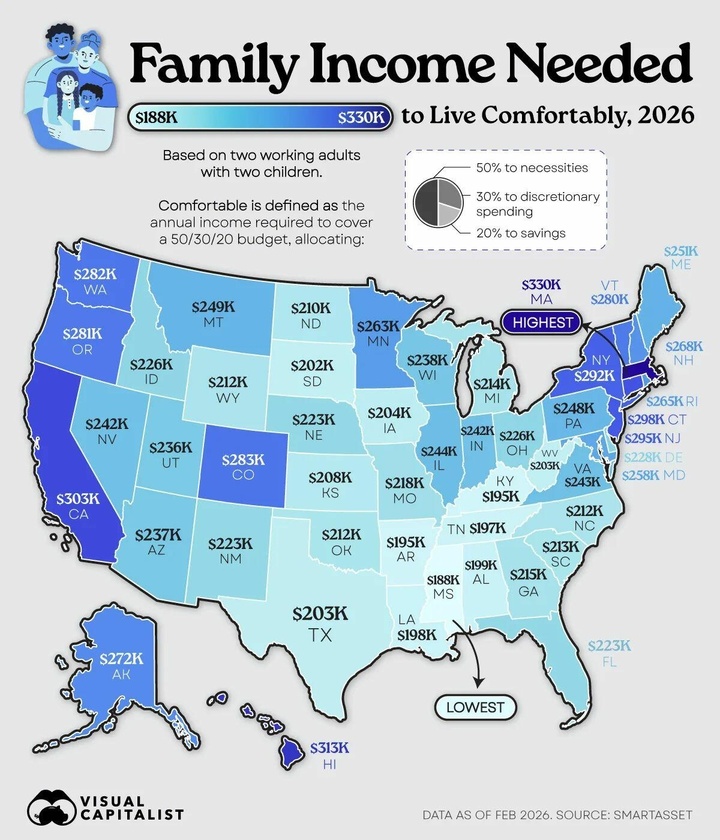
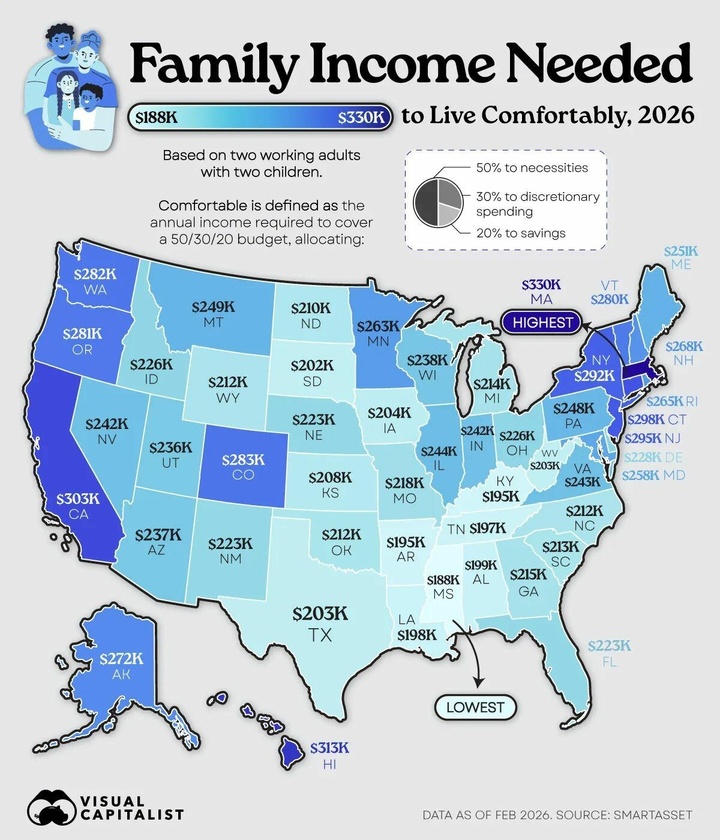
This Is The Income A Family Needs To Live Comfortably In Every US State
Here’s the short version of what it takes for a family of four to live comfortably in 2026 by state:
In Massachusetts, you’d need nearly $330,000 a year - the highest figure in the entire country. Only three states clear the $300,000 mark: Massachusetts, Hawaii, and California. At the other end of the spectrum, Mississippi is the most affordable at about $188,000. That’s a full $142,000 less than what you’d need in Massachusetts.
So… how much does a family of four need in your state?
This map shows the pre-tax income a household with two working adults and two kids needs to live comfortably in every U.S. state.
The numbers come from SmartAsset (as of February 2026). They’re based on the familiar 50/30/20 budget: 50% for necessities, 30% for discretionary spending, and 20% for savings or other goals. These aren’t bare-minimum survival numbers—they’re what it takes to live pretty well while still putting money aside.
And asVisual Capitalistnotes, Massachusetts sits at the very top of that list. Massachusetts tops the ranking, with a family of four needing $329,555 per year to meet the 50/30/20 benchmark.
Hawaii follows at $313,165, while California ranks third at $302,682.
Rank State Income needed for family of four (2026)
1 - Massachusetts - $329,555
2 - Hawaii - $313,165
3 - California - $302,682
4 - Connecticut - $298,189
5 - New Jersey - $295,110
6 - New York - $291,533
7 - Colorado - $283,213
8 - Washington - $281,798
9 - Oregon - $280,966
10 - Vermont - $280,384
11 - Alaska - $272,064
12 - New Hampshire - $267,904
13 - Rhode Island - $264,659
14 - Minnesota - $263,078
15 - Maryland - $257,837
16 - Maine - $250,931
17 - Montana - $249,434
18 - Pennsylvania - $247,936
19 - Illinois - $244,109
20 - Virginia - $242,944
21 - Nevada - $242,278
22 - Indiana - $241,696
23 - Wisconsin - $238,451
24 - Arizona - $236,870
25 - Utah - $235,789
26 - Delaware - $228,134
27 - Ohio - $226,221
28 - Idaho - $226,054
29 - Florida - $223,392
30 - New Mexico - $223,142
31 - Nebraska - $223,059
32 - Missouri - $217,734
33 - Georgia - $214,573
34 - Michigan - $214,323
35 - South Carolina - $212,909
36 - North Carolina - $212,410
37 - Wyoming - $212,410
38 - Oklahoma - $211,910
39 - North Dakota - $210,496
40 - Kansas - $207,917
41 - Iowa - $204,422
42 - Texas - $203,424
43 - West Virginia - $202,592
44 - South Dakota - $201,760
45 - Alabama - $198,931
46 - Louisiana - $197,933
47 - Tennessee - $197,267
48 - Arkansas - $195,437
49 - Kentucky - $194,854
50 - Mississippi - $187,533
Connecticut, New Jersey, and New York aren't far behind, bringing the number of states with comfortable-income thresholds above $290,000 to six.
Colorado and Vermont Make the Top 10
As expected, many of the highest income thresholds are concentrated in the Northeast and along the West Coast.
However, Colorado has the seventh-highest threshold in the country at $283,213, ranking above Washington and Oregon.
Vermont rounds out the top 10 at $280,384, despite having the second-smallest population of any U.S. state. Meanwhile, nearby states like New Hampshire, Maine, and Rhode Island all fall outside the top 10.
Just Six States Come in Below $200,000
Despite the wide range in living costs across the country, only six states have a comfortable-income threshold below $200,000 for a family of four.
Mississippi ranks lowest at $187,533, followed by Kentucky. The states of Arkansas, Tennessee, Louisiana, and Alabama also fall below the $200,000 mark.
The gap between Massachusetts and Mississippi exceeds $142,000 per year, meaning the Massachusetts benchmark is about 76% higher.
Sign Up for free to see more from this community or subscribe to Dinarian888 for $5/month to support Dinarian888 for more interaction and exclusive content.
Welcome to the Dinarian on Locals, where we discuss everything blockchain and digital asset related. We are here to learn from one another as this is a new and ever evolving space. Please post and share what you like, but be respectful to others as they are here to learn as well.
Knowledge is power, using that knowledge can be extremely powerful,
The Dinarian