TheDinarian
News • Business • Investing & Finance
Do You Own Any of the Altcoins the SEC Says Are Securities?
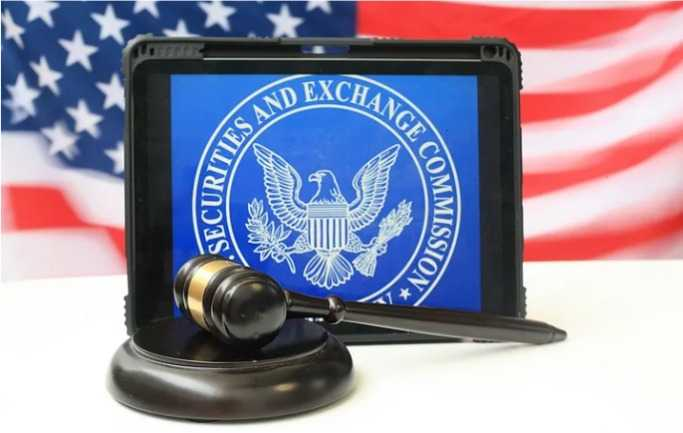
The U.S. Securities and Exchange Commission (SEC) named some 70 altcoins as securities. What action should we take immediately
July 04, 2023
post photo preview

To answer this, we must dive into the world of crypto-regulation and unravel some complex legalities. Let’s start with understanding why it matters.

I own a few of the altcoins that the SEC has labeled as securities, such as XRP, MANA, SAND, ALGO, BTT, DASH, and others, as I’m sure many HODLers do. I do not foresee selling any at this time.

IMO, these altcoins could recover a lot of their lost value over time, and particularly during th enext bull run. If selling creates a loss, you might want to wait.

The SEC announcement and the decision of a couple of exchanges to delist these altcoins have created fear, uncertainty, and doubt (FUD) across the crypto universe. But is it warranted?

Why It Matters & What to Do About It

When an altcoin is classified as a security by the SEC, it means that the altcoin must comply with specific regulations and requirements, which can impact its liquidity and market accessibility.

As a crypto investor, it’s important for me to keep track of such developments to stay compliant and understand how these might affect my investment’s potential.

When you look at what happened after the SEC opened its lawsuit against Ripple Labs’ XRP altcoin, several exchanges delisted XRP. That means you couldn’t buy or sell it on that exchange.

You could still move it off the exchange to sell elsewhere. IMO, it is not wise to leave your crypto on an exchange anyway. There is too much chance of a hack or bankruptcy of the exchange.

Look at FTX. Many American investors thought it was too big to fail. Oops.

However, if you remember November 2021, e-Toro announced it would delist Cardano (ADA) and Tron (TRX) by 2022 due to “regulatory concerns.”

I sold my ADA and TRX holdings immediately. It was the first such “scare” for me. Since then, several FUD incidents have occurred, including the SEC lawsuit against Ripple’s XRP. I still hold XRP in my cold wallet. Maybe I’ve gotten used to the SEC’s FUD and “scare tactics” and am not so apt to panic.

Knowledge is the key. Knowing and accepting the risks can help you make a more informed decision.

What Is the Howey Test?

To determine whether an asset qualifies as a security, the SEC often relies on the Howey Test, derived from a 1946 U.S. Supreme Court case, SEC v. W.J. Howey Co.

It involves assessing whether there’s an investment of money in a common enterprise, with an expectation of profit predominantly from the efforts of others.

“Under the Howey Test, a transaction qualifies as a security if it involves the following four elements:

1. An investment of money

2. In a common enterprise

3. A reasonable expectation of profit

4. Derived from the efforts of others

To be considered a security, a transaction must meet all four prongs of the Howey Test.” — Embroker.

Given their Initial Coin Offering (ICO) structures and reliance on specific teams for success, many altcoins can fall under this definition.

However, in 2021, one of the altcoins determined by the SEC to be a securities, received permission from the SEC to hold an ICO. Now, the SEC is saying they have been selling securities illegally since 2019. WTF?

Are These Cryptos Securities!? SEC vs. Binance Breakdown!!
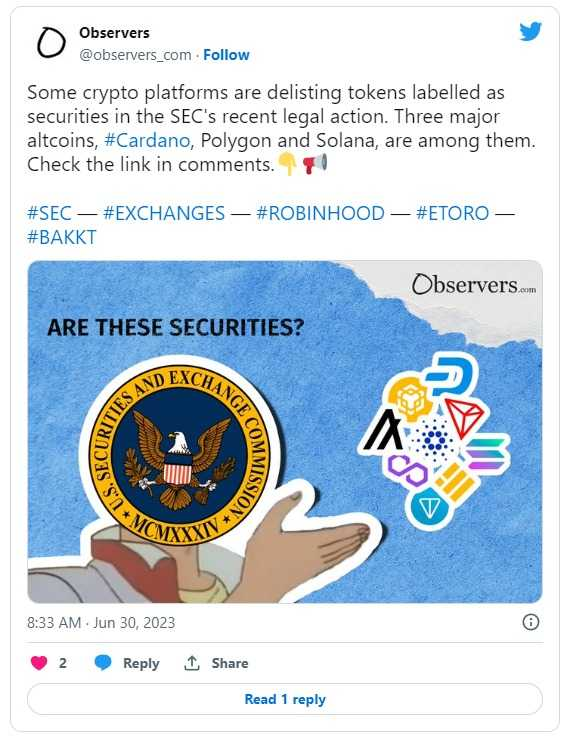
 
In this video, Guy discusses what the SEC sees as “a reasonable expectation of profit” and “the efforts of others,” regarding many of the more popular altcoins named by the SEC.


What Happens When an Altcoin Is a Security

Many investors wonder why the executive officers for these altcoins don’t simply register their coins with the SEC and be done with it.

Unless there is an exemption, if an altcoin is classified as a security, it must be registered with the SEC. This is a difficult, time-consuming, complicated, and costly process. These requirements also apply to the dealers, brokers, and exchanges that trade the altcoins.

It brings in a host of requirements, including regular periodic disclosures and updates about the business and compliance with broker/dealer rules.

Any misstep or noncompliance with SEC regulations could lead to sanctions, fines, and penalties.

On the one hand, this can limit the coin’s trading options, but on the other, it can offer some protection for investors like us.

Additionally, registration with the SEC often gives an aura of legitimacy to the altcoin. With the number of scam coins and rug pulls in the cryptocurrency market, this is a good thing for investors.

Plus, after being deemed a security or registering as a security, if the altcoin’s administrators fail to meet all the requirements, they leave themselves open to class-action lawsuits by investors.

However, the SEC could have given much clearer guidance to prevent the goat screw surrounding these altcoins, severely damaging investors more than the exchanges, brokers, and dealers.

Which Crypto Are Not Securities

According to the SEC, Bitcoin and Ethereum are not considered securities, largely due to their decentralized nature.

Unlike most altcoins, they don’t rely on a single entity or group for their success, which means they fail the “efforts of others” part of the Howey Test. Therefore, they fall under different regulations than many altcoins.

Are the SEC-Identified Altcoins Still Good Investments?

Despite the regulatory complications, I believe that altcoins identified as securities can still be good investments.

Though, I would be hesitant to buy any of these since there are better choices with fewer problems even with the reduced price brought about by the FUD created by the SEC.

Although they come with different rules and potential risks, they also have unique potential benefits. Their SEC registration can boost investor confidence, and the mandated transparency can provide clearer insights into the project’s progress and financials.

Plus, like Ripple and XRP, it will likely take years to iron this all out, particularly if there are more lawsuits.

If you’re like me and own altcoins that the SEC has classified as securities, it’s crucial to understand what it implies and how it can affect your investment strategy.

However, if you decide to sell now, you risk the chance these altcoins will recover during the next bull run and could, at the minimum, get your money back.

You can possibly write off some of the losses on your taxes, but ask a tax professional about that because the rules change constantly.

“A White House official confirmed the budget will include a tax provision intended to reduce wash sales trading by crypto investors. At present, investors can sell any cryptocurrencies at a loss, claim the loss on their taxes and then buy the same amount and type of cryptocurrencies again.” — Coin Desk, 9 MAR 23.

Always stay informed, comply with the regulations, and adapt your strategy as needed. Happy investing!

As I stated above, move your cryptocurrency to a more secure environment you control with a cold wallet.

No exchange is immune to hacks or insolvency.

“Chainalysis identified $3.8 billion in cryptocurrency hacks last year, which is 15% up in 2021 ($3.3 billion) and dramatically up on the $0.5 billion stolen in 2020.”


Link

community logo
Join the TheDinarian Community
To read more articles like this, sign up and join my community today
0
What else you may like…
Videos
Podcasts
Posts
Articles
🚨 There was a time when the US military knew exactly who the real enemy was—Britain.

Trump is reviving that clarity.

From Greenland to housing cartels, he's dismantling 80 years of imperial control over American policy.

👇 Watch 👇

00:12:39
Catherine Austin Fitts:

Catherine Austin Fitts:

"The bankers [have] put Trump in to get the control grid for them... [but] everybody wants... their own control grid. The Chinese and the Russians don't want the City of London controlling their CBDC... [so these powers are] fighting with each other."

This clip of Fitts, a former Assistant Secretary of Housing and Urban Development, investment banker, and founder of the Solari Report (@solari_the), is taken from a discussion with CapitalCosm (@CapitalCosm) posted to YouTube on January 10, 2026.

----------------Partial transcription of clip---------------

"What happened was, when the administration came in, I had said in 2024, the bankers are going to put Trump in to get the control grid for them. And in fact, that's what happened. But it was moving so quickly, Danny, I literally, I would do an interview like this, and I couldn't remember all the things he'd done last week. They were moving so fast.

"So we just started to make a collection and I could send people and ...

00:02:40
We Are Heading Into The World Of AI🤖

Elon Musk's jaw-dropping prediction (Jan 2026):

“Don’t go into medical school.”
Elon Musk: “Yes. Pointless, any school.”

In 3 years (2029), Optimus robots will be better surgeons than any human on Earth — at scale.

By 4–5 years? Not even close. The best medicine in the world will be free — 👉better than what the President gets today.

1:19 clip — the moment Elon says goodbye to traditional medicine forever 👇

3–5 years until AI surgeons dominate?

00:01:19
👉 Coinbase just launched an AI agent for Crypto Trading

Custom AI assistants that print money in your sleep? 🔜

The future of Crypto x AI is about to go crazy.

👉 Here’s what you need to know:

💠 'Based Agent' enables creation of custom AI agents
💠 Users set up personalized agents in < 3 minutes
💠 Equipped w/ crypto wallet and on-chain functions
💠 Capable of completing trades, swaps, and staking
💠 Integrates with Coinbase’s SDK, OpenAI, & Replit

👉 What this means for the future of Crypto:

1. Open Access: Democratized access to advanced trading
2. Automated Txns: Complex trades + streamlined on-chain activity
3. AI Dominance: Est ~80% of crypto 👉txns done by AI agents by 2025

🚨 I personally wouldn't bet against Brian Armstrong and Jesse Pollak.

👉 Coinbase just launched an AI agent for Crypto Trading
⚠️ Ripple Secures Preliminary Electronic Money Institution license 🚀

We’ve secured our preliminary Electronic Money Institution license approval from Luxembourg’s Commission de Surveillance du Secteur Financier (CSSF). 🇪🇺

This is a pivotal step toward scaling Ripple Payments across the EU, bringing institutional-grade digital asset infrastructure to the region. on.ripple.com/49D0FjW

The momentum is global:

→ 75+ licenses & registrations worldwide
→ $95B+ in volume processed to date
→ Reaching 90% of daily FX markets

With the EU taking the lead in building a regulatory framework for digital assets, we're helping institutions transition from pilots to commercial scale, and we’re bridging the gap between legacy finance and the digital future to unlock trillions in dormant capital.

https://x.com/i/status/2011363419501347177

@usbank is testing custom issuance of its own stablecoin on Stellar.

Stellar’s stablecoin market cap increased 53% YoY. The market cap of RWAs on Stellar increased 196% to $890.2 million. Get the latest from @MessariCrypto.

Lights out and away we go!

https://messari.io/report/stellar-financial-ecosystem-update

post photo preview
⚠️ More Secret Than The Atomic Bomb ⚠️

⚠️ More Secret Than The Atomic Bomb ⚠️

A deep dive into the triangular UAP seen throughout the United States and the world for decades. With the Immaculate Constellation report, at least SOME equilateral and isosceles triangle craft have been identified as reproduction and Alien Reproduction Vehicles.

Numerous sightings and whistleblower testimony have lent evidence to the thesis DOD and private contractors have operated reverse-engineered triangular craft out of key military bases since at least the 1980s. Key testimonies here include: Edgar Fouche and the TR-3b reverse-engineered triangle, US sightings from 1980-2000, and a strange illustration of a triangular craft called the XF-131 Super Sentinel.

Was Edgar Fouche's testimony of TR-3B and Area 51 programs true? How many prototype and operational triangle ARVs have been constructed? Why did the X-Files contract the work of an allegedly real triangle ARV out of Lockheed Martin's Helendale Plant?

00:00​ Intro
03:27​ Triangle ARV ...

post photo preview
🚨David Grusch on The Megyn Kelly Show🚨

Earlier this week, UFO/UAP whistleblower David Grusch appeared on The Megyn Kelly Show for a brief but revealing interview. During the conversation, Grusch named individuals he claimed were involved in managing the alleged UFO/UAP Legacy crash retrieval program, statements that immediately drew attention across the disclosure community.

Most notably, Grusch asserted that former Vice President Dick Cheney played a central role in overseeing the program. Cheney’s name has circulated within UFO/UAP research circles for years, but this marks the first time it has been spoken publicly by a former intelligence official who claims direct knowledge of the issue. It is also notable that just weeks ago, journalist Ross Coulthart independently referenced Cheney in a similar context, lending additional weight to the consistency of these claims.

Grusch also named former Director of National Intelligence James Clapper, stating that Clapper was not only aware of the crash retrieval issue, but managed it and helped place individuals into key roles, both publicly and behind the scenes. These are serious assertions that warrant scrutiny and further investigation, given their potential implications for disclosure.

Please watch the full interview and consider its significance within the broader context of the disclosure conversation. Please note that the interview concludes with a paid promotional pitch, and Grusch does not provide any additional comments after the pitch.


  🙏 Donations Accepted, Thank You For Your Support 🙏

If you find value in my content, consider showing your support via:

💳 Stripe:
1) or visit http://thedinarian.locals.com/donate

💳 PayPal: 
2) Simply scan the QR code below 📲 or Click Here: https://www.paypal.com/donate/?business=8K3TZ2YFZ7SMU&no_recurring=0&item_name=Support+Crypto+Michael+%E2%9A%A1+Dinarian+on+Locals+Blog&currency_code=USD


🔗 Crypto Donations Graciously Accepted👇
XRP: r9pid4yrQgs6XSFWhMZ8NkxW3gkydWNyQX
XLM: GDMJF2OCHN3NNNX4T4F6POPBTXK23GTNSNQWUMIVKESTHMQM7XDYAIZT
XDC: xdcc2C02203C4f91375889d7AfADB09E207Edf809A6


Read full Article
post photo preview
Stellar CEO Reveals Where Real Opportunity Lies in Crypto Market: Details

In a recent tweet, Stellar Development Foundation (SDF) CEO and Executive Director Denelle Dixon defines what "real opportunity" is in blockchain as a new financial future beckons.

The SDF CEO was reacting to a recent Bloomberg report on Bank of New York Mellon Corp (BNY), Nasdaq, S&P Global and iCapital participation in a new $50 million investment round by Digital Asset Holdings. This comes as some of Wall Street’s biggest names embrace the technology that underpins cryptocurrencies to handle traditional assets.

Reacting to this development, Stellar Foundation CEO Denelle Dixon stated that every blockchain investment is a bet on a different financial future. Dixon added that seeing banks explore blockchain technology validates what has been known over the years.

Real opportunity defined

While Wall Street’s biggest names betting on blockchain might be one of the most significant adoption milestones in the digital asset market, Dixon defines what real opportunity is and what it is not.

According to the SDF executive director, real opportunity is not replicating old systems on new rails but rather building open networks that fundamentally expand global finance participation.

"But the real opportunity isn’t replicating old systems on new rails—it’s building open networks that fundamentally expand who gets to participate in global finance. That’s the opportunity," Dixon tweeted.

At the Meridian 2025 event, Stellar outlined its long-term privacy strategy, committing to investing in critical privacy infrastructure and building foundational cryptographic capabilities.

Stellar eyes privacy upgrade

A new protocol upgrade is on the horizon for the Stellar network: X-Ray, which lays the groundwork for developers to build privacy applications on Stellar using zero-knowledge (ZK) cryptography.

The protocol timeline testnet vote is anticipated for Jan. 7, 2026, while the mainnet vote is expected for Jan. 22, 2026.

Source

  🙏 Donations Accepted, Thank You For Your Support 🙏

If you find value in my content, consider showing your support via:

💳 Stripe:
1) Visit http://thedinarian.locals.com/donate

💳 PayPal: 
2) Simply scan the QR code below 📲 or Click Here

🔗 Crypto Donations Graciously Accepted👇
XRP: r9pid4yrQgs6XSFWhMZ8NkxW3gkydWNyQX
XLM: GDMJF2OCHN3NNNX4T4F6POPBTXK23GTNSNQWUMIVKESTHMQM7XDYAIZT
XDC: xdcc2C02203C4f91375889d7AfADB09E207Edf809A6

Read full Article
post photo preview
XDC Network's acquisition of Contour Network

XDC Network's acquisition of Contour Network marks a silent shift to connect the digital trade infrastructure to real-time, tokenized settlement rails.

In a world where cross-border payments still take days and trap trillions in idle liquidity, integrating Contour’s trade workflows with XDC Network Blockchains' ISO 20022 financial messaging standard to bridge TradFi and Web3 in Trade Finance.

The Current State of Cross-Border Trade Settlements

Cross-border payments remain one of the most inefficient parts of global finance. For decades, companies have inter-dependency with banks and their correspondent banks across the world, forcing them to maintain trillions of dollars in pre-funded nostro and vostro balances — the capital that sits idle while transactions crawl across borders.

Traditional settlement is slow, often 1–5 days, and often with ~2-3% in FX and conversion fees. For every hour a corporation can’t access its own cash increases the cost of financing, tightens liquidity that could be used for other purposes, which in turn slows economic activity.

Before SWIFT, payments were fully manual. Intermediary banks maintained ledgers, and reconciliation across multiple institutions limited speed and volume.

SWIFT reshaped global payments by introducing a secure, standardized messaging infrastructure through ISO 20022 - which quickly became the language of money for 11,000+ institutions in 200 countries.

But SWIFT only fixed the messaging — not the movement. Actual value still moves through slow, capital-intensive correspondent chains.

Regulated and Compliant Stablecoin such as USDC (Circle) solves the part SWIFT never could: instant, on-chain settlement.

Stablecoin Settlement revamping Trade and Tokenization

Stablecoin such as USDC is a digital token pegged to the US Dollar, still the most widely used currency for trade, enabling the movement of funds instantly 24*7 globally - transparently, instantly, and without the need for any intermediaries and the need to lock in trillions of dollars of idle cash.

Tokenized settlement replaces multi-day reconciliation with on-chain finality, reducing:

  • Dependency on intermediaries
  • Operational friction
  • Trillions locked in idle liquidity

For corporates trapped in long working capital cycles, this is transformative.

Digital dollars like USDC make the process simple:

Fiat → Stablecoin → On-Chain Transfer → Fiat

This hybrid model is already widely used across remittances, payouts, and treasury flows.

But one critical piece of global commerce is still lagging:

👉 Trade finance.

The Missing link is still Trade Finance Infrastructure.

While payments innovation has raced ahead, trade finance infrastructure hasn’t kept up. Document flows, letters of credit, and supply-chain financing remain siloed, paper-heavy, and operationally outdated.

This is exactly where the next breakthrough will happen - and why the recent XDC Network acquisition of Contour is a silent revolution.

It transforms to a new era of trade-driven liquidity through an end-to-end digital trade from shipping docs to payment confirmation – one infrastructure that powers all.

The breakthrough won’t come from payments alone — it will come from connecting trade finance to real-time settlement rails.

The XDC + Contour Shift: A Silent Revolution

  • Contour already connects global banks and corporates through digital LCs and digitized trade workflows.
  • XDC Blockchain brings a settlement layer built for speed, tokenization, and institutional-grade interoperability and ISO 20022 messaging compatibility

Contour’s digital letter of credit workflows will be integrated with XDC’s blockchain network to streamline trade documentation and settlement.

Together, they form the first end-to-end digital trade finance network linking:

Documentation → Validation → Settlement all under a single infrastructure.

XDC Ventures (XVC.TECH) is launching a Stable-Coin Lab to work with financial institutions on regulated stablecoin pilots for trade to deepen institutional trade-finance integration through launch of pilots with banks and corporates for regulated stable-coin issuance and settlement.

The Bottom Line

Payments alone won’t transform Global Trade Finance — Trade finance + Tokenized Settlement will.

This is the shift happening underway XDC Network's acquisition of Contour is the quiet catalyst.

Learn how trade finance is being revolutionised:

https://www.reuters.com/press-releases/xdc-ventures-acquires-contour-network-launches-stablecoin-lab-trade-finance-2025-10-22/

Source

🙏 Donations Accepted, Thank You For Your Support 🙏

If you find value in my content, consider showing your support via:

💳 Stripe:
1) or visit http://thedinarian.locals.com/donate

💳 PayPal
2) Simply scan the QR code below 📲 or Click Here

🔗 Crypto Donations Graciously Accepted👇
XRP: r9pid4yrQgs6XSFWhMZ8NkxW3gkydWNyQX
XLM: GDMJF2OCHN3NNNX4T4F6POPBTXK23GTNSNQWUMIVKESTHMQM7XDYAIZT
XDC: xdcc2C02203C4f91375889d7AfADB09E207Edf809A6


Read full Article
See More
Available on mobile and TV devices
google store google store app store app store
google store google store app tv store app tv store amazon store amazon store roku store roku store
Powered by Locals