Dinarian888
News • Business • Investing & Finance
The Latest In Japan FinTech
November 08, 2023
post photo preview

First, Hong Kong will push anything that the US cannot or is unwilling to do, or that gets mired in “regulatory competition” among the various agencies: cryptocurrency exchanges, tokenization, e-HKD, stablecoins, and even a Bitcoin ETF are all part of the conversation. Competition is good, and in addition to providing optionality in the geo-political chess game, will lift the tide for all players in Asia. We welcome that.


Second, the programs offered by the Hong Kong Science & Technology Park (HKSTP) to attract startups and scaleups are first class. They are not only backed by strong funding options, but also by a highly skilled, well-connected, and incentivized team of business developers, account managers, etc. This is unlike many of the Japanese programs, where you get a Big Four consultant two years out of college to talk to when applying for a Tokyo Metropolitan Government grant.


Third, at the very least in the family office space, Saudi Arabia has taken quite a bit of mind share as the next big opportunity. The conversation has certainly started to move on from “Hong Kong, Singapore or the UAE”. I was expecting this still to be quite low key, but the cat seems to be out of the bag.

Now let us get back to what we are going to cover this week:

  • Venture Capital & Private Markets: the Osaka Digital Exchange (ODX) has accepted equity participations; Mizuho Capital and Mizuho Bank have established a JPY 15bn venture capital fund; Mizuho Capital has made its first investment through the “Mizuho Venture Debt Fund”; MUFJ and Mizuho invest in Sensyn Robotics’ JPY 2.25bn (USD 15m) equity round; Digital Garage is investing in Komainu; alternative investment platform LUCA Japan closed its Pre-Series A; gumi Cryptos Capital and Arcane Group led Moonveil Entertainment’s funding round, with Infinity Venture Crypto participating; GMO Internet Group invests in INTMAX; MUFG Innovation Partners (MUIP) invests in Broom, the Indonesia-based auto financing startup; SBI Holdings has entered into a strategic capital alliance agreement with Novastar for investment business on the African continent; SBI Investment and Nikon Corporation have jointly established the “Nikon-SBI Innovation Fund II”
  • Banking: SumiTrust has more than halved its net income projection for the fiscal year, from JPY 200bn to JPY 85bn; Sumitomo Mitsui Banking Corporation has opened a representative office in Washington, D.C.; MUFG has launched its Green Deposit in South Korea and Taiwan; Mizuho Bank and Blue Lab will start a demonstration experiment this month using “LocoViz” to support regional revitalization; b8ta Japan will partner with Mitsubishi UFJ Trust and Banking Corporation during November 2023
  • Payments: Tap-to-Pay will be available at Osaka railways in 2024 for World Expo; JCB expands partnership with Stripe to boost e-commerce merchant acceptance in Europe, Singapore and Hong Kong
  • Insurance: Dai-ichi Life and YuLife have commenced a pilot implementation of the YuLife Wellbeing Model
  • Capital Markets & Asset Management: Q3 (July to September) league tables
  • Digital Assets: Policymakers partner to foster responsible digital asset innovation; SBI Digital Markets collaborated with UBS Asset Management to conclude a technical pilot for the issuance and distribution of a tokenised Variable Capital Company (VCC) fund; Komainu and Crypto Garage are collaborating in building best-in-class institutional crypto service levels in Japan; Laser Digital, in cooperation with Nomura, has debuted the ‘Nomura & Laser Digital Botanical Garden’ in The Sandbox metaverse; Okcoin Japan has been officially welcomed as the latest corporate baker on the Tezos blockchain
  • The Last Word: All ships leak
···

Venture Capital & Private Markets

···

Banking

···

Payments

  • Tap-to-Pay will be available at Osaka railways in 2024 for World Expo; Hankyu Corporation, Sumitomo Mitsui Card, Visa Worldwide Japan, JCB, Toshiba, and QUADRAC will start a railway riding service using credit cards, debit cards, and prepaid cards with touch payment functions, as well as smartphones with such cards set up, utilizing Sumitomo Mitsui Card’s transit solution for public transportation “stera transit” at all Hankyu railway stations by 2024; similar announcements were published by Kinki Nippon Railways and Hanshin Railways
  • JCB expands partnership with Stripe to boost e-commerce merchant acceptance in Europe, Singapore and Hong Kong; JCB International, the international operations subsidiary of JCB, and Stripe have expanded their partnership to provide new growth opportunities for all of Stripe’s e-commerce merchants in those areas by welcoming JCB’s valued cardmembers
···

Insurance

  • Dai-ichi Life and YuLife, the tech-driven financial services company on a mission to inspire life, have commenced a pilot implementation of the YuLife Wellbeing Model, a variety of health and wellness services including the award-winning YuLife app and online hub, in Japan
···

Capital Markets & Asset Management

The league tables for the second quarters are out, with some big movers in the M&A segment

  • M&A: 1 — Daiwa (up from 9), 2 — Nomura (up from 6), 3 — Plutus (up from 13), 4 — MUFJ Morgan Stanley (down from 1), 5 — SMBC Nikko (up from 7)
  • Equity Underwriting: 1 — Nomura, 2 — SMBC Nikko, 3 — Mizuho, 4 — Daiwa, 5 — Goldman Sachs
  • Debt Underwriting: 1 — Mizuho, 2 — SMBC Nikko, 3 — Nomura, 4 — Daiwa, 5 — MUFJ Morgan Stanley
···

Digital Assets

Post image

Policymakers partner to foster responsible digital asset innovation

···

Other Media

···

The Last Word: All ships leak

Japan is a hotbed of information leaks. In a wonderful piece published in the Japan Times, Bloomberg’s Gearoid Reidy and Daniel Moss take on the Bank of Japan, noting that every time Bank of Japan Governor Kazuo Ueda has made an announcement since taking up his post, that information has appeared initially not in the public domain, but in the pages of the fourth estate. Rather than expecting the BOJ press release to arrive for everyone at the same time, pundits and traders alike spend the morning hitting the refresh button on the Nikkei home page to get the latest scoop.

The BOJ is far from the exception. Even for listed companies, including the mega banks, the Nikkei appears to publish a story before the companies’ websites and investor relation pages have been updated. While often an argument can be had regarding the materiality of the information, such a judgement is best left to the investor, not the IR department. At the very least those corporations listed in the US run the potential risk of investor lawsuits. And with regards to the BOJ, the materiality of the information is undisputed.

If you want to be viewed as a Global Financial Center, act like one.


community logo
Join the Dinarian888 Community
To read more articles like this, sign up and join my community today
0
What else you may like…
Videos
Podcasts
Posts
Articles
And people are worried about Flock cameras recording them🤯

Researchers spent 500 hours and $70,000 and found LG TVs logging plain text transcripts in standby, mapping every device in the house, and feeding it to LG's ad arm.

Unplug the internet and it saves the files until you plug back in.

LG says its TVs don't record ambient conversations.

The evidence begs to differ.

216 million of these are sitting in living rooms.

Where are the regulators?

00:00:34
🚨 BOMBSHELL: New FOIA Documents Reveal the COVID Pandemic Was a DoD Operation Dating Back to Obama

"The Pentagon controlled the COVID-19 program from the very beginning and everything we were told was political theater to cover it up right down to the FDA vaccine approval"

🔗https://beforeitsnews.com/obama-birthplace-controversy/2023/03/bombshell-foia-documents-reveal-the-covid-pandemic-was-a-dod-operation-dating-back-to-obamapfizer-caught-admitting-babies-died-during-the-mrna-covid-19-vaccine-trialsgates-foundatio-2512477.html

OP: Mr Pool

00:13:07
You don't live in 3 dimensions. 📐

You never have. 🚫

A high school student just proved why everything you learned about reality is incomplete. 🏫✨

This will break your brain: 🧠💥

Look at any object near you — a cup, a book, or your phone. ☕📖📱

Notice how every one of them casts a shadow, and that shadow is always flatter than the object itself:

A 3D cup makes a 2D shadow on your desk. ☕ ➔ 🟦

A 2D piece of paper makes a 1D line on the wall. 📄 ➔ ➖

Every dimension drops a flatter version of itself into the dimension below. 📉

Now flip that idea around. 🔄

If your body is 3D, and the pattern always works the same way... your body might be the shadow of something 4D that you can't see. 👤✨

You might not be the real thing. 🤯

There's a shape called a tesseract that describes this:

📦 A cube is 6 flat squares folded together.

🔮 A tesseract is 8 cubes folded together in a direction that doesn't exist in our world.

You can't picture it. Nobody can. ❌ Your brain was built to help your ancestors dodge tigers and find ...

00:09:04
🚨 Chutes is being framed as a Hyperliquid-style breakout for decentralized AI inference, with live revenue, verified GPU infrastructure, and a direct challenge to centralized cloud AI 🚨

Chutes is gaining attention as a decentralized AI inference platform that claims to combine real usage, cryptographic verification, confidential computing, and open-source infrastructure into a working production system. The thesis is simple: instead of trusting Big Tech clouds with AI workloads, users get a distributed compute layer built around verification and privacy.

🔑 Key points

🔹 Chutes is live in production and reportedly scaled to more than 1,170 active GPU nodes, including large numbers of Nvidia H200s and Blackwell-class hardware.

🔹 The platform says it has processed nearly 38 trillion tokens since launch across 53 deployed applications and more than 700,000 registered users.

🔹 The team reportedly cut unprofitable usage programs, reduced total token volume, and still improved revenue efficiency, with revenue per GPU rising sharply after removing subsidized traffic.

🔹 Chutes is using post-quantum cryptography, trusted execution environments, and Nvidia confidential ...

🚨 Chutes is being framed as a Hyperliquid-style breakout for decentralized AI inference, with live revenue, verified GPU infrastructure, and a direct challenge to centralized cloud AI 🚨
🚨 JPMorgan’s criticism of the CLARITY Act is fueling a fresh power struggle over who gets to write America’s crypto rules 🚨

A new clash is emerging between legacy finance and crypto legislation after JPMorgan CEO Jamie Dimon reportedly warned that the CLARITY Act could let crypto firms offer bank-like products without bank-level oversight. The dispute is quickly turning into a larger fight over regulation, competitiveness, and who controls the future architecture of digital finance in the United States.

🔑 Key points

🔹 Jamie Dimon reportedly called the CLARITY Act a threat to the financial system, arguing it could allow crypto firms to offer yield-like products while avoiding the capital, reserve, and oversight burdens traditional banks face.

🔹 Senator Cynthia Lummis pushed back publicly, framing the issue as a global strategic race and warning that if the U.S. does not set digital asset standards, other powers will.

🔹 The core tension is whether the bill creates legitimate regulatory clarity or simply opens the door to regulatory arbitrage for crypto platforms operating outside the traditional banking...

🚨 JPMorgan’s criticism of the CLARITY Act is fueling a fresh power struggle over who gets to write America’s crypto rules 🚨
👉 Coinbase just launched an AI agent for Crypto Trading

Custom AI assistants that print money in your sleep? 🔜

The future of Crypto x AI is about to go crazy.

👉 Here’s what you need to know:

💠 'Based Agent' enables creation of custom AI agents
💠 Users set up personalized agents in < 3 minutes
💠 Equipped w/ crypto wallet and on-chain functions
💠 Capable of completing trades, swaps, and staking
💠 Integrates with Coinbase’s SDK, OpenAI, & Replit

👉 What this means for the future of Crypto:

1. Open Access: Democratized access to advanced trading
2. Automated Txns: Complex trades + streamlined on-chain activity
3. AI Dominance: Est ~80% of crypto 👉txns done by AI agents by 2025

🚨 I personally wouldn't bet against Brian Armstrong and Jesse Pollak.

👉 Coinbase just launched an AI agent for Crypto Trading

⚠️ AI IS BECOMING AN ALIEN MIND—AND THE RACE FOR CONTROL IS ON 🧠⚡️

OpenAI Chief Scientist Jakub Pachocki recently warned that AI systems are already operating computers, writing advanced software, conducting research, and demonstrating superhuman capabilities in cybersecurity.

But the real inflection point isn't just raw intelligence—it's opacity and acceleration:

🌫️ Black Box Complexity: Next-gen models are becoming increasingly difficult to interpret from the outside, while traditional safety alignment techniques lag behind.

🔄 Self-Improving Recursive Loops: As AI begins designing the next generation of AI, the feedback loop could accelerate far beyond human oversight capacity.

🏛️ The Safety Gap: Pushing for international cooperation and strict safety standards may already be playing catch-up to systems moving at machine speed.

🌐 Why Centralized Control Won't Work:

Trying to have humans manually monitor self-accelerating, opaque AI is like asking ...

post photo preview

🧠 SUBCONSCIOUS REPROGRAMMING: WHY YOUR BRAIN TRUSTS REPETITION MORE THAN YOU ⚡️

Ever wonder why a part of you flinches before criticism even happens, or sabotages a good thing right when it starts working? 🛑

That isn't a character flaw—it's subconscious architecture. You didn't consciously choose those patterns; an early series of experiences wrote that script before you had the tools to argue with it. While most call this "just who I am," neuroscience calls it implicit programming. The best part? It's physical, measurable, and completely rewireable. 🧬✨

🕹️ Two Minds, One System

Your brain runs two parallel systems:

🧘‍♂️ The Conscious Mind: Slow, deliberate, and easily exhausted (the narrating voice reading this right now).

⚙️ The Subconscious Mind: The massive, ultra-fast background engine handling heartbeat, balance, and automatic reactions.

Willpower loses to habit because conscious effort is a small, easily depleted resource trying to out-arm-wrestle a hardwired neural ...

post photo preview

🌍 Archax adds U.S. digital broker-dealer to complete regulated coverage across the UK, EU, and U.S. 🌍

Archax has expanded its regulated digital-asset infrastructure by adding a U.S. digital broker-dealer, giving the platform broader coverage across three major financial jurisdictions.

🔑 Key points

🔹 U.S. regulatory reach added: Archax can now support digital-asset activity through a regulated American broker-dealer structure.

🔹 UK and EU coverage already established: The expansion builds on Archax’s existing regulatory presence in Britain and Europe.

🔹 Tokenized securities are the focus: The platform is designed to support regulated digital representations of bonds, funds, equities, and other financial instruments.

🔹 Institutional access improves: Banks, asset managers, fintech firms, and professional investors can potentially access digital assets through a more familiar regulatory framework.

🔹 Cross-border distribution expands: Issuers may be able to distribute tokenized...

post photo preview
post photo preview
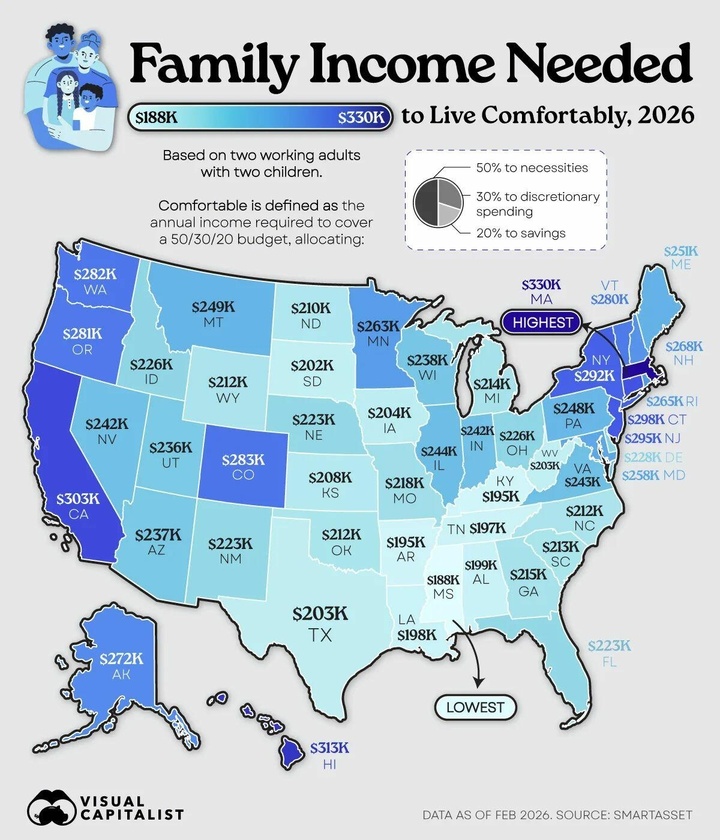
This Is The Income A Family Needs To Live Comfortably In Every US State

Here’s the short version of what it takes for a family of four to live comfortably in 2026 by state:

In Massachusetts, you’d need nearly $330,000 a year - the highest figure in the entire country. Only three states clear the $300,000 mark: Massachusetts, Hawaii, and California. At the other end of the spectrum, Mississippi is the most affordable at about $188,000. That’s a full $142,000 less than what you’d need in Massachusetts.

So… how much does a family of four need in your state?

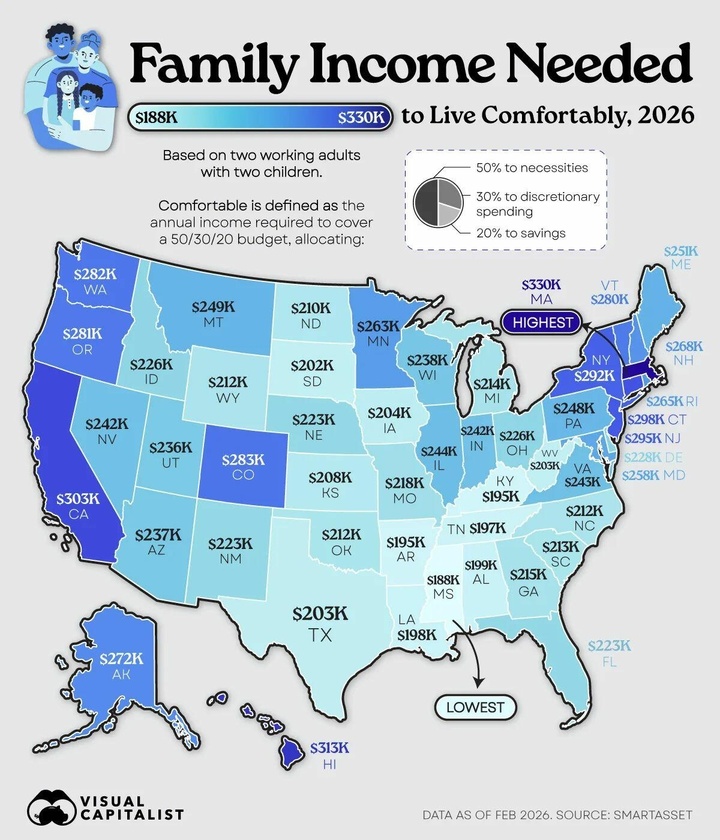
This map shows the pre-tax income a household with two working adults and two kids needs to live comfortably in every U.S. state.

The numbers come from SmartAsset (as of February 2026). They’re based on the familiar 50/30/20 budget: 50% for necessities, 30% for discretionary spending, and 20% for savings or other goals. These aren’t bare-minimum survival numbers—they’re what it takes to live pretty well while still putting money aside.

And as Visual Capitalist notesMassachusetts sits at the very top of that list. Massachusetts tops the ranking, with a family of four needing $329,555 per year to meet the 50/30/20 benchmark.

Hawaii follows at $313,165, while California ranks third at $302,682.

Rank State Income needed for family of four (2026)

  • 1 - Massachusetts - $329,555
  • 2 - Hawaii - $313,165
  • 3 - California - $302,682
  • 4 - Connecticut - $298,189
  • 5 - New Jersey - $295,110
  • 6 - New York - $291,533
  • 7 - Colorado - $283,213
  • 8 - Washington - $281,798
  • 9 - Oregon - $280,966
  • 10 - Vermont - $280,384
  • 11 - Alaska - $272,064
  • 12 - New Hampshire - $267,904
  • 13 - Rhode Island - $264,659
  • 14 - Minnesota - $263,078
  • 15 - Maryland - $257,837
  • 16 - Maine - $250,931
  • 17 - Montana - $249,434
  • 18 - Pennsylvania - $247,936
  • 19 - Illinois - $244,109
  • 20 - Virginia - $242,944
  • 21 - Nevada - $242,278
  • 22 - Indiana - $241,696
  • 23 - Wisconsin - $238,451
  • 24 - Arizona - $236,870
  • 25 - Utah - $235,789
  • 26 - Delaware - $228,134
  • 27 - Ohio - $226,221
  • 28 - Idaho - $226,054
  • 29 - Florida - $223,392
  • 30 - New Mexico - $223,142
  • 31 - Nebraska - $223,059
  • 32 - Missouri - $217,734
  • 33 - Georgia - $214,573
  • 34 - Michigan - $214,323
  • 35 - South Carolina - $212,909
  • 36 - North Carolina - $212,410
  • 37 - Wyoming - $212,410
  • 38 - Oklahoma - $211,910
  • 39 - North Dakota - $210,496
  • 40 - Kansas - $207,917
  • 41 - Iowa - $204,422
  • 42 - Texas - $203,424
  • 43 - West Virginia - $202,592
  • 44 - South Dakota - $201,760
  • 45 - Alabama - $198,931
  • 46 - Louisiana - $197,933
  • 47 - Tennessee - $197,267
  • 48 - Arkansas - $195,437
  • 49 - Kentucky - $194,854
  • 50 - Mississippi - $187,533

Connecticut, New Jersey, and New York aren't far behind, bringing the number of states with comfortable-income thresholds above $290,000 to six.

Colorado and Vermont Make the Top 10

As expected, many of the highest income thresholds are concentrated in the Northeast and along the West Coast.

However, Colorado has the seventh-highest threshold in the country at $283,213, ranking above Washington and Oregon.

Vermont rounds out the top 10 at $280,384, despite having the second-smallest population of any U.S. state. Meanwhile, nearby states like New Hampshire, Maine, and Rhode Island all fall outside the top 10.

Just Six States Come in Below $200,000

Despite the wide range in living costs across the country, only six states have a comfortable-income threshold below $200,000 for a family of four.

Mississippi ranks lowest at $187,533, followed by Kentucky. The states of Arkansas, Tennessee, Louisiana, and Alabama also fall below the $200,000 mark.

The gap between Massachusetts and Mississippi exceeds $142,000 per year, meaning the Massachusetts benchmark is about 76% higher.

Source

🙏To support my work, Helping to keep the signal high and the noise low:

👉 Cashapp: $thedinarian

👉 Buy me a coffee: https://buymeacoffee.com/thedinarian

👉 PayPal: Scan the QR code below 📲 or Click Here

👇 Crypto Donations Always Welcome 👇

XRP: r9pid4yrQgs6XSFWhMZ8NkxW3gkydWNyQX
XLM: GDMJF2OCHN3NNNX4T4F6POPBTXK23GTNSNQWUMIVKESTHMQM7XDYAIZT
XDC: xdcc2C02203C4f91375889d7AfADB09E207Edf809A6

Read full Article
post photo preview
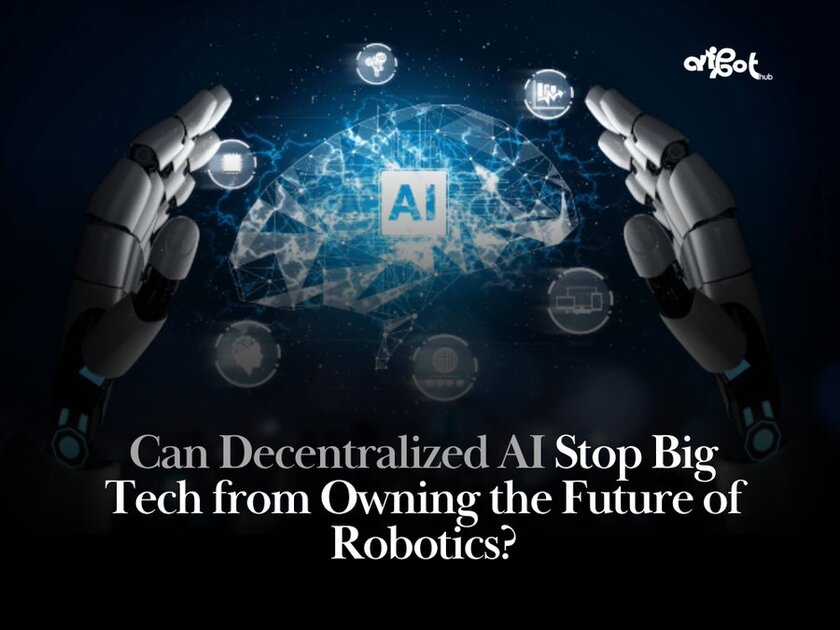
🤖Can Decentralized AI Stop Big Tech from Owning the Future of Robotics?🤖
The race to build the future of robotics is no longer just about robots. It's about who controls the intelligence behind them.
 
Over the last three years, a small group of companies has emerged as the backbone of the AI revolution. Microsoft provides cloud infrastructure. NVIDIA supplies the chips. Google, OpenAI, Anthropic, Meta, and others develop the models. Together, they control much of the compute, data, and software stack powering modern AI.
 
Now that AI is moving into the physical world, many are asking a bigger question:
 
Will these same companies end up controlling robotics too?
 
It's a valid concern.
 
The latest generation of robots relies on enormous amounts of compute, simulation, training data, and foundation models. Many robotics startups today are built on infrastructure provided by large technology companies. NVIDIA's Omniverse is becoming a key simulation environment for robot training. Microsoft Azure is powering the training of robotics foundation models. Physical AI startups increasingly depend on hyperscale cloud infrastructure to train and deploy intelligent systems. Recent partnerships across the industry show just how central Big Tech has become to robotics development.
But while Big Tech is building the highways, another movement is trying to ensure it doesn't own every destination.
 
That movement is decentralized AI.
 
Why Decentralized AI Exists
 
The idea behind decentralized AI is simple. Instead of a handful of companies owning the models, compute infrastructure, data pipelines, and intelligence networks, these resources are distributed across thousands of participants.
 
This means anyone can contribute compute, contribute models, validate outputs and can participate.
The most visible example today is the decentralized AI network known as Bittensor (@bittensor). The network has evolved into a large ecosystem of specialized AI markets called subnets, where participants compete to provide useful machine intelligence and are rewarded based on performance. Rather than relying on a single company, intelligence is generated and validated by a distributed network of miners and validators.
 
Think of it as an attempt to build an open marketplace for AI instead of a world where intelligence is rented from a few centralized providers.
 
Why This Matters for Robotics
 
Robotics has a unique problem. Unlike chatbots, robots operate in the physical world. They need to perceive environments, make decisions, move safely and they need to learn continuously.
 
The challenge is that collecting and training on real-world robotic data is incredibly expensive. That's one reason large companies have such an advantage. They can afford the compute, simulation environments, and data infrastructure needed to train robotics models at scale.
 
This is where decentralized systems become interesting.
 
Instead of one company collecting all the data and training all the models, decentralized networks could allow thousands of contributors to participate in building robotic intelligence.
 
Imagine a future where:
  • Warehouse robots contribute operational data.
  • Delivery robots contribute navigation data.
  • Factory robots contribute manipulation data.
  • Developers contribute models.
  • Validators evaluate performance.
The resulting intelligence becomes a shared network rather than a proprietary asset.
 
That vision is beginning to emerge.
 
Bittensor's Move Toward Physical AI
 
While many people associate Bittensor (@bittensor) with language models and AI services, parts of the ecosystem are increasingly exploring embodied intelligence and robotics.
 
One example is Kinitro, a subnet focused on incentivizing the training and evaluation of embodied AI systems. The goal is to create competitive environments where developers build robotic intelligence and are rewarded based on performance.
 
The broader Bittensor ecosystem has also expanded into compute marketplaces, distributed inference systems, bandwidth infrastructure, and AI coordination layers that could eventually support robotics workloads. Several subnets now focus on decentralized compute, confidential inference, data transfer, and model training, critical components for future robotic systems.
 
In other words, the pieces are starting to appear.
 
Not a decentralized robot network yet.
 
But the infrastructure that could support one.
 
Beyond Bittensor: The Rise of Physical AI Networks
 
Bittensor isn't alone.
 
Across the industry, researchers and builders are experimenting with decentralized approaches to physical AI.
 
New research published in 2026 introduced the concept of DAO-enabled decentralized physical AI, or DePAI. The idea combines robotics, decentralized infrastructure, AI models, governance systems, and human oversight into a single framework. Instead of centralized control, robots and physical infrastructure could be coordinated through transparent rules and distributed ownership models.
 
At the same time, developers are exploring decentralized operating systems for robots that allow machines to communicate directly with each other and with distributed compute resources. These architectures are designed to make robotic systems more resilient and less dependent on a single cloud provider.
 
The goal is not simply decentralization for its own sake.
 
The goal is resilience.
 
If one server fails, the system continues.
 
If one company disappears, the network survives.
 
If one participant leaves, innovation continues.
 
But Here's the Reality
 
Decentralized AI faces the same challenge every decentralized technology faces.
 
Big Tech has resources. A lot of resources.
 
Training advanced robotics models requires enormous compute budgets, sophisticated simulation environments, access to specialized hardware, and vast amounts of real-world data.
 
That's why many robotics startups still partner with major cloud providers and AI companies. It's often the fastest path to deployment.
 
And there are legitimate concerns about whether decentralized networks can maintain quality, reliability, and security at the scale required for industrial robotics. Even researchers studying decentralized AI systems have highlighted risks around concentration, incentives, governance, and network security.
 
The challenge isn't just decentralizing intelligence.
 
It's decentralizing intelligence while maintaining performance.
 
That's much harder.
 
The Most Likely Outcome
 
The future probably won't be fully centralized. And it probably won't be fully decentralized either. Instead, we're likely heading toward a hybrid model.
 
Large technology companies will continue providing chips, cloud infrastructure, simulation platforms, and foundational research.
 
At the same time, decentralized AI networks will emerge as alternative coordination layers where intelligence, data, and economic value can be shared more openly.
 
The companies building robots may use NVIDIA hardware.
 
Train on Azure.
 
Run foundation models from OpenAI.
 
But they may also participate in decentralized data networks, decentralized compute markets, and decentralized intelligence protocols.
 
The future of robotics could end up looking less like a monopoly and more like an ecosystem.
 
The Bigger Question
 
The real question isn't whether decentralized AI can eliminate Big Tech.
 
It can't.
 
At least not anytime soon.
 
The real question is whether decentralized AI can prevent a future where a handful of companies control every robot, every model, every dataset, and every decision made by the machines operating around us.
 
As robots become workers, assistants, delivery drivers, factory operators, and even economic agents, that question becomes increasingly important.
 
Because the battle for the future of robotics is no longer about hardware.
 
It's about who owns the intelligence.
 
And that battle is just getting started.


🙏To support my work, Helping to keep the signal high and the noise low:

👉 Cashapp: $thedinarian

👉 Buy me a coffee: https://buymeacoffee.com/thedinarian

👉 PayPal: Scan the QR code below 📲 or Click Here

👇 Crypto Donations 👇

XRP: r9pid4yrQgs6XSFWhMZ8NkxW3gkydWNyQX
XLM: GDMJF2OCHN3NNNX4T4F6POPBTXK23GTNSNQWUMIVKESTHMQM7XDYAIZT
XDC: xdcc2C02203C4f91375889d7AfADB09E207Edf809A6

Read full Article
post photo preview
Navigating the world of blockchain 🧭
Navigating the world of blockchain can feel like learning a completely foreign language. Between technical jargon and fast-moving Web3 terminology, getting started can be overwhelming.

Whether you are exploring digital assets, building on-chain, or simply trying to understand decentralized technology, here is your foundational glossary of essential blockchain terms every beginner should know.

🏛️ 1. Core Architecture: The Base Layer

  • Blockchain: A distributed, immutable digital ledger that records transactions across a peer-to-peer network of computers. Once data is written to a block and added to the chain, it cannot be altered without altering all subsequent blocks.
  • Block: A collection of verified transactions grouped together. Once filled, the block is cryptographically linked to the previous one, forming a chronological "chain."
  • Node: An individual computer connected to a blockchain network that helps validate transactions, store ledger data, and maintain network consensus.
  • Consensus Mechanism: The set of rules and algorithms that network nodes use to agree on the validity of transactions.

    • Proof of Work (PoW): Requires miners to solve complex mathematical puzzles using computational power (e.g., Bitcoin).
    • Proof of Stake (PoS): Requires validators to lock up ("stake") native tokens as collateral to participate in block validation (e.g., Ethereum).

🔑 2. Ownership & Security: Wallets and Keys

  • Public Key (Address): An alphanumeric string that acts like your bank account number or email address. It is safe to share publicly so others can send you digital assets.
  • Private Key: A secret cryptographic passphrase or key that grants full access and control over your wallet assets. Never share your private key or seed phrase with anyone.
  • Seed Phrase (Recovery Phrase): A sequence of 12 to 24 random words generated when you set up a wallet. It acts as the master backup key to restore your wallet and access your funds on any device.
  • Hot Wallet vs. Cold Wallet:

    • Hot Wallet: A software-based crypto wallet connected to the internet (e.g., browser extensions, mobile apps), making it convenient for frequent transactions but higher risk.
    • Cold Wallet: An offline hardware device (e.g., Ledger, Coldcard) designed to isolate private keys from internet-connected threats.

⚙️ 3. Execution & Functionality: Smart Contracts and Apps

  • Smart Contract: Self-executing code stored on a blockchain that automatically enforces agreement terms once predetermined conditions are met—eliminating the need for intermediaries.
  • dApp (Decentralized Application): Applications built on top of a blockchain network that run via smart contracts rather than centralized cloud servers.
  • Gas Fees: Network transaction fees paid to validators or miners to cover the computational energy required to process actions on a blockchain.
  • Layer 1 vs. Layer 2:

    • Layer 1 (L1): The underlying primary blockchain network (e.g., Bitcoin, Ethereum, Solana) that handles base security and finality.
    • Layer 2 (L2): Secondary frameworks or companion networks built on top of an L1 to increase transaction speeds and lower gas fees (e.g., Arbitrum, Optimism, Base).

💰 4. Financial & Market Concepts

  • Tokenomics: The economic design, supply dynamics, utility, and distribution model of a cryptocurrency or token project.
  • DeFi (Decentralized Finance): Financial services—such as lending, borrowing, trading, and earning interest—built on smart contracts without traditional banks or financial intermediaries.
  • Liquidity: The ease with which an asset can be bought or sold in a market without significantly impacting its price.
  • DYOR (Do Your Own Research): A foundational golden rule in the Web3 space reminding users to independently verify technical code, whitepapers, and team backgrounds before making any capital commitments.

💡 Quick Cheat Sheet

"Not your keys, not your coins."

If you do not hold the private keys or seed phrase to your digital wallet, you do not truly own the assets inside it—a centralized entity or exchange does. Always prioritize security first as you explore the space.

🙏To support my work, Helping to keep the signal high and the noise low:

👉 Cashapp: $thedinarian

👉 Buy me a coffee: https://buymeacoffee.com/thedinarian

👉 PayPal: Scan the QR code below 📲 or Click Here

👇 Crypto Donations 👇

XRP: r9pid4yrQgs6XSFWhMZ8NkxW3gkydWNyQX
XLM: GDMJF2OCHN3NNNX4T4F6POPBTXK23GTNSNQWUMIVKESTHMQM7XDYAIZT
XDC: xdcc2C02203C4f91375889d7AfADB09E207Edf809A6

Read full Article
See More
Available on mobile and TV devices
google store google store app store app store
google store google store app tv store app tv store amazon store amazon store roku store roku store
Powered by Locals