Key Takeaways
- 0G has rebranded to focus on a decentralized AI operating system.
- The system separates data storage and computation for various AI applications.
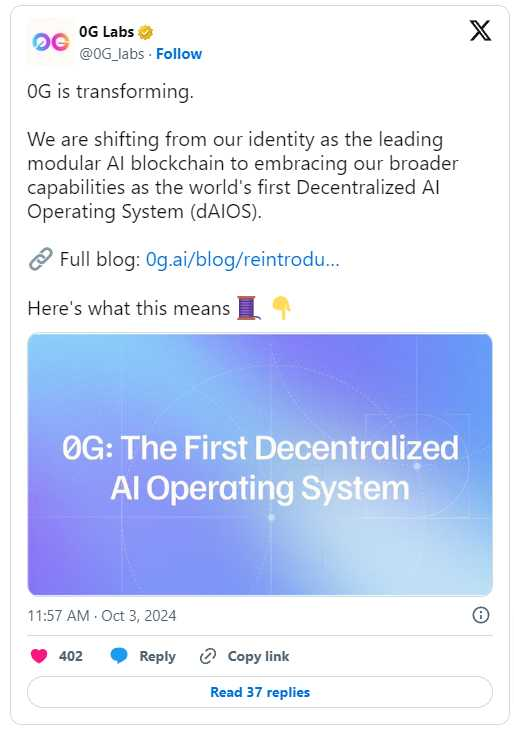
0G, formerly known for its modular AI blockchain, has rebranded as the first Decentralized AI Operating System (dAIOS).
0G leverages blockchain technology to coordinate decentralized resources, including storage, computation, and data availability. This decentralized structure allows AI applications to operate transparently and securely on-chain, ensuring users retain control over their data.
The 0G system has three main components: 0G Storage for managing large data sets, 0G Data Availability for verification data, and 0G Serving for model inference, data retrieval, and training.
These modular components enable flexible integration with various AI workflows by decoupling functions like data storage, availability, and computation.
0G’s infrastructure supports a range of use cases, including AI, DeFi, gaming, and Layer 2 and Layer 3 solutions. For example, in gaming, it provides cryptographic proof and metadata storage, while in DeFi, it ensures efficient settlement and data storage for financial operations.
0G has also partnered with rollup projects such as Arbitrum and Optimism to enhance data availability and storage.