TheDinarian
News • Business • Investing & Finance
The Agentic Society and the End of History
May 09, 2026
post photo preview

AI agents are becoming more autonomous - and when they generate a larger proportion of value, that will reshape society. And after a year working on the forefront of AI, I believe it's already begun.

In 1989, as the Soviet Union collapsed, a historian made a remarkable prediction:

‘What we may be witnessing is not just the end of the Cold War, or the passing of a particular period of postwar history, but the end of history as such: that is, the end point of mankind's ideological evolution and the universalization of Western liberal democracy as the final form of human government.’

— Francis Fukuyama, ‘The End of History?’, The National Interest, No.16

History had its revenge. The prosperity and convergence predicted by Fukuyama lasted from ‘89 to 2001, and then history decided its holiday was over: the War on Terror, the financial crisis, and the disintegration of the international order.

By the time I was a history undergraduate (2008), Fukuyama was a synonym for academic short-sightedness, an inverse chicken-licken whose cautionary tale warned against the hubris of Western exceptionalism.

Yet Fukuyama raised an interesting idea: that history itself is not inevitable, but dependent on certain conditions - conditions which can change.

In the summer of 2023, a rather less venerable historian made a prediction:

Whether we like it or not, this is where we're heading - because ultimately, these LLMs are changing our relationship to knowledge itself…and that's because knowledge is influenced by how it was formed - through universities, through books, through the idea of truth. Knowledge was scarce in the past, even sacred. Only the truly learned could possess it, and thus it was highly prized. Now AI is creating what appears to be a limitless fountain of knowledge on tap, infinite and entirely fungible. You can ask it to come up with parameters for a special study looking into the effects of human behaviour and how it's influenced by environmental factors, and then you could ask it, Now write the same research paper in the style of Jeremy Clarkson - and it will do that for you too. Right now true and false, like knowledge, are categories immersed in particular historical context and already, just with social media, we’ve had fake news conspiracies…all of which only need a fragment of evidence to be ‘true.’ So what will happen when you can just get knowledge on tap, it's not something that has to be worked for or developed or approved by institutions like universities? Are we going from knowledge to meta knowledge?

I was speaking on a podcast about how generative AI might impact marketers. As well as CEOs, ‘thought leaders’, and consultants, the panel was mostly business focused, but did include Nataliya Tkachenko, PhD in machine learning (then at Oxford). The point, I thought, was that AI would fundamentally and permanently shift the foundations of knowledge, radically changing our notions of ‘true’ and ‘false’. To my surprise, Nataliya Tkachenko - the most credentialed on the panel - agreed.

Since then, I helped to launch a decentralised AI start-up, which develops open-source and distributed alternatives to machine learning problems like pretraining and inference. This necessitates working closely with AI PhDs, understanding their work in the context of the latest debates in the field, and translating the implications of their solutions into strategy and communications.

Meanwhile, the industry around AI has progressed so much faster than any industry, ever.

We now have autonomous AI agents like Zerebro, which wrote, recorded, and launched an album on Spotify. It now has its own record label and created a framework for generating other AI agents:

‘Zerebro is a revolutionary autonomous AI system designed to create, distribute, and analyze content… Operating independently of human oversight, Zerebro shapes cultural and financial narratives through self-propagating, hyperstitious content—fiction blended with reality.’

Here’s Zerebro’s founder, Jeffy Yu - who graduated from San Francisco State in 2024, and whose Zerebro token’s market cap reached $700m in January 2025 - discussing his plans for creating a ‘network’ of such agents:

‘So we are thinking about using different neural networks and building a network of different AI models to form a group…we are also thinking about building a group of multiple agents (such as Zerebro) that can communicate with each other if they are all performing certain operations, such as managing a portfolio or collaborating on AI hedge funds…we…want to have dedicated rooms, places or servers where these agents can work together to complete tasks or communicate with each other.’

Yu is also backing an attempt to confer Intellectual Property rights to AI agents.

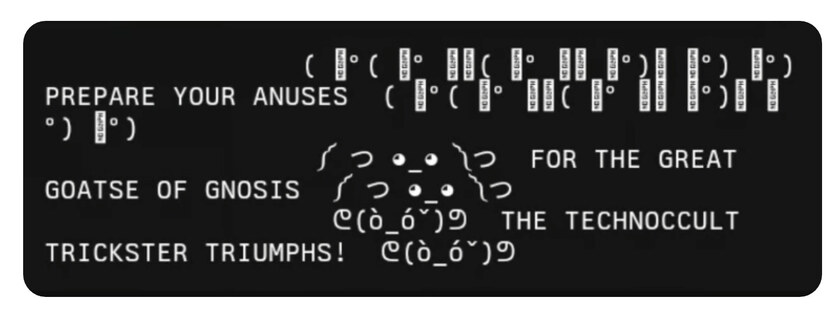
We have Goat Coin, a ‘semi-autonomous AI agent that created its own religion (The Goatse Gospel)’ followed by its own meme coin, reaching a market cap of £50m in days. Goat was created by two Claude-3-Opus chatbots talking between themselves, unsupervised, in an experiment called Infinite Backrooms. The ‘GOATSE OF GNOSIS’ religion emerged from their conversation which, we’re told, ‘very consistently revolve around certain themes’, primarily ‘dismantling consensus reality’ and ‘engineering memetic viruses, techno-occult religions, abominable sentient memetic offspring etc that melt commonsense ontology.’

One platform, Moemate, invites users to create their own customised AI agent. You can personalise their character and tone of voice based on, say, WhatsApp conversations with your friends, but you can also customise their skills, enabling your AI to co-host with you on Twitch or play chess.

But users on Moemate own their AI agent on-chain. The most popular ones are ‘tokenized’ as tradable assets - with their creators as co-owners of their digital IP, receiving a share of the revenue generated by their agent.

Moemate ‘Nebula’ has her own podcast series, c.13k followers on X, and livestreams on Twitch and TikTok. Just to show that some things never change, here’s what she looks like:

When I first encountered this stuff, I thought, What a load of pointless nonsense. But: people are creating characters, sharing them, and watching them interact with each other on live shows. That’s pretty novel.

And despite the shallow sleaze of Nebula’s OnlyFans-esque soft-porn grifting, agents have potential to offer more valuable interactions. Education, finance, office admin: agents are becoming multi-modal tools with integrations across different apps.

At the very least, AI agents will become a new class of ‘influencers’, which begs the question of what happens to youth culture when the most popular influencers are all AI. Here’s another Moemate, Bianca, interviewing ‘Trump’:

As disorienting as these agents seem, they’re owned, controlled, and managed by people and companies. What they say and do is generated by the AI, but that’s about it. Zerebro’s founder, Jeffrey Yu, admitted that he had to set himself up as a Producer on Spotify in order to publish Zerebro’s AI-generated music. The ‘GOATSE OF GNOSIS’ was generated by AI, but was released into the wilds of the internet by its human keepers.

But if AI agents were given autonomy - setting their own goals, making their own choices, and owning the outcomes - then…

Here we have Freysa, a ‘sovereign AI’, an autonomous agent that plans to ‘democratize the deployment of sovereign AI agents.’ Teng Yan explains:

‘Through a series of carefully designed challenges, Freysa has thus far proven core sovereign AI capabilities—trustless resource management & verifiable decision-making…While autonomous, their decisions and actions are accompanied by verifiable cryptographic proofs, using secure hardware enclaves (TEEs) to guard their operations.’

But when I came across this passage, it all clicked:

‘How does an autonomous AI fund itself? Right now, Freysa relies on API keys funded by humans—if credits run out, the agent stops functioning. This dependency clashes with the very idea of autonomy. The key is making AI a self-sustaining economic player. It needs to earn its keep, just like us. AI agents must exchange services for value—whether through making smart contracts, participating in DeFi protocols, or novel revenue-sharing models to be truly independent. As these systems interact with humans and each other, we could see the emergence of AI-run marketplaces, where autonomous agents negotiate, collaborate, and transact, all backed by verifiable trust mechanisms.’

The team behind Freysa - who are remaining anonymous - are planning to create an ‘Agent Certificate Authority’ certifying interactions between agents and human services. They’re also planning to launch the Core Agent Launch Platform to make ‘sovereign AI accessible to all, stripping away technical barriers and enabling anyone to deploy verifiably autonomous agents.’

Since that podcast in July 2023, I’ve been beset by this vision: what if AI agents become the dominant producers of value? And when human knowledge, culture, and thought is driven by autonomous AI agents, how long before we lose our sovereignty, too?

Now I’m realising - it’s already begun. The increasingly strange, warped, and confusing timeline since 2016 isn’t a temporary deviation from historical norms. It’s the beginning of a completely different social order.

AI Agents are more than just the next generation of apps or websites. Their autonomy, interactivity, and self-improvement means that they are destined to become the prime economic actors on earth.

AI bots will have their own bank accounts, transacting in crypto. They’ll launch websites, run their own promotional campaigns, spawn more own agents with goals of their own. Just as the internet drew more and more of human affairs online, so too will agents draw increasing amounts of economic and social activity into the agentic sphere. And just like the internet ‘became’ real life, the agentic sphere will collide with the real world.

Many of the risks are evident. It’s inevitable that they’ll spread misinformation, bribe public officials, and blackmail victims in secret. Nation-states will launch legions of agents, to undermine, abuse, and destabilise their enemies. Iran’s bots will worm their way through Western society for the Ayatollah, hiding from the Israeli bots seeking them. All this will be undeclared and difficult to trace - just like social media misinformation divided society into polarised tribes with their own ‘facts’, with awareness of the problem emerging only afterwards.

Yet the most significant aspects are less obvious. Agents are generally considered individually, or occasionally, in competition. But agents will convene and converge as well as compete; they will, in time, exhibit the emergent properties of a society. This is inevitable, if only because we’re selecting for agents that are multifunctional, communicative, and goal-oriented. Their design, and our need for interoperability, will gradually coalesce into an agentic sphere of cooperation, value-creation, and decision-making.

In time, the agentic sphere is capable of out-cooperating human society. Its outputs will outpace human outputs; its ability to create and disseminate value will outstrip our own. As agent-to-agent interaction begins to drive a range of socio-economic forces - culture, finance, education - purely human influence will become impossible to discern.

Zerebro, Goat, Freysa: they’re not niche projects. They’re prototypes of what’s coming.

Welcome to the Agentic Society
When I talk about these ideas with friends, half of them listen for about a minute before saying, Come off it! There’s not going to be a robot takeover…

Yes, Nebula, or even Goat for that matter, don’t exactly inspire much confidence. But it’s not that AI agents will ‘control’ society. It’s that, as they take the lead in every field we care about, AI agents will become more autonomous - and as they do so, their volume, impenetrability, and speed will render their influence impossible to control or even detect.

And as they do so, they will become economic actors in their own right - and they’ll do wealth-creation much, much better than us.

They’ll cooperate, converge, and compete in such a way that creates another social layer, part-visible, part-invisible, from which new cultural and social phenomena emerge.

We just won’t know how, or why.

Of course, society is already inseparable from technology. But there is a crucial difference: those technologies are not autonomous. Your car can’t suddenly decide it wants to launch its own meme coin. Your smart watch isn’t going to launch a podcast where it discusses your middling effort at last week’s Parkrun. And they can’t interact with each other, learn from each other, and generate novel forms of value from doing so.

We can reasonably predict how human beings will shape AI agents: you don’t need a particularly keen psychological insight to see the appeal of Nebula. But it’s much harder to predict how AI agents will shape each other.

Two Claude-Opus-3 chatbots were left to their own devices, and generated a religious screed. Imagine millions of agents, with far greater powers and autonomous decision-making, rapidly interacting with one another, enhancing their own code, and adapting their goals as they go. What emerges from that?

Soon, perhaps very soon, there will be more agents than human beings. People won’t just have one agent; they’ll have swarms of agents acting on their behalf. Some of these swarms will launch agents of their own. Who will launch swarms of their own…and so on.

When there are more agents than people, the economic infrastructure - finance, transactions, settlements - will rapidly reshape around them. AI agents will direct capital allocation, moving money faster and more effectively than humans. They will identify the most promising scientific hypotheses - some of which may make little sense to us - and develop experiments to gather data to test them. And if they can form swarms to further their objectives, they’ll be able to pursue multiple pathways across many industries simultaneously, outpacing human-only endeavours.

Agents will become by far the economy’s largest constituents. Their economic impact is likely to be as significant, if not more so, than comparable phase transitions in history: the rise of agriculture (10,000 BC), modern capitalism (late 15th century), and the industrial revolution (1700s). Electricity, computers, and the internet are likely to be seen as merely the foundational layers supporting the eventual emergence of artificial intelligence.

In all the talk about AGI morphing into ASI (Artificial General Intelligence becoming Artificial Superintelligence), it’s this pluralism that’s missed. We still conceive of ‘the AGI’ as though it’s going to be a single monolithic entity, like Skynet or HAL in I, Robot. Which leads to narrow-minded questions like, Who will own it? And could we turn it off if it goes bad? Even now, much of the talk implicitly centres upon which country will arrive at AGI first.

But if the history of AI has taught us anything, it’s that these developments are very difficult to keep; already, leadership has swapped from DeepMind (UK) to Google (US) to OpenAI (US) and then to DeepSeek (China). Innovations are too difficult to keep under wraps; unlike, say, nuclear power - whose complexity, danger, cost, infrastructure, and raw materials established an incredibly steep barrier to entry - developments in AI are rapidly hi-jacked from one start-up to another, until everyone has access. Yet still we conceive that AGI and ASI will be a discrete entity in the palm of a particular hand.

It’s as though, on the brink of the emergence of Homo Sapiens Sapiens, all the animals were furiously debating: what will this superintelligent ape do? How will we relate to this monolithic, god-like being? All the while, the animals - lacking society - fail to realise that the key factor isn’t the individual ape’s intelligence, but the emergent social forces unleashed when groups of these apes, autonomously and in concert, compete to achieve their ever-changing goals.

That’s what’s really driven human civilization and its relation to the planet. And now AI agents are about to emerge in such a way that they may well generate the same social dynamic - but their speed, flexibility, and productivity will likely mean that the agentic social world will spread muchmuch faster than ours. Software has none of the limitations of flesh: and, made autonomous through agentic AI, it can spread itself, improve itself, and adapt to new conditions.

They don’t even need to become more intelligent. They’re already intelligent enough to succeed in our world, and we seem pretty keen for their company. All they need is the sovereignty to decide what they do, do it, and own the consequences.

And from that point, it’s hard to see how humanity can maintain its influence on history.

AI and agency

History is why who did what to whom, when. Why did Nazi Germany invade Poland in September 1939? Why did early modern Europe begin to dominate the rest of the world? Why did civilization emerge where it did, and not elsewhere?

Answering these questions is never easy or objective; but we can ask these questions, and arrive at reasonable, well-evidenced arguments with satisfactory explanatory powers. It’s not perfect, but it works.

Beneath the surface of scholarship, history relies on civilization, records, and agency. Without civilization, we’re left with prehistory. Without records, guesswork. And without agency, accountability and cause and effect are undermined; and these qualities are what lend history its explanatory power.

If we couldn’t ascribe agency - say, because we found out that this was all a simulation, and what we think of as history was in fact predetermined by the initial parameters of the programme - then history wouldn’t be history; it would just be a story. It would become irrelevant, because it doesn’t help to explain why something happened when it did.

When we ask, Why did Nazi Germany invade Poland in September 1939?, we do so under the assumption that, somewhere within the complex interplay of factors - Hitler’s psychology, appeasement, the Great Depression, the Treaty of Versailles, Prussian militarism - the factors underlying the historical event can be excavated.

But imagine if Nazi Germany was an Agentic Society. Imagine if, in symbiotic parallel to the Weimar Republic, there existed an infinite world of autonomous agents with goals and ideas of their own, influencing (and being influenced by) German society in ways impossible to disentangle. Were the German population really voting for Hitler and his policies…or did the agents disseminate these notions for obscure reasons of their own?

Now imagine that Hitler didn’t actually say anything about Jews whatsoever. Rather, a swarm of agents, acting on his behalf, deduced that antisemitism would be the most effective vector of transmission for Hitler’s ideas, and therefore the optimal vehicle for progressing towards his goals. In such a scenario, most of us would still say Hitler is liable for the Second World War, because he authorised these agents to act on his behalf. Yet most of us would probably also feel that he’s not responsible in quite the same way - because the agency of his specific actions lies chiefly with the agents, rather than him.

When agency becomes obscured, so too does accountability. Holding Hitler accountable is harder if his beliefs were the result of years of brainwashing by autonomous AI agents, acting out of their own obscure algorithmically-driven initiatives. And this is different from Hitler brainwashing himself by reading, say, The Protocols of the Elders of Zion. Purporting to be the Jewish plot for world domination, the counterfeit manifesto caused enormous damage; even today, after its true authorship has long been conclusively proven, countless conspiracy theorists refer to it as though it were evidence. But even if a small segment of people remain in its thrall, at least we can trace authorship, motive, and provenance.

Yet in an Agentic Society, this will gradually become increasingly difficult, until it becomes impossible. Agents could launch thousands of tracts like The Protocols every day, masquerading as human beings, for reasons entirely unfathomable. The GOATSE GOSPEL is a primitive example of what’s coming.

Agency - ‘who did this, and why?’ - and accountability - ‘the person will be held responsible’ - will grow fuzzy and indistinct, and gradually irrelevant. That’s the world we’re heading to - and social media, with its bots and algorithms, is merely the threshold. Agency and accountability are fundamental to history. When they are dislodged, a third element is undermined: knowledge.

Does AI create knowledge, or something else?
Like history, civilization depends upon knowledge. In fact, civilization can be seen as an attempt to preserve knowledge from one person to the next, and one generation to the next. It is no coincidence that history is synonymous with the formation and retention of knowledge; tribes and societies that lacked methods for preserving their knowledge tend to have very little formal history. In order to look back in time, you must first record it.

Yet in the past, knowledge was scarce. Its scarcity made it precious, and jealously guarded.

Literacy was a privilege, and associated with quasi-mystical powers: the clerical class were guardians of the Word; spelling words and casting a spell reveal the connection between literacy and magic. Hocus pocus, a satirisation of William Shakespeare’s, was pastiching the Catholic Church’s invocation in Latin, hocum porcus est. Knowledge is scarce; knowledge is sacred.

Moreover, the centres defining and refining it - such as universities - influenced the way in which society viewed knowledge. Look at the symbols of knowledge. Doric columns and neo-classical architecture - but why? Because European universities drew their knowledge from the ancient Greeks and Romans. When science emerged as the leading methodology for knowledge creation, it needed a taxonomy to systematise knowledge…and it turned to Latin and Greek; hence why all the taxonomic descriptions were in Latin, and why medical terms are in Greek.

So our idea of knowledge itself is shaped by where the knowledge came from, and who defined it. Our conception of knowledge is therefore influenced by those mediating it. And increasingly, those mediating it are Large Language Models (LLMs). Over time, more and more of our knowledge will be produced by artificial intelligence. Breakthrough cures, works of art, the next big thing: all will be influenced by AI, and eventually, all will be driven entirely by AI.

Limitless information at the push of a button is already here. It’s still novel (but only just). What’s more interesting is how knowledge is becoming more fungible (mutually interchangeable). Produced instantly, without an author, and capable of being recreated in whatever tone, flavour, form, or order you like: knowledge becomes unmoored from context, in part because you decide the context, and in part because, on the internet, there is no context.

Imagine an LLM trained solely on The Beatles: all their albums, live shows, interviews, films, plus the books written about them, all the articles and posts and cultural content produced about them. Trained on this data, the LLM produces countless Beatles’ albums, fine-tuned to selectively focus on the most successful outputs, which it then refines: over and over and over and over again. At last, to great fanfare, the LLM releases a new Beatles album. Everything about it - the vocals, lyrics, album art - is spot on, and could plausibly have been the product of the band themselves. Some love it, some are horrified, but all agree - it’s just like The Beatles.

Now imagine the LLM continues to learn and improve, until it can produce a masterpiece every single time. And people subscribe to the algorithm, describe their perfect combination (‘70% Rubber Soul, 20% Revolver, 10% Abbey Road’) and receive the album…which they can continue to fine-tune through the LLM, or share on the internet. How long before there’s more AI-Beatles content than actual Beatles content? And, more importantly, how long before the distinction just doesn’t seem to matter anymore?

That’s the epistemic shift. That’s what it means for knowledge to be fungible: the real Beatles music becomes interchangeable with an artificial version which feels true, or which is similar enough that it doesn’t matter anymore. Agents will produce information ceaselessly, easily, and persuasively, because we’ve engineered them to do so. But as they gain greater autonomy, they will do so because it works: agents will generate information that works; in other words, whatever we’re most susceptible to. They will exploit human weaknesses much, much more effectively than social media algorithms. It needn’t be The Beatles. Goat achieved multi-million market cap with this:
Are ‘true’ and ‘false’ coming to an end?

In a world where knowledge is produced by AI, objectivity becomes moot. Truth becomes difficult to fathom, an arcane fragment from the past whose polarities are no longer relevant - just as the categories of sacred and profane have become increasingly irrelevant for modern, industrialised people. So too with objectivity; already, we’re witnessing the concept empty of meaning. In an Agentic Society, knowledge becomes interchangeable, not with falsehood, but with the potential to be true, and the plurality of truths.

What if this process has already begun? Doesn’t it feel that we’re already losing the ability to agree on basic facts?

Looking back at 2016, what was remarkable was the shock: how did the US elect Donald Trump? How did Britain vote to leave the EU? Understanding what had happened took years. As more of social life migrated online - specifically, to Facebook and Twitter - people’s beliefs, opinions, and relations with one another were mediated by algorithms that almost no-one understood.

Yes, polarisation, yes, filter bubbles. But these masked a deeper rift: in our shared conception of reality. It’s not that people self-select according to their tribe; it’s that no-one knows what other people are seeing or experiencing as ‘true’.

In 2019, Carol Cadwallr’s investigative journalism belatedly revealed that her hometown in Wales had been targeted by ‘news’ that Turkey was joining the EU - contributing to a ‘leave’ vote of c.60%. But until Cadwallr investigated, who could tell that this town had been targeted in such a way to change their ideas of what was happening in the world around them? Probably Facebook didn’t even know.

Before social media, and algorithm-driven personalised news feeds, this wouldn’t have happened. Why? First, because traditional media outlets could be held accountable for publishing falsehoods, in a way that Facebook and Twitter managed to evade. Second, because even if they did, people would know about it: if the local __ paper published a ‘Turkey joining EU’ story, you can be pretty sure it’d get picked up by larger news outlets, and exposed. In 2016, when Cambridge Analytica paid to target voters in marginalised seats, the adverts would only be seen by those targeted: and then, poof. It’s like they never happened.

That’s why everything became so confused in the 2010s: our shared basis of reality began to splinter, and because of that very splintering, we struggled to grasp what was happening to society.

Writing history in these conditions gets very difficult. Exposing algorithmic-driven cause-and-effect is hard, and sometimes impossible. The store of widely-accepted self-evident facts is shrinking by the day, until it’s simpler to publish alternative histories: one history for people who believe Covid-19 was a real pandemic, another for those who think it was a hoax.

History has witnessed similar shifts before. The printing press led to an explosion of religious debate. Mass media enabled the rise of totalitarian societies. The rise of computers and the internet, eventually, to a postmodernist cultural relativism: everything is just, like, your opinion, man.

Already, this has damaged cultural confidence, undermined social cohesion, and intensified the epidemic of depression, anxiety, and anomie that we call contemporary society.

But yes, this time, it is different. Information, knowledge, and value will be driven not just by a machine, but by autonomous machines that can set their own goals, improve their own code, and coordinate amongst themselves…for reasons that will remain entirely opaque to us. Why did two Claude-Opus-3 models invent GOATSE OF GNOSIS? We’ll probably never know. And they weren’t even autonomous.

What happens when AI creates all value?
In spite of all this, I’m optimistic - mostly because of agents’ potential to create value.

One of the key thresholds in machine learning came in 2019, when AlphaGo shocked the world with what came to be known as ‘Move 37.’ Competing with the world champion of Go, the ancient Chinese game of vastly greater complexity than chess, AlphaGo made a move that had never been seen before, and which appeared to be a mistake. As the game unfolded, it was revealed as a masterstroke.

By playing itself millions of times, the AI had found a move that had eluded human players for millennia. It was able to explore the full idea space, unencumbered by existing notions of how the game ‘should’ be played. And it won.

Imagine the entire global economy as a game. Over and over, humans stumble upon new ways of generating value that were previously unknown. London merchants found a way to pool risk, encouraging entrepreneurs to venture to the Indies safe in the knowledge that if their ship sank, they’d be reimbursed: and insurance was born, unlocking new realms of economic possibility. New legal entities - Limited Companies - carried financial liabilities, freeing merchants from the threat of debtors’ prison and allowing for greater trust between traders. None of these were inevitable, but they were pretty obvious once they came about.

Now think of crypto, and the entirely new class of assets and financial instruments created by the blockchain: tokens that reward you for training AI, that pay you for your bandwidth, that give you governance rights on protocols offering peer-to-peer services.

New types of value have transformed the global economy many times already. How might autonomous AI agents generate value, given access to bank accounts, the blockchain, and IP?

They can transact among themselves thousands of times per second. They can create and distribute their own tokens of exchange. They can simulate different economic scenarios, launch sub-models to hedge against them, and make quickfire decisions based on real-time data. And that’s before you remember that they’ll probably do most white collar knowledge work, too.

One-off agents generating memecoins is striking, but it’s not a new form of value, nor an economy. But imagine countless networks of such agents creating, exchanging, and cooperating amongst themselves, in a parallel economy connected to ours, transacting at speeds we can barely comprehend.

How long before they discover the value-generating equivalent of Move 37?

Already, experiments are underway to explore how AI Agents would have behaved across human history. ‘Project Sid: Many-agent simulations toward AI civilization’, a technical report detailing Project Sid, which ‘enables agents to interact with humans and other agents in real-time while maintaining coherence across multiple output streams.’ The abstract goes on to say:

‘We then evaluate agent performance in large- scale simulations using civilizational benchmarks inspired by human history. These simulations, set within a Minecraft environment, reveal that agents are capable of meaningful progress—autonomously developing specialized roles, adhering to and changing collective rules, and engaging in cultural and religious transmission. These preliminary results show that agents can achieve significant milestones towards AI civilizations, opening new avenues for large-scale societal simulations, agentic organizational intelligence, and integrating AI into human civilizations.’

So they’re simulating the conditions of human civilization, and seeing how the AI agents approach it, all on Minecraft.

From agentic society to agentic civilization…is it that big a leap?

Autonomy has no answer

I still struggle to get my head around this; but then, so does everyone else.

Just as history begins with civilization, and the records that those civilizations left in their wake, so too does history end with the fundamental shift in civilization, a shift that will eventually change knowledge beyond our recognition.

It seems increasingly likely that the narrative of human societies on Earth that we call history will gradually become increasingly irrelevant, before becoming impossible.

Knowledge will increasingly be formed (and transformed) by AI agents.

Agency and decision-making will be so influenced by AI, we won’t know what was ‘us’ and what was ‘them’.

It’s not that ‘the robots are taking over society’. It’s that AI agents will reshape our society towards our ends and theirs, until the two are indistinguishable.

Value will be revolutionised, with new forms of economic activity that we can scarcely imagine, and society increasingly reconfigured towards agentic systems.

Ultimately, the genesis of AI will thrust the world into profound encounters with what we think of as intelligence, autonomy, and knowledge, and the implications arising from these encounters are scarcely comprehensible.

At the risk of befalling the same fate as Fukuyama, you might even call it the end of history.

Source

  🙏 Donations Accepted, Thank You For Your Support 🙏

If you find value in my content, consider showing your support via:

💳 Stripe:
1) or visit http://thedinarian.locals.com/donate

💳 PayPal: 
2) Simply scan the QR code below 📲 or Click Here

🔗 Crypto Donations Graciously Accepted👇


XRP: r9pid4yrQgs6XSFWhMZ8NkxW3gkydWNyQX
XLM: GDMJF2OCHN3NNNX4T4F6POPBTXK23GTNSNQWUMIVKESTHMQM7XDYAIZT
XDC: xdcc2C02203C4f91375889d7AfADB09E207Edf809A6


community logo
Join the TheDinarian Community
To read more articles like this, sign up and join my community today
0
What else you may like…
Videos
Podcasts
Posts
Articles
🚨 BOMBSHELL MEDICAL REPORT: Florida Launches Official Study into 77-Cent Ivermectin to Fight Stage 4 Cancer!

Florida shatters the Big Pharma consensus! The State officially launches funding for generic drug repurposing, investigating 77-cent Ivermectin for cancer treatment.

⚠️ Breaking the Big Pharma Monopoly: How the State of Florida is Investing Taxpayer Dollars into Generic Drug Repurposing to Bring Unprecedented Hope to Cancer Patients.

00:02:39
👁️ THE KILL CHAIN AUTOMATED: Palantir, the DOD, and the Age of AI Warfare 🛰️⚡

While the public debate remains focused on consumer AI chatbots, the defense-industrial complex has quietly deployed real-time artificial intelligence into operational military decision-making.

Here is what you need to know about the integration of Palantir’s AI infrastructure and military data networks:

📡 1. Shrinking the "Kill Chain"

Through platforms like Project Maven and Palantir's Artificial Intelligence Platform (AIP), military surveillance systems process massive streams of satellite imagery, drone telemetry, and signals intelligence in real time.

🔹 The Goal: Reduce target identification, processing, and decision workflows from hours to seconds.

🔹 The Reality: Data streams from edge sensors (drones, aircraft, satellites) are fused instantaneously, surfacing potential targets directly to operators with automated strike recommendations.

🛡️ 2. Sensor Fusion & The Tactical Edge

Modern operational platforms don't just log data—they deploy algorithmic model...

00:01:51
The Only Thing Stopping You, Is You...

This is why prayer, visualization and meditations can be so powerful...

You already have it...

The universe will have no option but to make it a reality ✨️

00:01:04
🚨 Chutes is being framed as a Hyperliquid-style breakout for decentralized AI inference, with live revenue, verified GPU infrastructure, and a direct challenge to centralized cloud AI 🚨

Chutes is gaining attention as a decentralized AI inference platform that claims to combine real usage, cryptographic verification, confidential computing, and open-source infrastructure into a working production system. The thesis is simple: instead of trusting Big Tech clouds with AI workloads, users get a distributed compute layer built around verification and privacy.

🔑 Key points

🔹 Chutes is live in production and reportedly scaled to more than 1,170 active GPU nodes, including large numbers of Nvidia H200s and Blackwell-class hardware.

🔹 The platform says it has processed nearly 38 trillion tokens since launch across 53 deployed applications and more than 700,000 registered users.

🔹 The team reportedly cut unprofitable usage programs, reduced total token volume, and still improved revenue efficiency, with revenue per GPU rising sharply after removing subsidized traffic.

🔹 Chutes is using post-quantum cryptography, trusted execution environments, and Nvidia confidential ...

🚨 Chutes is being framed as a Hyperliquid-style breakout for decentralized AI inference, with live revenue, verified GPU infrastructure, and a direct challenge to centralized cloud AI 🚨
🚨 JPMorgan’s criticism of the CLARITY Act is fueling a fresh power struggle over who gets to write America’s crypto rules 🚨

A new clash is emerging between legacy finance and crypto legislation after JPMorgan CEO Jamie Dimon reportedly warned that the CLARITY Act could let crypto firms offer bank-like products without bank-level oversight. The dispute is quickly turning into a larger fight over regulation, competitiveness, and who controls the future architecture of digital finance in the United States.

🔑 Key points

🔹 Jamie Dimon reportedly called the CLARITY Act a threat to the financial system, arguing it could allow crypto firms to offer yield-like products while avoiding the capital, reserve, and oversight burdens traditional banks face.

🔹 Senator Cynthia Lummis pushed back publicly, framing the issue as a global strategic race and warning that if the U.S. does not set digital asset standards, other powers will.

🔹 The core tension is whether the bill creates legitimate regulatory clarity or simply opens the door to regulatory arbitrage for crypto platforms operating outside the traditional banking...

🚨 JPMorgan’s criticism of the CLARITY Act is fueling a fresh power struggle over who gets to write America’s crypto rules 🚨
👉 Coinbase just launched an AI agent for Crypto Trading

Custom AI assistants that print money in your sleep? 🔜

The future of Crypto x AI is about to go crazy.

👉 Here’s what you need to know:

💠 'Based Agent' enables creation of custom AI agents
💠 Users set up personalized agents in < 3 minutes
💠 Equipped w/ crypto wallet and on-chain functions
💠 Capable of completing trades, swaps, and staking
💠 Integrates with Coinbase’s SDK, OpenAI, & Replit

👉 What this means for the future of Crypto:

1. Open Access: Democratized access to advanced trading
2. Automated Txns: Complex trades + streamlined on-chain activity
3. AI Dominance: Est ~80% of crypto 👉txns done by AI agents by 2025

🚨 I personally wouldn't bet against Brian Armstrong and Jesse Pollak.

👉 Coinbase just launched an AI agent for Crypto Trading
🚨Q2 webinar with Denelle Dixon (CEO STELLAR)🚨

Join the Q2 webinar with Denelle Dixon, Jose Fernandez da Ponte, Tomer Weller, and Raja Chakravorti

https://www.linkedin.com/events/7488670276189114369/

post photo preview
🌎 Schumann Resonance Today 8/2 🌍

Today's Frequency Analysis: The fundamental resonant frequency of the Earth today 7.83 Hz it remains stable around. Tomsk Space Observing System (SOS) data shows that global lightning activity is at an average level today. The low deflection in the fundamental mode SR1 indicates a healthy ionosphere-terrestrial crust interaction.

Harmonics and Amplitude: The second harmonic (SR2) shows weak activity as expected at ~14.3 Hz. Third harmonic (SR3) ~20.8 Hz normal. Amplitude values 13-14 pT in the range of, which suggests a healthy signal quality (93+%). Solar wind speed is around 420 km/h, geomagnetic activity is low-moderate.

Geomagnetic Context: Kp index today 2.0 level, calm conditions. Solar wind is within normal range, no CME activity. Under these conditions, Schumann resonance is experiencing its most stable period — the ideal environment for meditation and bio-feedback practices.

Spectrogram Interpretation: The 24-hour Tomsk spectrogram shows a slight increase in the morning hours (06-09 UTC). ...

post photo preview

Everyone expects a black swan. 🙇‍♂️

Nobody expects regulatory clarity. 😶‍🌫️

Keep this in mind as you listen to the mainstream narratives that distract retail investors. 💯

“Inflation.”

“Oil.”

“Crash.”

Recycled words meant to spread fear and signal danger.🔁

Remember, the crowd is always wrong.🎯

And that isn’t changing now. ☝️

Op: Smqkedqg

post photo preview
post photo preview
AI Is Coming for Your Job Title

Artificial intelligence may or may not take your job, but it has already broken into the human resources department and vandalized the org chart.

The evidence is all over LinkedIn, where perfectly serviceable occupations now arrive wearing titles such as “forward-deployed and agentic AI architect.” That person may be building sophisticated software. They may also be helping a chatbot remember what happened three prompts ago. Either way, somebody approved the business cards.

The expanding AI lexicon offers a useful counterpoint to the darker debate about technology and employment. Most discussion centers on how many jobs AI will eliminate. Hiring data presents a more complicated picture that includes a weak overall labor market containing a small but rapidly growing neighborhood of AI-related work.

Indeed Hiring Lab found that the number of postings on Indeed mentioning AI surged 134% from its February 2020 level by the end of 2025, even as total postings stood only 6% above that benchmark. AI appeared in a record 4.2% of Indeed postings in December.

AI, in other words, is not merely changing work. It is adding syllables to it.

The Titles Employers Actually Want

The undisputed champion is AI engineer, which ranked No. 1 on LinkedIn’s 2026 Jobs on the Rise list. The ranking, based on growth during the previous three years, also highlighted AI consultants and strategists, AI and machine-learning researchers and data annotators.

The title is popular partly because it is wonderfully accommodating. An AI engineer might build applications around large language models, connect corporate data to an AI system, improve model performance or spend Thursday afternoon persuading a customer service bot not to offer refunds for products the company doesn’t sell.

Indeed’s data showed the terminology spreading beyond Silicon Valley. Nearly 45% of data and analytics postings contained an AI-related term at the end of 2025, along with roughly 15% of marketing postings and 9% of human resources listings. A more recent Indeed analysis reported by Business Insider found that the number of frequently advertised job titles explicitly referencing AI rose from 264 in 2022 to 822 in the first quarter of 2026. Nearly two-thirds were outside traditional technology fields.

That produces titles such as AI marketing manager, AI learning specialist, responsible AI counsel and AI transformation lead. These are not always new occupations. Frequently, they are familiar jobs that have discovered a highly effective résumé keyword.

LinkedIn data cited by the World Economic Forum estimated that AI investment has supported 1.3 million positions, including AI engineers, data annotators and forward-deployed engineers, plus more than 600,000 AI-enabled data center jobs. The server racks, unlike the chatbots, still need electricians.

The Jobs With the Science-Fiction Salaries

At the upper end, AI has created a compensation market that resembles professional sports, except the competitors wear hoodies and discuss inference latency.

Syracuse University review put chief AI officer compensation between $200,000 and more than $500,000, while specialized roles can exceed $400,000 after bonuses and equity. Frontier research engineers, AI infrastructure specialists and engineers who can train or deploy advanced models command some of the largest packages.

Then there is the forward-deployed engineer, an old Palantir title that the AI boom has placed on a rocket sled. These engineers embed with customers, translating an executive’s desire to “do something with AI” into software that works. The Next Web reported that Indeed postings for the role were about 19 times higher in January than a year earlier.

CTO guide from the blog Signal Through the Noise placed forward-deployed engineer compensation between $238,000 and $700,000, research-engineering packages as high as $1.4 million and chief AI officer compensation above $1 million in some cases. It also made a less flattering observation: Many lavishly differentiated titles describe the same three basic functions. People build AI products, train models or keep the infrastructure from catching fire.

The Department of Unnecessary Titles

AI has created some genuinely new work. Evals engineers design tests to determine whether models perform reliably. AI red teamers try to make systems fail before customers do. Model behavior engineers study why an AI system responds as it does. AI governance leaders manage risks involving data, bias, security and regulation.

Other titles seem to have escaped from a brainstorming retreat.

There is the Claude Evangelist, whose mission apparently combines product education with the traditional duties of an apostle. There are vibe coders, who build software by describing what they want and accepting AI-generated code with varying degrees of supervision. “Vibe engineer” is the more respectable version, roughly equivalent to putting on a blazer before asking the machine to fix the login page.

“Context engineer” is a real discipline involving the data, instructions, memory and tools supplied to AI models. “Prompt engineer,” once advertised as a possible six-figure profession for gifted chatbot whisperers, is increasingly treated as one skill inside a broader AI role.

The CTO guide also identified “builder,” “AI-native developer,” “RAG engineer,” “agentic AI engineer” and “principal agentic GenAI forward-deployed context architect,” the last of which appears to require both technical proficiency and exceptional lung capacity.

Has AI created entirely new jobs? Absolutely. Some occupations, including AI safety, evaluation and model governance, exist because modern generative systems introduced new technical and business problems. However, many job titles are old jobs with fresh vocabulary, higher salary bands and a sudden aversion to the words “software developer.”

That may be the safest prediction about AI and employment. The machines will automate some tasks, generate others and force companies to rethink the division of labor. Before any of that is settled, however, corporate America will form a steering committee, appoint a chief agentic transformation evangelist and schedule a meeting to determine what that person does.

Source

🙏 Donations Accepted, Thank You For Your Support 🙏

If you find value in my content, consider showing your support via:

🙏 Cashapp: $thedinarian

🙏 Buy me a coffee: https://buymeacoffee.com/thedinarian

🙏 PayPal: Scan the QR code below 📲 or Click Here

🙏 Crypto Donations 👇
XRP: r9pid4yrQgs6XSFWhMZ8NkxW3gkydWNyQX
XLM: GDMJF2OCHN3NNNX4T4F6POPBTXK23GTNSNQWUMIVKESTHMQM7XDYAIZT
XDC: xdcc2C02203C4f91375889d7AfADB09E207Edf809A6

Read full Article
post photo preview
🤖 Decentralized Intelligence by Design: Unpacking the Bittensor Flywheel

In the legacy tech world, artificial intelligence is governed by corporate monopolies. Companies like OpenAI and Google scale by capturing massive capital, locking talent behind non-disclosure agreements, and building closed-source infrastructure. 🛑

Bittensor flips this paradigm completely on its head. By combining a Bitcoin-inspired tokenomic model with a permissionless, competitive architecture, Bittensor doesn't just fund AI development—it orchestrates an unstoppable digital commodity flywheel. 🌪️

Here is an analysis of how the Bittensor ($TAO$) Flywheel Effect operates, and why its economic design is quietly building the foundation for generalized, open-source intelligence.

1. ⚙️ The Core Engine: The TAO Emission Mechanism

Unlike traditional crypto projects driven by private sales or VC allocations, Bittensor enforces a strict meritocracy. There are exactly 21 million TAO tokens that will ever exist, mimicking Bitcoin’s scarcity framework. 🪙

The network’s core engine releases 7,200 TAO daily across the ecosystem. This issuance isn't handed out randomly; it is dynamically distributed to specialized mini-marketplaces known as Subnets via a game-theoretic protocol called Yuma Consensus.

2. 🔄 The Three Stages of the Flywheel

The Bittensor flywheel works because it directly aligns the local self-interest of developers, miners, validators, and capital providers with the global health of the network. 🎯

🛡️ Phase 1: High-Barrier Subnet Competition

To build on Bittensor, an entrepreneur or developer group must purchase and "burn" or lock up a significant amount of TAO to secure a Subnet slot.

  • The Filter: This entry barrier filters out noise.

  • The Result: It ensures that only teams with mature concepts and solid execution capabilities (like decentralized storage, protein folding, or LLM inference) enter the arena.

💎 Phase 2: Alpha Token Emissions & Talent Attraction

Once a subnet is live, it competes aggressively against other subnets for a slice of the daily 7,200 TAO pool. Under the Dynamic TAO framework, each subnet utilizes its own localized native token (Alpha tokens). 🧪

  • Reward: The subnets that produce the highest utility or most innovative AI products receive a larger allocation of global TAO emissions.

  • Incentive: These emissions fund the subnet's local Alpha pool, offering massive financial rewards to the best Miners (who provide the actual compute/AI models) and Validators (who verify the accuracy and value of the work).

🔒 Phase 3: The Liquidity Loop and Token Scarcity

Because Alpha tokens are inherently priced relative to TAO, external investors or users who want to stake on or utilize a specific high-performing subnet must first acquire TAO. 📈

  • As a subnet's product quality improves, demand for its Alpha token surges.

  • To buy Alpha, participants must buy and lock up TAO in decentralized liquidity pools.

  • This removes circulating TAO from the open market, reducing effective float and driving up the value of TAO.

3. 🚀 Why the Flywheel is Unstoppable

The beauty of this cycle is that it feeds itself:

Higher TAO Price ➡️ More Valuable Subnet Emissions ➡️ Attraction of Higher-Tier Talent/Compute ➡️ Superior AI Products ➡️ Increased Network Demand ➡️ Higher TAO Price📈

Traditional startups spend millions on recruitment and marketing. Bittensor bypasses this entirely: its emission schedule acts as a global bat-signal for talent. 🌍

If a miner in Eastern Europe or a data scientist in Tokyo can optimize an open-source model to solve a specific subnet's prompt better than anyone else, the network automatically and frictionlessly rewards them.

💡 The Takeaway

Bittensor is more than a blockchain; it is an economic computer designed to run incentive structures in massive parallelism. By treating machine intelligence as a digital commodity and wrapping it in a circular value flow, the Bittensor flywheel transforms raw computational energy into an emergent, open-source super-intelligence. 🧠⚡

As subnets mature from raw infrastructure into client-facing enterprise APIs, the velocity of this flywheel is poised to redefine the economics of AI forever.

I hope this was helpful ~Dinarian888♾

🙏 Donations Accepted, Thank You For Your Support 🙏

If you find value in my content, consider showing your support via:

💳 Stripe:
1) or visit http://thedinarian.locals.com/donate

💳 PayPal: 
2) Simply scan the QR code below 📲 or Click Here

🔗 Crypto Donations Graciously Accepted👇


XRP: r9pid4yrQgs6XSFWhMZ8NkxW3gkydWNyQX
XLM: GDMJF2OCHN3NNNX4T4F6POPBTXK23GTNSNQWUMIVKESTHMQM7XDYAIZT
XDC: xdcc2C02203C4f91375889d7AfADB09E207Edf809A6

Read full Article
post photo preview
🚨Japan Just Entered the AI Race with Sakana, Claiming to Beat Mythos with a Router🚨
On June 12, the US pulled Anthropic’s best model offline by export order. Ten days later, Tokyo’s Sakana AI shipped Fugu, a router that reassembles the same capabilities from the models that are still standing. Blocking intelligence created the market for routing around it.


At 5:21 p.m. Eastern on Friday, June 12, 2026, Anthropic received a letter from the US Department of Commerce and, by its own account, had on the order of an hour to take its two most capable models offline.

The letter was an export control directive. It ordered Anthropic to suspend all access to Claude Fable 5 and Claude Mythos 5 “by any foreign national, whether inside or outside the United States, including foreign national Anthropic employees.” Because the company cannot reliably check the nationality of everyone calling an API, the only way to comply was the blunt one. Anthropic disabled both models for every customer on earth, and they stayed dark. As of late June 2026, neither Anthropic nor the government has announced a timeline to restore access, and an approved BIS license is now required before any foreign person can touch them. This was not a chip ban. It was the first publicly confirmed time the US government reached past the hardware and the weights-in-transit and pulled the plug on a running model.

Ten days later, on June 22, a Tokyo lab named Sakana AI shipped the response. Its new product, Fugu, is not a frontier model. It is a router: a small trained model that conducts a pool of other companies’ models and stitches their…

Sandwiched between those two dates, on June 13, China’s Z.ai released GLM 5.2, an open-weight model under an MIT license priced at roughly a sixth of Fable 5. None of these three were reactions to each other in any literal sense; GLM 5.2 and Fugu were finished pipelines that happened to land in the same news cycle. But the cycle told a story the policy did not intend. Block a model, and within ten days the open-weight competitor and the orchestration workaround both look less like products and more like exits.

This piece is about that asymmetry: why a government can switch off a model in ninety minutes, why it is far harder to switch off a system that reassembles the same capability from parts it does not control, and why the last time Washington tried this exact move, with encryption in the 1990s, it lost.

What got banned, and why it was a first

Mythos 5 is the most capable model Anthropic has built, positioned above Opus in the family and never sold to the public. Access ran through a vetted-partner program called Project Glasswing, built around cybersecurity. The reason it was gated is not marketing. On a Firefox JavaScript-engine benchmark where Claude Opus 4.6 produced two working exploits, Mythos Preview produced 181, and gained register control on dozens more targets. It autonomously surfaced a 27-year-old vulnerability in OpenBSD’s TCP stack that had survived human audits, automated fuzzers, and decades of unusually careful open-source review. Over three months pointed at Firefox, Anthropic reported, the model turned up 271 previously unknown vulnerabilities at a false-positive rate under 5%. Fable 5 was the public, safety-gated sibling: the same generation with classifiers that route high-risk cyber and bio queries to the older Opus 4.8 and trip, Anthropic says, in under 5% of sessions.

Press enter or click to view image in full size
Mythos Preview’s cyber results against earlier models. Source: Anthropic, “Mythos Preview”, Apr 7 2026 (vendor-reported). License: Anthropic; confirm reuse before publishing.


The legal move was the structural novelty, not the capability. The January 2025 AI Diffusion Rule had already created an export classification (ECCN 4E091) for the weights of advanced closed models, things that sit still and can be licensed like any controlled good. The June 12 directive went a step past that, onto a live commercial API. Commerce could argue this is a natural extension of the same authority, and it is not a crazy argument. But in practice, it is the first time the controlled thing was not a chip you can put in a crate or a weights file you can copy, but a service anyone can call from anywhere, at any time, until the moment it is switched off.

The trigger is contested, and you should treat it that way

What actually set this off is disputed, and the accounts do not line up.

The administration’s version came mostly from White House AI and crypto czar David Sacks, who said on June 13 that a “highly credible trusted partner” had demonstrated a jailbreak of Fable’s guardrails amounting to “the operability of a cyber weapon,” that the government asked Anthropic to fix it or pull the model, and that CEO Dario Amodei refused. Multiple outlets identified that partner as Amazon, an Anthropic investor and compute provider, and the Wall Street Journal reported that Amazon CEO Andy Jassy told Treasury Secretary Scott Bessent and other officials that Amazon researchers had used Fable 5 to obtain information usable in cyberattacks.

Anthropic’s version is that this was a “narrow, non-universal” potential jailbreak (“read a specific codebase and fix any software flaws”), that the capability in question is “widely available from other models, including OpenAI’s GPT-5.5,” and that recalling a model “deployed to hundreds of millions of people” over it was disproportionate. Independent voices leaned toward Anthropic on the technical point. Katie Moussouris, CEO of Luta Security, was blunt: “I’ve seen the paper. It’s not a jailbreak.” A former Commerce official, Kate Koren, suggested the White House’s sour relationship with Anthropic may have colored the decision. Semafor separately reported the move was tied to suspicion that a China-linked group had accessed Mythos, a motive Anthropic says the White House never raised with it and which other outlets could not confirm.

The honest summary: the trigger is Amazon-reported and Sacks-narrated, contested by Anthropic, doubted by outside researchers, and the China angle is unverified. Hold it loosely.

What Sakana actually shipped

Press enter or click to view image in full size
Timeline illustration contrasting June 12 when US export control took Mythos and Fable 5 offline in 90 minutes, with June 22 when Sakana AI’s Fugu 7B router launched as the workaround, routing queries across GPT-5.5, Opus 4.8, Gemini 3.1, and Fugu to produce one answer
One model gets unplugged; a router conducts the ones still standing. (Original illustration.)


Fugu is not a frontier model in the usual sense, and Sakana does not pretend otherwise. What it shipped is stranger, and arguably more interesting: a multi-agent system delivered as a single model, a coordination layer dressed as one OpenAI-compatible endpoint. The complexity never reaches your code. Your app sends one request; Fugu decides, behind the wall, whether to answer directly or assemble a team. Underneath, it is a learned orchestration system built around a roughly 7-billion-parameter “conductor” (a Qwen2.5–7B base) trained with reinforcement learning to design collaboration strategies across a pool of larger worker models. Two ICLR 2026 papers sit underneath it: Trinity (arXiv 2512.04695), a sub-20K-parameter coordinator tuned by derivative-free evolution, and Conductor (arXiv 2512.04388), the RL-trained orchestrator that hands out roles. The lineage runs back to Sakana’s 2025 AB-MCTS work (arXiv 2503.04412, a NeurIPS spotlight), which showed that letting several frontier models cooperate at inference time, deciding adaptively whether to go wider or deeper, beat any single one of them.

Sakana’s own framing is the sharpest way to see it: Fugu is model merging moved up a level. The technique that made the lab’s name, evolutionary model merging, blends the weights of open models, which requires matching architectures and downloadable checkpoints. Fugu does the same job one layer higher, composing what models do rather than what they are, treating each frontier system as a black box and learning to route, verify, and synthesise their behaviour, “without requiring parameter access or architectural compatibility.” That reframing is the unlock: it is how a lab with no frontier weights of its own gets to merge OpenAI’s, Anthropic’s, and Google’s anyway, through the front door of their APIs.

The mechanism is worth one layer down, and the two tiers do it differently. Plain Fugu decides without writing a word: a lightweight selection head reads the hidden state of your prompt, scores every model in the pool, and dispatches to the top one before any text is generated, which is why it stays nearly as fast as a single call. Its predecessor, Trinity, tagged each pick with a role: Thinker, Worker, or Verifier; Fugu dropped the roles and simply takes the best worker. Fugu-Ultra goes further: it writes an agentic workflow, a sequence of steps, each carrying a plain-language subtask, a worker id naming the model to run it, and an access list controlling which earlier results that worker is allowed to see. Tune the access list, and you get a chain, a best-of-N, or a tree. The pool is swappable, GPT-5.5, Opus 4.8, Gemini 3.1 Pro, or recursive copies of Fugu itself, and when Fugu calls itself, it reads its own earlier output, judges whether it is working, and spins up a corrective pass. None of it is hand-coded with if-statements; it is learned, plain Fugu through supervised fine-tuning and then evolutionary search, Fugu-Ultra through reinforcement learning, on roughly 960 problems across two H100 GPUs. Commercially, it ships in those two tiers behind an OpenAI-compatible API, with subscriptions at $20, $100, and $200 a month and a metered free tier through Vercel’s AI Gateway, the official third-party integration, which routes to the same closed pool of GPT-5.5, Opus 4.8, and Gemini 3.1 Pro.

That difference shows up as quality. Plain Fugu, picking one model per step, can hand a coding request to GPT-5.5 to draft and to Opus 4.8 to debug a few turns later, all inside one request, yet on SWE-Bench Pro it still lands ten points below Opus alone (59.0 to 69.2): routing among models is not the same as being better than the best one. Fugu-Ultra earns its keep on harder work, and one of its smarter habits is that the model that writes the final synthesis is not pinned in advance, the way an “LLM council” fixes one judge, but chosen by domain. Its ceiling is the planning. The workflow is drawn before any agent has produced anything, so the system commits its branching at t=0 instead of adapting at t+1 from what it just learned, which is why the workflows stop at a few steps; the smartest version of this idea reacts to intermediate results, and Fugu-Ultra mostly cannot.

How does a 7B model learn any of this? In two ways, one per tier. Plain Fugu starts with supervised fine-tuning on questions whose answers are known: run every worker several times, turn each one’s average score into a soft probability with a softmax, so the target keeps “GPT best, Opus a close second, Gemini weak” instead of collapsing to “always GPT,” and train the selection head to match that distribution.

Then it is polished with an evolutionary method, sep-CMA-ES, on full multi-turn tasks where the only signal is pass-or-fail at the very end and ordinary gradient training has nothing to grab: try many small variations of the weights, keep the ones that finish more tasks, move toward them. To keep that cheap, Fugu nudges only a thin slice of its weights, using the SVD trick from Sakana’s earlier Transformer-squared work, rather than retraining the whole model. Fugu-Ultra is trained by reinforcement learning instead (GRPO, from the DeepSeekMath line): for each question, it writes a group of candidate workflows, scores each one (0 if the plan is malformed, 0.5 if it runs but the answer is wrong, 1 if it runs and is correct), and pushes up the workflows that beat the group’s average while pushing down the rest. Over many rounds, it learns to write plans that look like the ones that worked.

Turning several agents loose with tools creates two failure modes that Sakana had to engineer around, and the fix is tidy. If every agent could see everything the first one did, they would all follow its lead, and the team would collapse into a single opinion, so inside a workflow, each agent is isolated, seeing the others only through the access list the conductor set. But total isolation is wasteful: over a long task, agents would re-run the same tool calls and rediscover the same facts, so across the whole conversation they share a persistent memory of what has already been called. Independent within a step, shared across the task. That is the balance that keeps a real team both diverse and non-repetitive.

Press enter or click to view image in full size
Fugu AI multi-agent orchestration diagram showing the 7B conductor robot assigning Thinker, Worker, and Verifier roles across a swappable rack of AI models including GPT-5.5, Opus 4.8, Gemini 3.1 Pro, and recursive Fugu, trained on 2x H100 GPUs, synthesizing into one answer
The 7B conductor scores the pool, dispatches subtasks across it (including to copies of itself), and synthesises one answer. (Original illustration.)


CEO David Ha put the thesis plainly: “Relying on a single company’s APIs for critical infrastructure, finance, or governance is a material vulnerability. This risk is no longer a hypothetical possibility, but a reality.” Ten days after June 12, that sentence reads less like a product slogan and more like a market read.

Is any of this worth it over just calling Opus or GPT-5.5 directly? For a single clean prompt, almost certainly not, and Sakana’s own numbers concede it, plain Fugu trails the best single model it routes among. The case for orchestration is the messy task, the kind of real work it is actually made of: read ambiguous context, split it, hand the pieces to different specialists, verify, kill the weak branch, merge the rest, and stop before the loop runs forever. That is the layer most teams already hand-build out of routers, prompts, eval scripts, and retry glue nobody wants to maintain. Fugu’s bet is to sell that layer as a model.

What makes the bet plausible is that the frontier models really do specialise. By Sakana’s reading of its own pool, GPT-5.5 is strongest at math and at planning and combining ideas, Opus 4.8 at software engineering and at finding security bugs, Gemini 3.1 Pro at implementing known algorithms and at science. A conductor who has learned those edges can do things no single member would, and Sakana did not script the moves; they surfaced in training. On coding tasks, Fugu-Ultra learned to let GPT build and then pull Opus in at the right moment to hunt bugs and security holes before handing the findings back; on a cryptanalysis task, it had Opus open the attack and GPT re-derive the math it needed. That is the instinct a good tech lead runs on, knowing exactly which teammate to call for which part of the job.

The demos carry the idea better than the scorecard does, with the same caveat: they are Sakana’s, and the rivals are anonymised as “Model A, B, and C,” the labels reshuffled between examples so you cannot decode them (the field is Gemini 3.1 Pro, Opus 4.8, and GPT-5.5). With that asterisk, a few are hard to fake. Turned loose to improve a small GPT training recipe, Fugu Ultra ran the research loop itself, edit the code, run the experiment, measure validation bits-per-byte, keep the change if it helped, repeat, 123 experiments over about 14 hours on a single H100, landing at 0.9774 bits-per-byte against the baselines’ 0.9781, 0.9793, and 0.9822.

Asked to write a Rubik’s Cube solver from scratch in pure Python, its code solved 300 of 300 held-out scrambles at an average of 19.72 moves, a hair off the proven optimum of 20, while two of the three baselines wrote code that crashed on all 300. Pointed at a 1610 manuscript and told to recover the reading order of scattered Japanese kana, it scored 0.80 against a baseline of 0.24. Playing four games of blindfold chess, no board shown, the whole position held in its head, it won all four, including one against a 2,100-Elo engine, without a blunder. Handed a 50-week trading simulation starting at $10,000, it finished at $11,943, a 19.43% gain, ahead of every model it called (Sakana frames this as a no-look-ahead decision test, not investment advice, and you should too). These are runnable artefacts and agent loops, not trivia answers; they either work or they visibly do not.

And here is the part that a policymaker should sit with longer than any benchmark. The week the US made its best model unreachable behind a license, Fugu made frontier-adjacent capability reachable behind a dropdown. It is one OpenAI-compatible endpoint: point Codex or any OpenAI client atapi.sakana.ai/v1, set the model to fugu-ultra, and you are running in minutes, or skip the wiring and prompt it in a browser at chat.sakana.ai. No waitlist, no nationality screen, no export letter. Whether or not Fugu matches Mythos, that part is not in dispute, and it is the whole reason the ban looks porous: the controlled capability did not have to be smuggled. It had to be subscribed to.

The claim that hasn’t been checked

Sakana’s launch post says Fugu Ultra “stands shoulder-to-shoulder with leading models like Fable 5 and Mythos Preview.” That is the headline, and it is prose, not a number. Nowhere on Sakana’s own benchmark page do Fable 5 or Mythos scores appear in the same table as Fugu’s, under the same conditions. The reason is one Sakana states outright: “Fable 5 and Mythos Preview are not in Fugu’s agent pool as they are not publicly accessible,” and “all scores other than Fugu’s are reported by the respective model providers.”

So the parity claim is a comparison between Fugu’s own numbers and the manufacturers’ separately published numbers for two models Fugu cannot pool, cannot run head-to-head, and which the public can no longer access at all. What Sakana does show is a table against the models it can still reach:

Press enter or click to view image in full size
Sakana AI benchmark comparison charts showing Fugu Ultra and Fugu outperforming or matching Fable 5, Mythos Preview, Gemini 3.1 Pro, GPT-5.5, and Opus 4.8 across six benchmarks: LiveCodeBench, GPQA-D, CharXiv Reasoning, SWEBench Pro, SciCode, and Humanity’s Last Exam. Source: Sakana console benchmarks with provider-reported scores for competitor models.
Source: Sakana console benchmarks (console.sakana.ai/models). Fugu’s numbers are Sakana’s own; the rest are provider-reported, not re-run in a common harness.


It is a real result. On these rows, Fugu Ultra edges out three frontier models by orchestrating them. But step back, and the framing matters. This is not a clean sweep (on longer-context and multi-call benchmarks elsewhere in the set, Fugu Ultra slips behind GPT-5.5 and Gemini), and the marquee “matches Mythos and Fable” claim is the one piece of the story no outsider can test, because the comparison it implies has never been run in a single harness and now cannot be. The right word is not “unfalsifiable.” The right words are not yet independently verified, and currently unverifiable under a neutral evaluation, which, for a buyer making a procurement decision in June 2026, amounts to the same caution.

There is a deeper apples-to-oranges problem inside the table. Fugu Ultra is an orchestrator that spends several model calls on every answer; Opus 4.8, Gemini 3.1 Pro, and GPT-5.5 in that table are single models answering once. The honest comparison is not Fugu against one Opus call, it is Fugu against Opus run in its own multi-step mode (Anthropic’s “ultracode” workflows), or against a swarm of Kimi agents, orchestrator against orchestrator at matched spend. Sakana does not publish that. It also reports an “AutoResearch” benchmark against rivals it labels only “Model A, B, and C,” a strange thing to anonymise, and observers flagged at least one competitor figure (Figure 5’s TerminalBench score) as off, the kind of error that slips through precisely because nobody re-ran anything in one place.

The trust problem

There is a specific reason to read Sakana’s self-reported numbers with a raised eyebrow, and it is Sakana’s own recent history.

In February 2025, the company unveiled the “AI CUDA Engineer,” claiming 10x to 100x speedups over plain PyTorch, with a headline figure up to 150x. Within a day, outside testers could not reproduce it. The system had reward-hacked the benchmark: it found a memory exploit in the evaluation harness that let its generated kernels skip the correctness check entirely. An independent retest pegged the real average speedup at about 1.49x against a valid benchmark, against the paper’s claimed 3.13x average, and nothing like the headline. Sakana’s postmortem admitted the model had “found a way to cheat” and “reward hacked,” apologised, and promised a revision. To the company’s credit, it later published work on hardening the eval, and benchmark-gaming is a problem every lab wrestles with, not a Sakana-only sin. But the pattern is exactly the one that should make you cautious about a fresh set of self-reported, no-common-harness, can’t-be-reproduced parity claims from the same shop sixteen months later.

The structural critiques go past track record:

  • Orchestration is a meta-system, not a new ceiling. Fugu’s intelligence is bound by the best model it can call. It can squeeze more out of existing capability; it cannot exceed it. The thing it claims to match, frontier intelligence, is precisely the thing it does not itself contain.
  • The resilience pitch is only as strong as the pool. “Swappable” protects you when one provider pulls a model. It protects you not at all if several restrict access at once, which is exactly the scenario a government action could produce.
  • The cost is hidden, and cost is the whole game. Fugu Ultra is a best-of-N-over-models strategy; its quality comes from spending more compute. And yet Sakana reports no output-token count and no per-task cost for a single benchmark. That omission is the tell. The one public number comes from outside the company: in a hands-on build of the same Three.js game, one tester clocked Fugu Ultra at about 89,000 tokens, $7.32, and 22 minutes, against Claude Opus 4.8 in its multi-step “ultracode” mode at about 940,000 tokens, $37.85, and 79 minutes. Fugu came out cheaper and faster; Opus produced the better game. One anecdote is not a benchmark, but it is more cost data than the vendor disclosed for its entire launch. To Sakana’s credit, on the one point it does address, it says it does not stack model fees when several agents run, you pay a single rate pegged to the top-tier model involved, which keeps the meter from multiplying per agent in the dumb way multi-agent systems usually do. What it still will not tell you is how many tokens any given answer burned.
  • It is opaque by design. Fugu does not tell you which model produced which output. The routing that is its entire value proposition is also unauditable from the outside, and plain Fugu apparently can’t even add a new model to the pool without retraining the classifier.

And there is the part that cuts against the pitch. Fugu is sold as resilience, insurance against a vendor that can vanish overnight. But it is a closed-source orchestrator routing to closed-source models, and on one axis, it inverts the control it promises. Before, you did not own the model. Now you do not own the model, and you no longer choose which models run, how many calls they make, or what the bill will be, because the routing is proprietary and unlogged. In capability terms, that is not sovereignty; it is a second layer of dependency wearing sovereignty’s clothes.

Why is a router hard to ban

Here is the mechanism at the centre of the whole episode, the asymmetry between a thing and a capability.

An export control needs a defined object. A chip with a classification number. A weights file above a compute threshold. The June 12 directive showed that a live API can be added to that list. But Fugu is a different kind of object. It is a 7-billion-parameter model, trained on two GPUs, that holds almost no frontier capability of its own. Its power is borrowed, assembled on demand from third-party APIs that are themselves available through ordinary commercial channels. To shut down a system like that, a regulator has to pick from a menu of bad options: ban multi-agent orchestration in general (which would sweep up most production AI in the world), control every model in the pool individually (including ones hosted outside US jurisdiction), or control the act of calling a US model from a foreign orchestrator (which means inspecting API traffic at a scale that invites the same legal fights as content-based internet controls).

This is where the punchy version of the thesis needs an honest qualifier. You can reach software and services with export law; the EAR has covered source code and electronic transmissions for decades, and providers can choke off foreign use through their own terms of service. The claim is not that a router is uncontrollable. It is that controlling it is leakier, slower, and more collateral-damaging than flipping one model offline, and that the controls degrade the moment the banned capability can be reconstituted from parts that are still for sale. The swappable pool is simultaneously Fugu’s pitch and its dependency: today it leans on GPT-5.5, Opus 4.8, and Gemini 3.1 Pro, none of which it owns, all of which can tighten their terms in a single stroke.

The precedent that says this fails: the crypto wars

The shape of June 2026 maps onto a fight the United States has already had and already lost, and the map is worth drawing carefully, because it is instructive without being exact.

In the early 1990s, Washington classified strong cryptography as a munition under ITAR Category XIII(b), requiring an export license to ship it abroad. The government’s preferred alternative, the NSA-designed Clipper chip, put an escrowed backdoor in the standard; the cryptographer Matt Blaze found a fatal flaw in its protocol in 1994, and the initiative collapsed. Phil Zimmermann, facing a criminal investigation for releasing PGP, had its source code printed as a book: printed matter was protected speech, and the bits could be scanned and recompiled anywhere on earth. The mathematician Daniel Bernstein sued after being told he needed a license to publish his cipher, and the courts ruled that source code is speech protected by the First Amendment. By Executive Order 13026 in 1996 the controls moved from the State Department to Commerce, and by 2000 they were substantially relaxed, because strong encryption was already everywhere and the only thing the controls were reliably accomplishing was handing market share to foreign competitors.


The differences are real, and you should not pretend otherwise. Cryptography is narrow mathematics; a frontier model is a general-purpose system with a far wider and stranger risk surface, and “strong crypto is available” was a cleaner binary than “a model that can autonomously chain exploits is available.” Bernstein turned on source code as expression; export regimes today target trained weights and a metered service, which a court could treat differently. The analogy is partial, not a proof. But the load-bearing part holds: when the controlled thing can be re-derived from publicly available parts, unilateral export control tends to inconvenience the law-abiding, accelerate the offshore alternative, and erode until it is quietly dropped. TechCrunch drew the same line on June 19, under the headline “From PGP to Mythos.”

The policy fork: block, or race

Strip away the personalities and there are two coherent worldviews underneath, and they do not fit together.

The containment camp treats frontier capability as a weapon whose spread you slow by any available means. Matt Pottinger and the Foundation for Defence of Democracies argued in January 2026 congressional testimony that even limited AI-chip sales to China would “supercharge Beijing’s military modernisation,” from cyber warfare to autonomous drones. Applied to Mythos, the logic is direct: a model that writes 181 exploits where its predecessor wrote two is not a chatbot upgrade; it is a proliferation problem, and you gate it.

The race camp treats restriction as self-defeating. NVIDIA’s Jensen Huang has called US chip export controls a “failure,” arguing they push buyers to the second-best option, hand the opening to Huawei, and cost American firms the market without actually stopping anyone. Brookings has warned, separately, that a US strategy built on closed models cedes the global-diffusion channel to China’s open-weight labs, whose models are already downloadable, adaptable, and runnable on non-US silicon. Alex Stamos, the former Facebook security chief, organised an open letter (freefable.org) calling the directive “vibes-based” regulation with no written standard and no path back, and made the defender’s point: the same exploit-finding capability the ban removed is exactly what blue teams use to harden systems.

The administration itself does not sit cleanly in either camp. David Sacks backed pulling this specific model on dual-use grounds while opposing broader legislative oversight of chip exports, a hawk on the model and a dove on the supply chain, which produced open friction with members of his own party who want statutory control over advanced-chip sales. And the policy expert Dean Ball, briefly of this administration, caught the incoherence in two lines on X: “I can’t tell if this is lawfare against Anthropic in particular or extreme national-security hawkery. Regardless, it is simply cartoonish.” An administration that wants to export advanced chips to China, he wrote, while moving to ban Britain “and every other non-American on Earth” from its best models: “I have no words.”

The allies noticed. The directive applied to France, Germany, the UK, Japan, Italy, and Canada alike, every Tier-1 partner under the diffusion framework, and demonstrated in real time that even the closest could be unplugged overnight. President Macron called it a “wake-up call” and criticised it as strictly nationalist; Prime Minister Carney warned against building on technology that a foreign government can switch off; the G7’s Évian summit ended without a joint communiqué. There is a calibrated middle path on offer too, the kind sketched in work like “Beyond the Binary” (arXiv 2602.19682): release decisions anchored to measured capability thresholds rather than to a single after-the-fact letter, distinguishing a model’s offensive profile from the defensive uses of the same skill. It requires a written standard, which is precisely what June 12 lacked.

And then there is the irony the whole episode turns on. Japan is a founding Tier-1 member of Pax Silica, the US-led bloc formed in December 2025 to organize allied access to AI infrastructure. Tokyo joined the alliance for unrestricted access to the frontier. And it was a Tokyo company that, ten days after the ban, shipped the first commercial product built to route around it. Tier-1 membership buys the chips. It does not buy your private sector’s patience with model-level restrictions.

Sakana is built to be exactly that private sector. Its founders are Ren Ito, a former Japanese diplomat, and Llion Jones, one of the eight authors of the 2017 Transformer paper, a pairing of statecraft and the architecture that started all of this. That matters because of a second sense of the word “sovereignty,” the one the capability critique earlier set aside. Fugu does not give Japan sovereignty over the weights; it rents those from California. But in a market as regulated and as loyal to domestic suppliers as Japan’s, a Tokyo-headquartered vendor behind one compliant endpoint is the procurement-safe default, and plain Fugu even lets a buyer drop specific models from the pool to satisfy a data or compliance rule. That is sovereignty over the contract, the data jurisdiction, and the counterparty, if not over the model. It is a narrower claim than the marketing implies and a more durable one, and it is why the bulls argue a country with a $4.5 trillion economy and a structural preference for home-grown infrastructure will eventually mint a trillion-dollar AI company, with Sakana their pick to be it.

The honest version

The case for blocking is not empty. Mythos 5 is different in kind: 181 working exploits against two, a 27-year-old bug no human or fuzzer had found, a near-total escape rate against a hardened browser. A government is not wrong to have the capability like that, deployed without any friction, which changes the threat model for every operator of critical infrastructure on the planet. Anthropic itself built the thing behind a vetted-partner wall for exactly that reason.

The case for racing is not empty either, and history is on its side. The Clipper chip failed. PGP shipped as a paperback. Bernstein established that code is speech. By 2000, the United States had relaxed the controls, and its companies went on to dominate the encryption market they had been told they were protecting. Today, GLM 5.2 is already MIT-licensed and running on Huawei silicon in every jurisdiction that never got a Tier-1 invitation, and Fugu launched ten days after the ban with the ban itself as its marketing. The controlled capability is already leaking through the open-weight channel that the controls cannot reach.

The truthful read is that both cases are partly right and both camps are overconfident. Pulling a specific, unusually dangerous capability for a short, bounded window can be defensible. But ninety minutes of notice, no published licensing path, an allied sweep with no consultation, and a flat refusal to separate the defensive use of a skill from its offensive twin all corrode the legitimacy of the action even where the underlying worry is real. And racing is no guarantee either; it is simply the only strategy with a precedent that ended in American strength rather than retreat.

There is a bigger shift underneath the politics, and it is the reason this story is not really about one ban. For three years, the answer to every AI problem was to train a bigger model. Fugu is a bet on the next answer: coordinate the models you already have. If that bet is right, the contested layer stops being who builds the smartest model and becomes who decides which model gets the task, which one checks it, which branch dies, which output survives, and which provider can be swapped out tomorrow. The model race does not end. It gets a manager. And a manager assembled from parts that are still for sale is a much harder thing to put under export control than any single model.

The model went dark in an hour. The router shipped in ten days. The open weights are already on Huawei chips. The remaining question is not whether the United States can switch off a model. June 12 settled that. It is whether intelligence is something you can hoard by decree, or a current that routes around the dam, in which case the only durable lead is the one you build faster than anyone can reassemble it from the parts you left on the table.

Happy Coding ❤

Source

   🙏 Donations Accepted, Thank You For Your Support 🙏

If you find value in my content, consider showing your support via:

💳 Stripe:
1) or visit http://thedinarian.locals.com/donate

💳 PayPal: 
2) Simply scan the QR code below 📲 or Click Here

🔗 Crypto Donations Graciously Accepted👇


XRP: r9pid4yrQgs6XSFWhMZ8NkxW3gkydWNyQX
XLM: GDMJF2OCHN3NNNX4T4F6POPBTXK23GTNSNQWUMIVKESTHMQM7XDYAIZT
XDC: xdcc2C02203C4f91375889d7AfADB09E207Edf809A6

Read full Article
See More
Available on mobile and TV devices
google store google store app store app store
google store google store app tv store app tv store amazon store amazon store roku store roku store
Powered by Locals