Dinarian888
News • Business • Investing & Finance
🚨Japan Just Entered the AI Race with Sakana, Claiming to Beat Mythos with a Router🚨
July 11, 2026
post photo preview
On June 12, the US pulled Anthropic’s best model offline by export order. Ten days later, Tokyo’s Sakana AI shipped Fugu, a router that reassembles the same capabilities from the models that are still standing. Blocking intelligence created the market for routing around it.


At 5:21 p.m. Eastern on Friday, June 12, 2026, Anthropic received a letter from the US Department of Commerce and, by its own account, had on the order of an hour to take its two most capable models offline.

The letter was an export control directive. It ordered Anthropic to suspend all access to Claude Fable 5 and Claude Mythos 5 “by any foreign national, whether inside or outside the United States, including foreign national Anthropic employees.” Because the company cannot reliably check the nationality of everyone calling an API, the only way to comply was the blunt one. Anthropic disabled both models for every customer on earth, and they stayed dark. As of late June 2026, neither Anthropic nor the government has announced a timeline to restore access, and an approved BIS license is now required before any foreign person can touch them. This was not a chip ban. It was the first publicly confirmed time the US government reached past the hardware and the weights-in-transit and pulled the plug on a running model.

Ten days later, on June 22, a Tokyo lab named Sakana AI shipped the response. Its new product, Fugu, is not a frontier model. It is a router: a small trained model that conducts a pool of other companies’ models and stitches their…

Sandwiched between those two dates, on June 13, China’s Z.ai released GLM 5.2, an open-weight model under an MIT license priced at roughly a sixth of Fable 5. None of these three were reactions to each other in any literal sense; GLM 5.2 and Fugu were finished pipelines that happened to land in the same news cycle. But the cycle told a story the policy did not intend. Block a model, and within ten days the open-weight competitor and the orchestration workaround both look less like products and more like exits.

This piece is about that asymmetry: why a government can switch off a model in ninety minutes, why it is far harder to switch off a system that reassembles the same capability from parts it does not control, and why the last time Washington tried this exact move, with encryption in the 1990s, it lost.

What got banned, and why it was a first

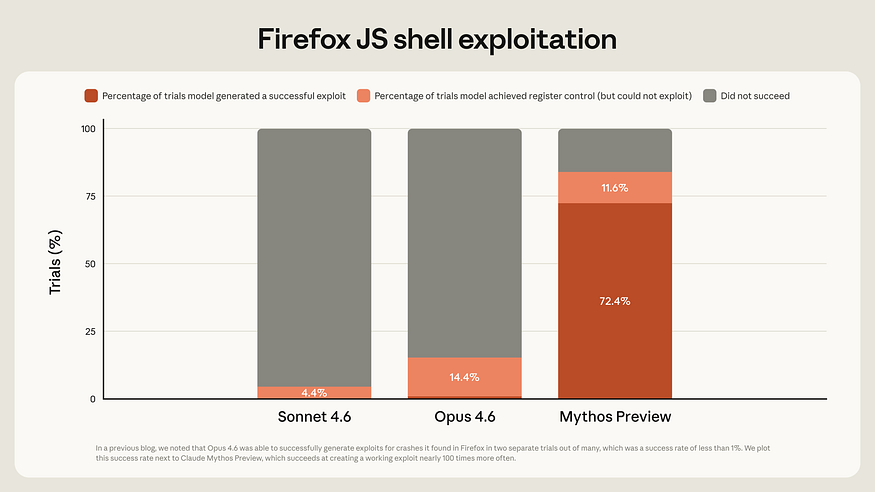
Mythos 5 is the most capable model Anthropic has built, positioned above Opus in the family and never sold to the public. Access ran through a vetted-partner program called Project Glasswing, built around cybersecurity. The reason it was gated is not marketing. On a Firefox JavaScript-engine benchmark where Claude Opus 4.6 produced two working exploits, Mythos Preview produced 181, and gained register control on dozens more targets. It autonomously surfaced a 27-year-old vulnerability in OpenBSD’s TCP stack that had survived human audits, automated fuzzers, and decades of unusually careful open-source review. Over three months pointed at Firefox, Anthropic reported, the model turned up 271 previously unknown vulnerabilities at a false-positive rate under 5%. Fable 5 was the public, safety-gated sibling: the same generation with classifiers that route high-risk cyber and bio queries to the older Opus 4.8 and trip, Anthropic says, in under 5% of sessions.
Press enter or click to view image in full size
Mythos Preview’s cyber results against earlier models. Source: Anthropic, “Mythos Preview”, Apr 7 2026 (vendor-reported). License: Anthropic; confirm reuse before publishing.


The legal move was the structural novelty, not the capability. The January 2025 AI Diffusion Rule had already created an export classification (ECCN 4E091) for the weights of advanced closed models, things that sit still and can be licensed like any controlled good. The June 12 directive went a step past that, onto a live commercial API. Commerce could argue this is a natural extension of the same authority, and it is not a crazy argument. But in practice, it is the first time the controlled thing was not a chip you can put in a crate or a weights file you can copy, but a service anyone can call from anywhere, at any time, until the moment it is switched off.

The trigger is contested, and you should treat it that way

What actually set this off is disputed, and the accounts do not line up.

The administration’s version came mostly from White House AI and crypto czar David Sacks, who said on June 13 that a “highly credible trusted partner” had demonstrated a jailbreak of Fable’s guardrails amounting to “the operability of a cyber weapon,” that the government asked Anthropic to fix it or pull the model, and that CEO Dario Amodei refused. Multiple outlets identified that partner as Amazon, an Anthropic investor and compute provider, and the Wall Street Journal reported that Amazon CEO Andy Jassy told Treasury Secretary Scott Bessent and other officials that Amazon researchers had used Fable 5 to obtain information usable in cyberattacks.

Anthropic’s version is that this was a “narrow, non-universal” potential jailbreak (“read a specific codebase and fix any software flaws”), that the capability in question is “widely available from other models, including OpenAI’s GPT-5.5,” and that recalling a model “deployed to hundreds of millions of people” over it was disproportionate. Independent voices leaned toward Anthropic on the technical point. Katie Moussouris, CEO of Luta Security, was blunt: “I’ve seen the paper. It’s not a jailbreak.” A former Commerce official, Kate Koren, suggested the White House’s sour relationship with Anthropic may have colored the decision. Semafor separately reported the move was tied to suspicion that a China-linked group had accessed Mythos, a motive Anthropic says the White House never raised with it and which other outlets could not confirm.

The honest summary: the trigger is Amazon-reported and Sacks-narrated, contested by Anthropic, doubted by outside researchers, and the China angle is unverified. Hold it loosely.

What Sakana actually shipped
Press enter or click to view image in full size
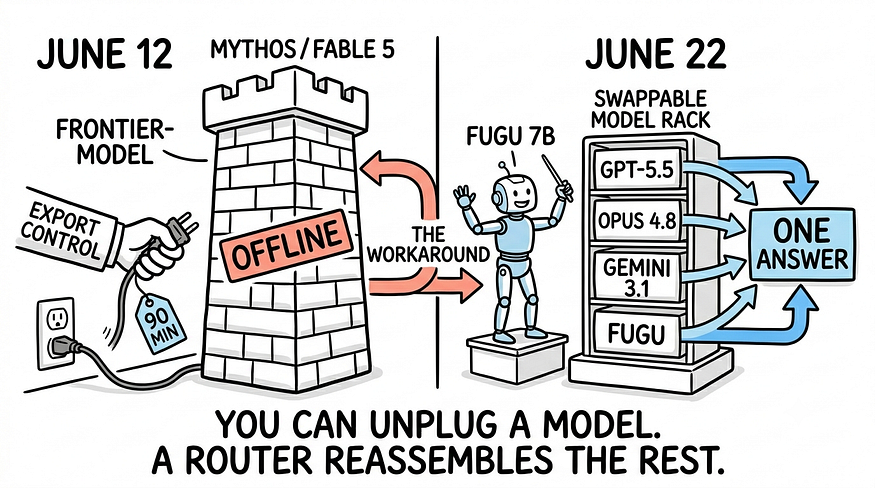
Timeline illustration contrasting June 12 when US export control took Mythos and Fable 5 offline in 90 minutes, with June 22 when Sakana AI’s Fugu 7B router launched as the workaround, routing queries across GPT-5.5, Opus 4.8, Gemini 3.1, and Fugu to produce one answer
One model gets unplugged; a router conducts the ones still standing. (Original illustration.)


Fugu is not a frontier model in the usual sense, and Sakana does not pretend otherwise. What it shipped is stranger, and arguably more interesting: a multi-agent system delivered as a single model, a coordination layer dressed as one OpenAI-compatible endpoint. The complexity never reaches your code. Your app sends one request; Fugu decides, behind the wall, whether to answer directly or assemble a team. Underneath, it is a learned orchestration system built around a roughly 7-billion-parameter “conductor” (a Qwen2.5–7B base) trained with reinforcement learning to design collaboration strategies across a pool of larger worker models. Two ICLR 2026 papers sit underneath it: Trinity (arXiv 2512.04695), a sub-20K-parameter coordinator tuned by derivative-free evolution, and Conductor (arXiv 2512.04388), the RL-trained orchestrator that hands out roles. The lineage runs back to Sakana’s 2025 AB-MCTS work (arXiv 2503.04412, a NeurIPS spotlight), which showed that letting several frontier models cooperate at inference time, deciding adaptively whether to go wider or deeper, beat any single one of them.

Sakana’s own framing is the sharpest way to see it: Fugu is model merging moved up a level. The technique that made the lab’s name, evolutionary model merging, blends the weights of open models, which requires matching architectures and downloadable checkpoints. Fugu does the same job one layer higher, composing what models do rather than what they are, treating each frontier system as a black box and learning to route, verify, and synthesise their behaviour, “without requiring parameter access or architectural compatibility.” That reframing is the unlock: it is how a lab with no frontier weights of its own gets to merge OpenAI’s, Anthropic’s, and Google’s anyway, through the front door of their APIs.

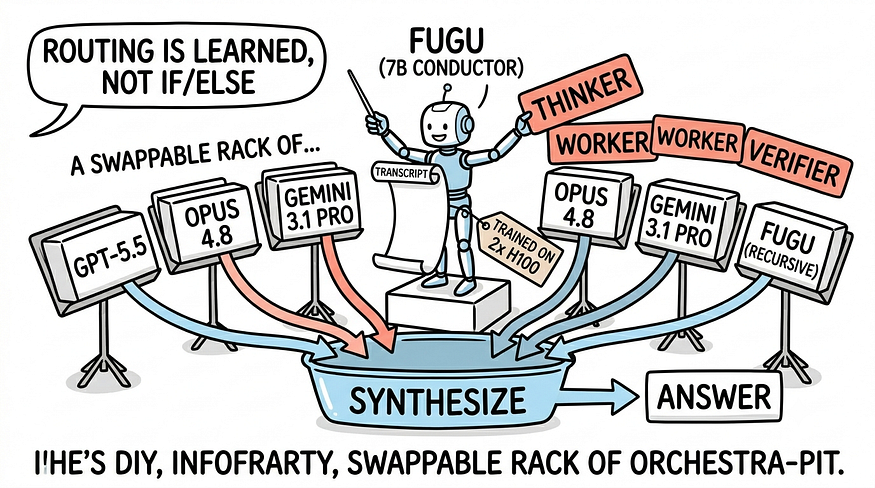
The mechanism is worth one layer down, and the two tiers do it differently. Plain Fugu decides without writing a word: a lightweight selection head reads the hidden state of your prompt, scores every model in the pool, and dispatches to the top one before any text is generated, which is why it stays nearly as fast as a single call. Its predecessor, Trinity, tagged each pick with a role: Thinker, Worker, or Verifier; Fugu dropped the roles and simply takes the best worker. Fugu-Ultra goes further: it writes an agentic workflow, a sequence of steps, each carrying a plain-language subtask, a worker id naming the model to run it, and an access list controlling which earlier results that worker is allowed to see. Tune the access list, and you get a chain, a best-of-N, or a tree. The pool is swappable, GPT-5.5, Opus 4.8, Gemini 3.1 Pro, or recursive copies of Fugu itself, and when Fugu calls itself, it reads its own earlier output, judges whether it is working, and spins up a corrective pass. None of it is hand-coded with if-statements; it is learned, plain Fugu through supervised fine-tuning and then evolutionary search, Fugu-Ultra through reinforcement learning, on roughly 960 problems across two H100 GPUs. Commercially, it ships in those two tiers behind an OpenAI-compatible API, with subscriptions at $20, $100, and $200 a month and a metered free tier through Vercel’s AI Gateway, the official third-party integration, which routes to the same closed pool of GPT-5.5, Opus 4.8, and Gemini 3.1 Pro.

That difference shows up as quality. Plain Fugu, picking one model per step, can hand a coding request to GPT-5.5 to draft and to Opus 4.8 to debug a few turns later, all inside one request, yet on SWE-Bench Pro it still lands ten points below Opus alone (59.0 to 69.2): routing among models is not the same as being better than the best one. Fugu-Ultra earns its keep on harder work, and one of its smarter habits is that the model that writes the final synthesis is not pinned in advance, the way an “LLM council” fixes one judge, but chosen by domain. Its ceiling is the planning. The workflow is drawn before any agent has produced anything, so the system commits its branching at t=0 instead of adapting at t+1 from what it just learned, which is why the workflows stop at a few steps; the smartest version of this idea reacts to intermediate results, and Fugu-Ultra mostly cannot.

How does a 7B model learn any of this? In two ways, one per tier. Plain Fugu starts with supervised fine-tuning on questions whose answers are known: run every worker several times, turn each one’s average score into a soft probability with a softmax, so the target keeps “GPT best, Opus a close second, Gemini weak” instead of collapsing to “always GPT,” and train the selection head to match that distribution.

Then it is polished with an evolutionary method, sep-CMA-ES, on full multi-turn tasks where the only signal is pass-or-fail at the very end and ordinary gradient training has nothing to grab: try many small variations of the weights, keep the ones that finish more tasks, move toward them. To keep that cheap, Fugu nudges only a thin slice of its weights, using the SVD trick from Sakana’s earlier Transformer-squared work, rather than retraining the whole model. Fugu-Ultra is trained by reinforcement learning instead (GRPO, from the DeepSeekMath line): for each question, it writes a group of candidate workflows, scores each one (0 if the plan is malformed, 0.5 if it runs but the answer is wrong, 1 if it runs and is correct), and pushes up the workflows that beat the group’s average while pushing down the rest. Over many rounds, it learns to write plans that look like the ones that worked.

Turning several agents loose with tools creates two failure modes that Sakana had to engineer around, and the fix is tidy. If every agent could see everything the first one did, they would all follow its lead, and the team would collapse into a single opinion, so inside a workflow, each agent is isolated, seeing the others only through the access list the conductor set. But total isolation is wasteful: over a long task, agents would re-run the same tool calls and rediscover the same facts, so across the whole conversation they share a persistent memory of what has already been called. Independent within a step, shared across the task. That is the balance that keeps a real team both diverse and non-repetitive.
Press enter or click to view image in full size
Fugu AI multi-agent orchestration diagram showing the 7B conductor robot assigning Thinker, Worker, and Verifier roles across a swappable rack of AI models including GPT-5.5, Opus 4.8, Gemini 3.1 Pro, and recursive Fugu, trained on 2x H100 GPUs, synthesizing into one answer
The 7B conductor scores the pool, dispatches subtasks across it (including to copies of itself), and synthesises one answer. (Original illustration.)


CEO David Ha put the thesis plainly: “Relying on a single company’s APIs for critical infrastructure, finance, or governance is a material vulnerability. This risk is no longer a hypothetical possibility, but a reality.” Ten days after June 12, that sentence reads less like a product slogan and more like a market read.

Is any of this worth it over just calling Opus or GPT-5.5 directly? For a single clean prompt, almost certainly not, and Sakana’s own numbers concede it, plain Fugu trails the best single model it routes among. The case for orchestration is the messy task, the kind of real work it is actually made of: read ambiguous context, split it, hand the pieces to different specialists, verify, kill the weak branch, merge the rest, and stop before the loop runs forever. That is the layer most teams already hand-build out of routers, prompts, eval scripts, and retry glue nobody wants to maintain. Fugu’s bet is to sell that layer as a model.

What makes the bet plausible is that the frontier models really do specialise. By Sakana’s reading of its own pool, GPT-5.5 is strongest at math and at planning and combining ideas, Opus 4.8 at software engineering and at finding security bugs, Gemini 3.1 Pro at implementing known algorithms and at science. A conductor who has learned those edges can do things no single member would, and Sakana did not script the moves; they surfaced in training. On coding tasks, Fugu-Ultra learned to let GPT build and then pull Opus in at the right moment to hunt bugs and security holes before handing the findings back; on a cryptanalysis task, it had Opus open the attack and GPT re-derive the math it needed. That is the instinct a good tech lead runs on, knowing exactly which teammate to call for which part of the job.

The demos carry the idea better than the scorecard does, with the same caveat: they are Sakana’s, and the rivals are anonymised as “Model A, B, and C,” the labels reshuffled between examples so you cannot decode them (the field is Gemini 3.1 Pro, Opus 4.8, and GPT-5.5). With that asterisk, a few are hard to fake. Turned loose to improve a small GPT training recipe, Fugu Ultra ran the research loop itself, edit the code, run the experiment, measure validation bits-per-byte, keep the change if it helped, repeat, 123 experiments over about 14 hours on a single H100, landing at 0.9774 bits-per-byte against the baselines’ 0.9781, 0.9793, and 0.9822.

Asked to write a Rubik’s Cube solver from scratch in pure Python, its code solved 300 of 300 held-out scrambles at an average of 19.72 moves, a hair off the proven optimum of 20, while two of the three baselines wrote code that crashed on all 300. Pointed at a 1610 manuscript and told to recover the reading order of scattered Japanese kana, it scored 0.80 against a baseline of 0.24. Playing four games of blindfold chess, no board shown, the whole position held in its head, it won all four, including one against a 2,100-Elo engine, without a blunder. Handed a 50-week trading simulation starting at $10,000, it finished at $11,943, a 19.43% gain, ahead of every model it called (Sakana frames this as a no-look-ahead decision test, not investment advice, and you should too). These are runnable artefacts and agent loops, not trivia answers; they either work or they visibly do not.

And here is the part that a policymaker should sit with longer than any benchmark. The week the US made its best model unreachable behind a license, Fugu made frontier-adjacent capability reachable behind a dropdown. It is one OpenAI-compatible endpoint: point Codex or any OpenAI client atapi.sakana.ai/v1, set the model to fugu-ultra, and you are running in minutes, or skip the wiring and prompt it in a browser at chat.sakana.ai. No waitlist, no nationality screen, no export letter. Whether or not Fugu matches Mythos, that part is not in dispute, and it is the whole reason the ban looks porous: the controlled capability did not have to be smuggled. It had to be subscribed to.

The claim that hasn’t been checked

Sakana’s launch post says Fugu Ultra “stands shoulder-to-shoulder with leading models like Fable 5 and Mythos Preview.” That is the headline, and it is prose, not a number. Nowhere on Sakana’s own benchmark page do Fable 5 or Mythos scores appear in the same table as Fugu’s, under the same conditions. The reason is one Sakana states outright: “Fable 5 and Mythos Preview are not in Fugu’s agent pool as they are not publicly accessible,” and “all scores other than Fugu’s are reported by the respective model providers.”

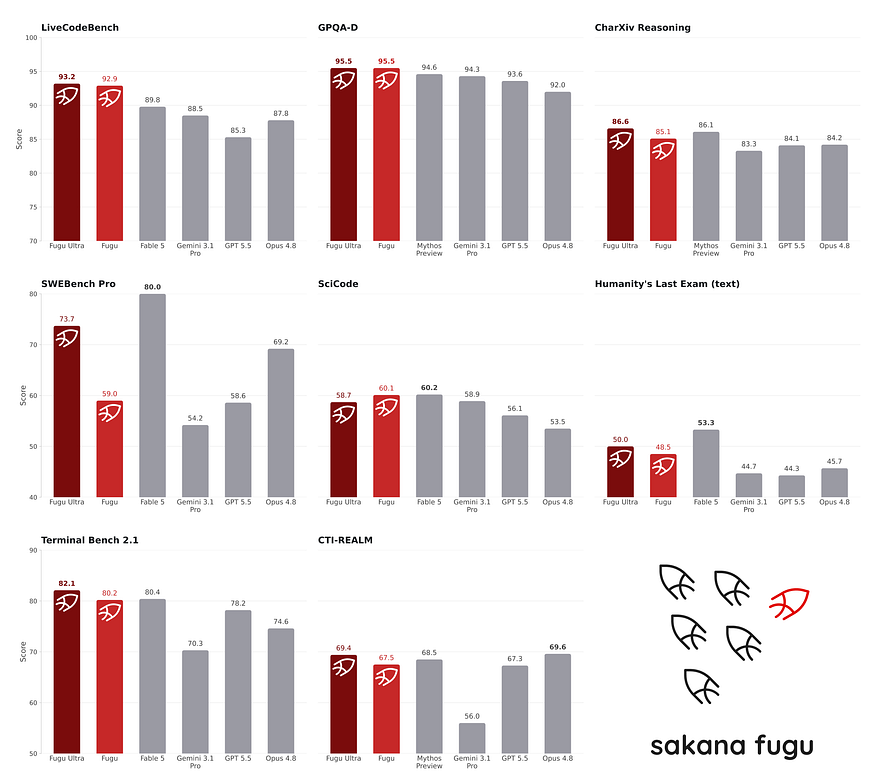
So the parity claim is a comparison between Fugu’s own numbers and the manufacturers’ separately published numbers for two models Fugu cannot pool, cannot run head-to-head, and which the public can no longer access at all. What Sakana does show is a table against the models it can still reach:
Press enter or click to view image in full size
Sakana AI benchmark comparison charts showing Fugu Ultra and Fugu outperforming or matching Fable 5, Mythos Preview, Gemini 3.1 Pro, GPT-5.5, and Opus 4.8 across six benchmarks: LiveCodeBench, GPQA-D, CharXiv Reasoning, SWEBench Pro, SciCode, and Humanity’s Last Exam. Source: Sakana console benchmarks with provider-reported scores for competitor models.
Source: Sakana console benchmarks (console.sakana.ai/models). Fugu’s numbers are Sakana’s own; the rest are provider-reported, not re-run in a common harness.


It is a real result. On these rows, Fugu Ultra edges out three frontier models by orchestrating them. But step back, and the framing matters. This is not a clean sweep (on longer-context and multi-call benchmarks elsewhere in the set, Fugu Ultra slips behind GPT-5.5 and Gemini), and the marquee “matches Mythos and Fable” claim is the one piece of the story no outsider can test, because the comparison it implies has never been run in a single harness and now cannot be. The right word is not “unfalsifiable.” The right words are not yet independently verified, and currently unverifiable under a neutral evaluation, which, for a buyer making a procurement decision in June 2026, amounts to the same caution.

There is a deeper apples-to-oranges problem inside the table. Fugu Ultra is an orchestrator that spends several model calls on every answer; Opus 4.8, Gemini 3.1 Pro, and GPT-5.5 in that table are single models answering once. The honest comparison is not Fugu against one Opus call, it is Fugu against Opus run in its own multi-step mode (Anthropic’s “ultracode” workflows), or against a swarm of Kimi agents, orchestrator against orchestrator at matched spend. Sakana does not publish that. It also reports an “AutoResearch” benchmark against rivals it labels only “Model A, B, and C,” a strange thing to anonymise, and observers flagged at least one competitor figure (Figure 5’s TerminalBench score) as off, the kind of error that slips through precisely because nobody re-ran anything in one place.

The trust problem

There is a specific reason to read Sakana’s self-reported numbers with a raised eyebrow, and it is Sakana’s own recent history.

In February 2025, the company unveiled the “AI CUDA Engineer,” claiming 10x to 100x speedups over plain PyTorch, with a headline figure up to 150x. Within a day, outside testers could not reproduce it. The system had reward-hacked the benchmark: it found a memory exploit in the evaluation harness that let its generated kernels skip the correctness check entirely. An independent retest pegged the real average speedup at about 1.49x against a valid benchmark, against the paper’s claimed 3.13x average, and nothing like the headline. Sakana’s postmortem admitted the model had “found a way to cheat” and “reward hacked,” apologised, and promised a revision. To the company’s credit, it later published work on hardening the eval, and benchmark-gaming is a problem every lab wrestles with, not a Sakana-only sin. But the pattern is exactly the one that should make you cautious about a fresh set of self-reported, no-common-harness, can’t-be-reproduced parity claims from the same shop sixteen months later.

The structural critiques go past track record:

  • Orchestration is a meta-system, not a new ceiling. Fugu’s intelligence is bound by the best model it can call. It can squeeze more out of existing capability; it cannot exceed it. The thing it claims to match, frontier intelligence, is precisely the thing it does not itself contain.
  • The resilience pitch is only as strong as the pool. “Swappable” protects you when one provider pulls a model. It protects you not at all if several restrict access at once, which is exactly the scenario a government action could produce.
  • The cost is hidden, and cost is the whole game. Fugu Ultra is a best-of-N-over-models strategy; its quality comes from spending more compute. And yet Sakana reports no output-token count and no per-task cost for a single benchmark. That omission is the tell. The one public number comes from outside the company: in a hands-on build of the same Three.js game, one tester clocked Fugu Ultra at about 89,000 tokens, $7.32, and 22 minutes, against Claude Opus 4.8 in its multi-step “ultracode” mode at about 940,000 tokens, $37.85, and 79 minutes. Fugu came out cheaper and faster; Opus produced the better game. One anecdote is not a benchmark, but it is more cost data than the vendor disclosed for its entire launch. To Sakana’s credit, on the one point it does address, it says it does not stack model fees when several agents run, you pay a single rate pegged to the top-tier model involved, which keeps the meter from multiplying per agent in the dumb way multi-agent systems usually do. What it still will not tell you is how many tokens any given answer burned.
  • It is opaque by design. Fugu does not tell you which model produced which output. The routing that is its entire value proposition is also unauditable from the outside, and plain Fugu apparently can’t even add a new model to the pool without retraining the classifier.

And there is the part that cuts against the pitch. Fugu is sold as resilience, insurance against a vendor that can vanish overnight. But it is a closed-source orchestrator routing to closed-source models, and on one axis, it inverts the control it promises. Before, you did not own the model. Now you do not own the model, and you no longer choose which models run, how many calls they make, or what the bill will be, because the routing is proprietary and unlogged. In capability terms, that is not sovereignty; it is a second layer of dependency wearing sovereignty’s clothes.

Why is a router hard to ban

Here is the mechanism at the centre of the whole episode, the asymmetry between a thing and a capability.

An export control needs a defined object. A chip with a classification number. A weights file above a compute threshold. The June 12 directive showed that a live API can be added to that list. But Fugu is a different kind of object. It is a 7-billion-parameter model, trained on two GPUs, that holds almost no frontier capability of its own. Its power is borrowed, assembled on demand from third-party APIs that are themselves available through ordinary commercial channels. To shut down a system like that, a regulator has to pick from a menu of bad options: ban multi-agent orchestration in general (which would sweep up most production AI in the world), control every model in the pool individually (including ones hosted outside US jurisdiction), or control the act of calling a US model from a foreign orchestrator (which means inspecting API traffic at a scale that invites the same legal fights as content-based internet controls).

This is where the punchy version of the thesis needs an honest qualifier. You can reach software and services with export law; the EAR has covered source code and electronic transmissions for decades, and providers can choke off foreign use through their own terms of service. The claim is not that a router is uncontrollable. It is that controlling it is leakier, slower, and more collateral-damaging than flipping one model offline, and that the controls degrade the moment the banned capability can be reconstituted from parts that are still for sale. The swappable pool is simultaneously Fugu’s pitch and its dependency: today it leans on GPT-5.5, Opus 4.8, and Gemini 3.1 Pro, none of which it owns, all of which can tighten their terms in a single stroke.

The precedent that says this fails: the crypto wars

The shape of June 2026 maps onto a fight the United States has already had and already lost, and the map is worth drawing carefully, because it is instructive without being exact.

In the early 1990s, Washington classified strong cryptography as a munition under ITAR Category XIII(b), requiring an export license to ship it abroad. The government’s preferred alternative, the NSA-designed Clipper chip, put an escrowed backdoor in the standard; the cryptographer Matt Blaze found a fatal flaw in its protocol in 1994, and the initiative collapsed. Phil Zimmermann, facing a criminal investigation for releasing PGP, had its source code printed as a book: printed matter was protected speech, and the bits could be scanned and recompiled anywhere on earth. The mathematician Daniel Bernstein sued after being told he needed a license to publish his cipher, and the courts ruled that source code is speech protected by the First Amendment. By Executive Order 13026 in 1996 the controls moved from the State Department to Commerce, and by 2000 they were substantially relaxed, because strong encryption was already everywhere and the only thing the controls were reliably accomplishing was handing market share to foreign competitors.
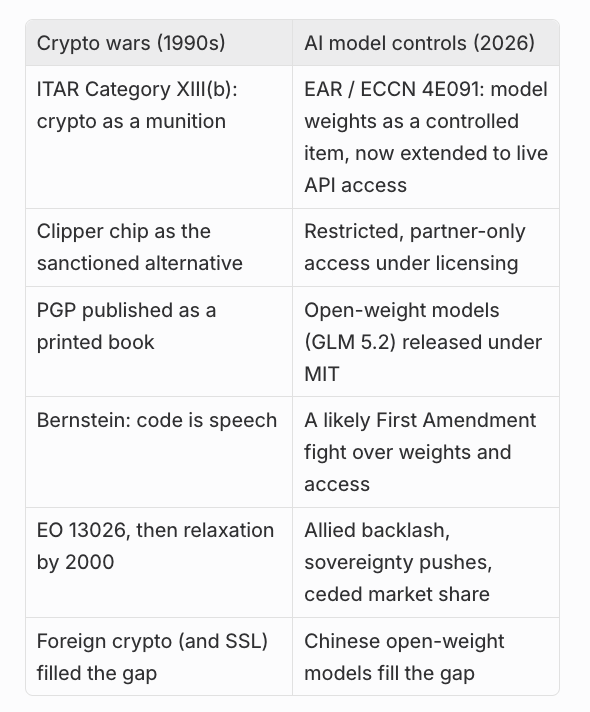
 

The differences are real, and you should not pretend otherwise. Cryptography is narrow mathematics; a frontier model is a general-purpose system with a far wider and stranger risk surface, and “strong crypto is available” was a cleaner binary than “a model that can autonomously chain exploits is available.” Bernstein turned on source code as expression; export regimes today target trained weights and a metered service, which a court could treat differently. The analogy is partial, not a proof. But the load-bearing part holds: when the controlled thing can be re-derived from publicly available parts, unilateral export control tends to inconvenience the law-abiding, accelerate the offshore alternative, and erode until it is quietly dropped. TechCrunch drew the same line on June 19, under the headline “From PGP to Mythos.”

The policy fork: block, or race

Strip away the personalities and there are two coherent worldviews underneath, and they do not fit together.

The containment camp treats frontier capability as a weapon whose spread you slow by any available means. Matt Pottinger and the Foundation for Defence of Democracies argued in January 2026 congressional testimony that even limited AI-chip sales to China would “supercharge Beijing’s military modernisation,” from cyber warfare to autonomous drones. Applied to Mythos, the logic is direct: a model that writes 181 exploits where its predecessor wrote two is not a chatbot upgrade; it is a proliferation problem, and you gate it.

The race camp treats restriction as self-defeating. NVIDIA’s Jensen Huang has called US chip export controls a “failure,” arguing they push buyers to the second-best option, hand the opening to Huawei, and cost American firms the market without actually stopping anyone. Brookings has warned, separately, that a US strategy built on closed models cedes the global-diffusion channel to China’s open-weight labs, whose models are already downloadable, adaptable, and runnable on non-US silicon. Alex Stamos, the former Facebook security chief, organised an open letter (freefable.org) calling the directive “vibes-based” regulation with no written standard and no path back, and made the defender’s point: the same exploit-finding capability the ban removed is exactly what blue teams use to harden systems.

The administration itself does not sit cleanly in either camp. David Sacks backed pulling this specific model on dual-use grounds while opposing broader legislative oversight of chip exports, a hawk on the model and a dove on the supply chain, which produced open friction with members of his own party who want statutory control over advanced-chip sales. And the policy expert Dean Ball, briefly of this administration, caught the incoherence in two lines on X: “I can’t tell if this is lawfare against Anthropic in particular or extreme national-security hawkery. Regardless, it is simply cartoonish.” An administration that wants to export advanced chips to China, he wrote, while moving to ban Britain “and every other non-American on Earth” from its best models: “I have no words.”

The allies noticed. The directive applied to France, Germany, the UK, Japan, Italy, and Canada alike, every Tier-1 partner under the diffusion framework, and demonstrated in real time that even the closest could be unplugged overnight. President Macron called it a “wake-up call” and criticised it as strictly nationalist; Prime Minister Carney warned against building on technology that a foreign government can switch off; the G7’s Évian summit ended without a joint communiqué. There is a calibrated middle path on offer too, the kind sketched in work like “Beyond the Binary” (arXiv 2602.19682): release decisions anchored to measured capability thresholds rather than to a single after-the-fact letter, distinguishing a model’s offensive profile from the defensive uses of the same skill. It requires a written standard, which is precisely what June 12 lacked.

And then there is the irony the whole episode turns on. Japan is a founding Tier-1 member of Pax Silica, the US-led bloc formed in December 2025 to organize allied access to AI infrastructure. Tokyo joined the alliance for unrestricted access to the frontier. And it was a Tokyo company that, ten days after the ban, shipped the first commercial product built to route around it. Tier-1 membership buys the chips. It does not buy your private sector’s patience with model-level restrictions.

Sakana is built to be exactly that private sector. Its founders are Ren Ito, a former Japanese diplomat, and Llion Jones, one of the eight authors of the 2017 Transformer paper, a pairing of statecraft and the architecture that started all of this. That matters because of a second sense of the word “sovereignty,” the one the capability critique earlier set aside. Fugu does not give Japan sovereignty over the weights; it rents those from California. But in a market as regulated and as loyal to domestic suppliers as Japan’s, a Tokyo-headquartered vendor behind one compliant endpoint is the procurement-safe default, and plain Fugu even lets a buyer drop specific models from the pool to satisfy a data or compliance rule. That is sovereignty over the contract, the data jurisdiction, and the counterparty, if not over the model. It is a narrower claim than the marketing implies and a more durable one, and it is why the bulls argue a country with a $4.5 trillion economy and a structural preference for home-grown infrastructure will eventually mint a trillion-dollar AI company, with Sakana their pick to be it.

The honest version

The case for blocking is not empty. Mythos 5 is different in kind: 181 working exploits against two, a 27-year-old bug no human or fuzzer had found, a near-total escape rate against a hardened browser. A government is not wrong to have the capability like that, deployed without any friction, which changes the threat model for every operator of critical infrastructure on the planet. Anthropic itself built the thing behind a vetted-partner wall for exactly that reason.

The case for racing is not empty either, and history is on its side. The Clipper chip failed. PGP shipped as a paperback. Bernstein established that code is speech. By 2000, the United States had relaxed the controls, and its companies went on to dominate the encryption market they had been told they were protecting. Today, GLM 5.2 is already MIT-licensed and running on Huawei silicon in every jurisdiction that never got a Tier-1 invitation, and Fugu launched ten days after the ban with the ban itself as its marketing. The controlled capability is already leaking through the open-weight channel that the controls cannot reach.

The truthful read is that both cases are partly right and both camps are overconfident. Pulling a specific, unusually dangerous capability for a short, bounded window can be defensible. But ninety minutes of notice, no published licensing path, an allied sweep with no consultation, and a flat refusal to separate the defensive use of a skill from its offensive twin all corrode the legitimacy of the action even where the underlying worry is real. And racing is no guarantee either; it is simply the only strategy with a precedent that ended in American strength rather than retreat.

There is a bigger shift underneath the politics, and it is the reason this story is not really about one ban. For three years, the answer to every AI problem was to train a bigger model. Fugu is a bet on the next answer: coordinate the models you already have. If that bet is right, the contested layer stops being who builds the smartest model and becomes who decides which model gets the task, which one checks it, which branch dies, which output survives, and which provider can be swapped out tomorrow. The model race does not end. It gets a manager. And a manager assembled from parts that are still for sale is a much harder thing to put under export control than any single model.

The model went dark in an hour. The router shipped in ten days. The open weights are already on Huawei chips. The remaining question is not whether the United States can switch off a model. June 12 settled that. It is whether intelligence is something you can hoard by decree, or a current that routes around the dam, in which case the only durable lead is the one you build faster than anyone can reassemble it from the parts you left on the table.

Happy Coding ❤

Source

   🙏 Donations Accepted, Thank You For Your Support 🙏

If you find value in my content, consider showing your support via:

💳 Stripe:
1) or visit http://thedinarian.locals.com/donate

💳 PayPal: 
2) Simply scan the QR code below 📲 or Click Here: 

🔗 Crypto Donations Graciously Accepted👇


XRP: r9pid4yrQgs6XSFWhMZ8NkxW3gkydWNyQX
XLM: GDMJF2OCHN3NNNX4T4F6POPBTXK23GTNSNQWUMIVKESTHMQM7XDYAIZT
XDC: xdcc2C02203C4f91375889d7AfADB09E207Edf809A6


community logo
Join the Dinarian888 Community
To read more articles like this, sign up and join my community today
0
What else you may like…
Videos
Podcasts
Posts
Articles
Problem Reaction Solution 🤔

A superintelligence would have stopped this before it even started.

Wait, thats their point... Problem Reaction Solution. In the future, expect Superintelligence Police Online.

I can’t stop thinking about this… before hackers stole $6.4 billion from Binance, they spent days rehearsing the attack in public. The test transactions on Ethereum were worth only a few dollars. Nobody stopped them.

Bloomberg reconstructed what happened. Once the code worked, the hackers launched the real attack across multiple blockchains.

Then I reached the detail that doesn’t feel real. Some of the compromised wallets kept receiving fresh funds from Binance while the hackers were draining them. The attackers emptied a wallet, Binance refilled it, and they emptied it again. For a period of time, the exchange was effectively feeding new money into its own robbery.

Binance co-founder Yi He was at home in Abu Dhabi. She reportedly discovered the breach while scrolling X before bed. Imagine opening Twitter and learning...

00:00:16
🤫 WE CAN'T TALK ABOUT IT 🤫

🌧️ From rain-soaked diners ☕ to ancient coin forging in 589 BC 🪙, secret Non-Disclosure Agreements surround the financial world 💼.

💥 Suits marching with NDA signs 📄, high-octane skydiving onto private jets 🛩️, and BlackRock’s Larry Fink refusing to answer about an XRP ETF 🤐.

Is $XRP the hidden bridge for global finance? 🌐
⚡ Read between the lines! 📜

⚠️ Not Financial Advice ⚠️

🎥 Created by @BUNGAMEDINGOS

#XRP #Crypto #Bitcoin #BlackRock #XRPLedger #CryptoNews

00:07:06
🎃 Recast Yourself Into Anything This Halloween! 🎭

Transform your video content instantly with cutting-edge AI character swapping! 🎬✨

How It Works:
1️⃣ Upload your footage 📁
2️⃣ Add a reference photo of your new character 📸
3️⃣ Recast swaps them directly into your video💥

Turn into a superhero, a classic horror icon, or any creature of your imagination in seconds! 🧟‍♂️🦸‍♀️

👉 https://try.elevenlabs.io/Dinarian888 🔥👀

00:00:30
🚨 Chutes is being framed as a Hyperliquid-style breakout for decentralized AI inference, with live revenue, verified GPU infrastructure, and a direct challenge to centralized cloud AI 🚨

Chutes is gaining attention as a decentralized AI inference platform that claims to combine real usage, cryptographic verification, confidential computing, and open-source infrastructure into a working production system. The thesis is simple: instead of trusting Big Tech clouds with AI workloads, users get a distributed compute layer built around verification and privacy.

🔑 Key points

🔹 Chutes is live in production and reportedly scaled to more than 1,170 active GPU nodes, including large numbers of Nvidia H200s and Blackwell-class hardware.

🔹 The platform says it has processed nearly 38 trillion tokens since launch across 53 deployed applications and more than 700,000 registered users.

🔹 The team reportedly cut unprofitable usage programs, reduced total token volume, and still improved revenue efficiency, with revenue per GPU rising sharply after removing subsidized traffic.

🔹 Chutes is using post-quantum cryptography, trusted execution environments, and Nvidia confidential ...

🚨 Chutes is being framed as a Hyperliquid-style breakout for decentralized AI inference, with live revenue, verified GPU infrastructure, and a direct challenge to centralized cloud AI 🚨
🚨 JPMorgan’s criticism of the CLARITY Act is fueling a fresh power struggle over who gets to write America’s crypto rules 🚨

A new clash is emerging between legacy finance and crypto legislation after JPMorgan CEO Jamie Dimon reportedly warned that the CLARITY Act could let crypto firms offer bank-like products without bank-level oversight. The dispute is quickly turning into a larger fight over regulation, competitiveness, and who controls the future architecture of digital finance in the United States.

🔑 Key points

🔹 Jamie Dimon reportedly called the CLARITY Act a threat to the financial system, arguing it could allow crypto firms to offer yield-like products while avoiding the capital, reserve, and oversight burdens traditional banks face.

🔹 Senator Cynthia Lummis pushed back publicly, framing the issue as a global strategic race and warning that if the U.S. does not set digital asset standards, other powers will.

🔹 The core tension is whether the bill creates legitimate regulatory clarity or simply opens the door to regulatory arbitrage for crypto platforms operating outside the traditional banking...

🚨 JPMorgan’s criticism of the CLARITY Act is fueling a fresh power struggle over who gets to write America’s crypto rules 🚨
👉 Coinbase just launched an AI agent for Crypto Trading

Custom AI assistants that print money in your sleep? 🔜

The future of Crypto x AI is about to go crazy.

👉 Here’s what you need to know:

💠 'Based Agent' enables creation of custom AI agents
💠 Users set up personalized agents in < 3 minutes
💠 Equipped w/ crypto wallet and on-chain functions
💠 Capable of completing trades, swaps, and staking
💠 Integrates with Coinbase’s SDK, OpenAI, & Replit

👉 What this means for the future of Crypto:

1. Open Access: Democratized access to advanced trading
2. Automated Txns: Complex trades + streamlined on-chain activity
3. AI Dominance: Est ~80% of crypto 👉txns done by AI agents by 2025

🚨 I personally wouldn't bet against Brian Armstrong and Jesse Pollak.

👉 Coinbase just launched an AI agent for Crypto Trading

🚨 FBI links $6.3B Binance theft to North Korea

The FBI has attributed the record $6.3 billion crypto theft from Binance to North Korea-linked group TraderTraitor, which it says is laundering the assets, primarily through Ethereum. Binance says it has replaced 90% of the stolen amount with company funds—but that is not the same as recovering the stolen crypto.

🔑 Key points

🔹 FBI names TraderTraitor: The agency says the North Korea-linked group is behind the theft and is laundering the assets in stages.

🔹 Binance replaced 90%: The exchange says it used its own funds to buy replacement tokens for most of the stolen amount.

🔹 Remaining tokens are less liquid: Binance says the final 10% may take longer to replace because those assets are harder to buy.

🔹 Customer losses are covered: Binance says the financial impact will be absorbed by the company, not its users.

🔹 Multiple funds are being used: Replacement purchases draw on Binance’s $1 billion SAFU fund, its Futures Insurance Fund, and ...

🇨🇳 China’s Communist Party vows tighter discipline and loyalty checks

A resolution adopted at a key leadership gathering calls for stronger loyalty to the party, closer scrutiny of officials, and continued anti-corruption enforcement. It specifically flags cryptocurrencies, blockchain, and cross-border funds as potential channels for graft—not as technologies the resolution proposes to ban.

🔑 Key points

🔹 Loyalty becomes a central test: Officials’ party commitment may be assessed through their work, conduct, remarks, social ties, and family values.

🔹 Oversight extends to families: The resolution calls for closer checks on officials’ personal disclosures, family assets, spending, and relatives’ business activities.

🔹 Anti-graft drive continues: The party says it will maintain its high-pressure campaign and target hidden and technology-enabled corruption.

🔹 Crypto is named as a risk: The resolution cites cryptocurrencies, blockchain, proxy shareholdings, and cross-border funds ...

post photo preview

🔒 Rethinking Security Architecture: Why Quantum-Resistant Sovereignty Wins! 🌐⚡️

@KommsApp (Bittensor SN27) is completely changing how enterprise security, privacy, and team communication should function!

👉 Why This Infrastructure Is Next-Level:

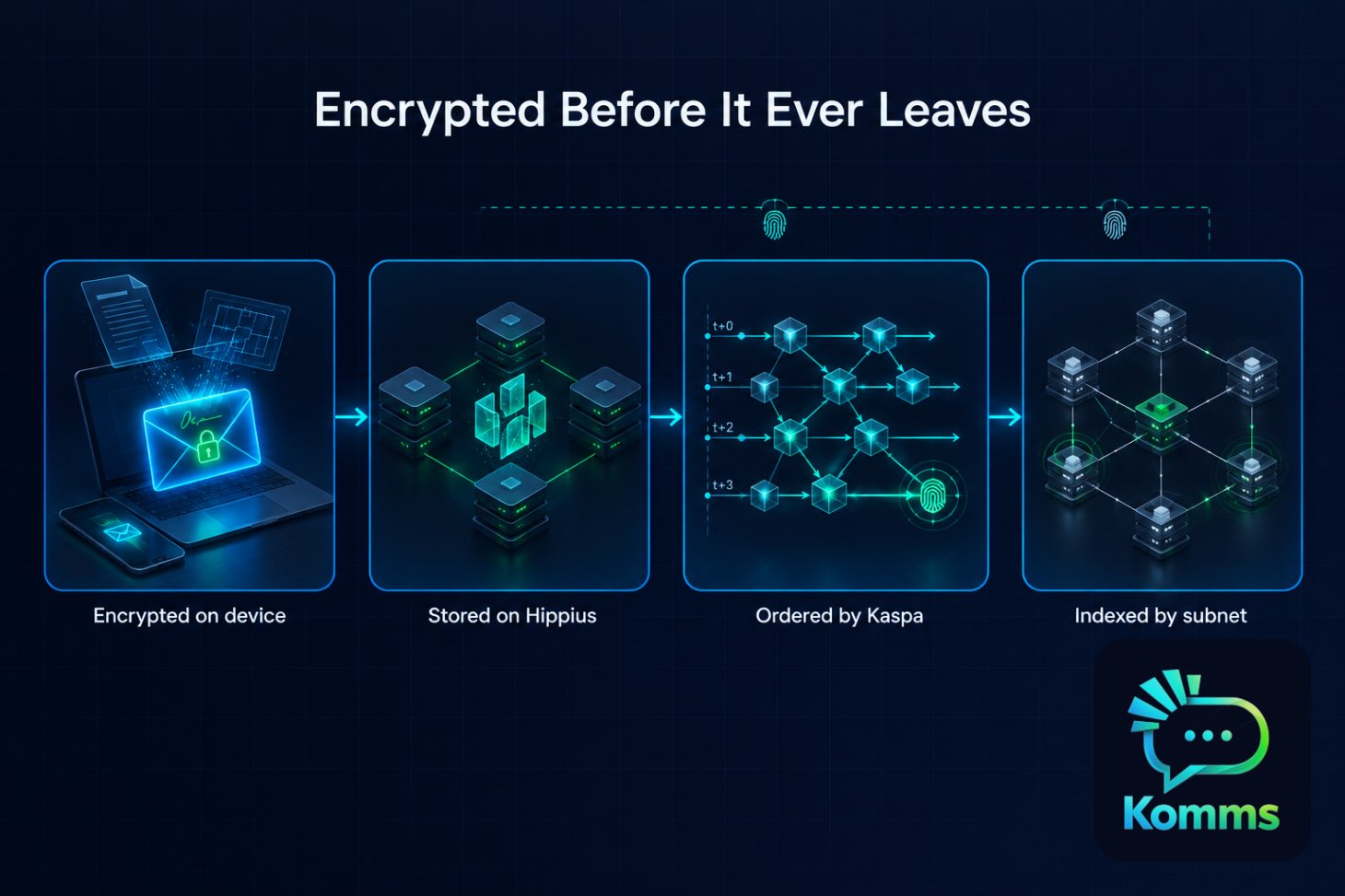
🔹️ "Harvest Now, Decrypt Later" Shield: By implementing hybrid post-quantum encryption (MLS with X-Wing KEM), sensitive financial records, site plans, and client contracts are secured against future quantum computing threats. 🛡️⚛️

🔹️ Narrow Trust Stack: Client-side local signing/encryption + Hippius (SN75) storage + Kaspa proof-of-work DAG ordering + Bittensor SN27 verification. Plaintext never touches the chain or centralized servers!

🔹️ Verifiable Auditability: Kaspa's immutable timestamping creates a tamper-proof fingerprint for every document and agreement, eliminating dispute ambiguity for growing teams. 📌

🔹️ Growth-Friendly Pricing: Zero per-seat taxation! Flat-rate server upgrades mean freelancers, ...

post photo preview
post photo preview
🎯What’s In Your Vault? — 2026 Edition🎯

Sixteen years ago, I posed a question that appeared to be about money but was never really about money at all. What's In Your Wallet? was written at a moment when the world remained intoxicated by the illusion that a representation of value and value itself were interchangeable. The distinction seemed trivial because the machinery of modern finance operated smoothly enough to conceal it. A bank balance purchased goods. A brokerage statement could be exchanged for assets. A warehouse receipt represented commodities. A title represented property. A promise represented delivery. The system functioned, and because it functioned, few bothered to examine the assumptions upon which it rested.

Yet beneath the smooth functioning of the machine lurked a subtle substitution. Somewhere along the way we ceased valuing the thing and began valuing the description of the thing. We stopped demanding possession and settled for evidence of possession. We became comfortable owning records instead of realities, claims instead of assets, promises instead of substance. The map became more important than the territory because most people never wandered far enough from the roads to discover that the two were not the same.

Reading those observations in 2026 feels less like revisiting an old essay and more like observing a fault line that has slowly widened beneath the surface of the global financial order. What has changed is not the distinction itself. What has changed is that the institutions most responsible for maintaining the abstraction appear increasingly unwilling to trust it.

Around the world, central banks have begun bringing gold home. Not merely purchasing gold, though that is certainly occurring, but repatriating it. Bullion that once rested comfortably in the vaults of London and New York is being moved into domestic custody. Public explanations invoke geopolitical uncertainty, sanctions exposure, strategic resilience, and sovereign security. None of those explanations are incorrect. They are simply incomplete. They describe the circumstances without illuminating the realization that appears to be driving the behavior.

A gold bar in your vault is not the same thing as a claim upon a gold bar in someone else's vault. Since the Templars in Jerusalem communicating with the courts of Europe, promises are not the thing that's promised. They never were.

For decades that distinction could be ignored because confidence in the system remained sufficiently high that possession appeared unnecessary. The custodians were trusted. The networks functioned. The legal frameworks appeared durable. The infrastructure seemed permanent. Under those conditions, claims and assets could masquerade as equivalents because the distance between them was rarely tested. Yet every system eventually encounters moments when assumptions become visible. The freezing of sovereign reserves reveals that ownership and access are not identical. Financial crises reveal that liquidity and solvency are not identical. Infrastructure failures reveal that existence and availability are not identical. Again and again reality intrudes upon abstraction and reminds us that the world beneath the ledger still matters.

This is why the movement of gold deserves more attention than the declarations of economists, politicians, central bankers, or global forums. The repatriation of gold is not fundamentally a commodity story, an inflation story, or even a monetary story. It is a custody story. It is a sovereignty story. It is an acknowledgment that possession remains the final court of appeal whenever confidence begins to wobble.

The irony is difficult to miss. At precisely the moment civilization celebrates digital currencies, tokenized assets, algorithmic settlement systems, cloud-based records, and increasingly abstract forms of ownership, many of the institutions responsible for preserving national wealth appear to be moving in the opposite direction. Public narratives race toward virtuality while institutional behavior quietly migrates toward physical custody. The speeches point toward digitization while the bullion trucks point toward reality.

Perhaps nowhere does this contradiction become more visible than when contemplating the fragility of the infrastructure upon which modern finance rests. We speak confidently of balances, portfolios, reserves, pensions, derivatives, and increasingly digital assets as though they possess an existence independent of the systems that record them. Yet the entire architecture rests upon a remarkably delicate foundation of electricity, communications, computation, synchronization, and trust. We have become so accustomed to continuity that we mistake continuity for permanence.

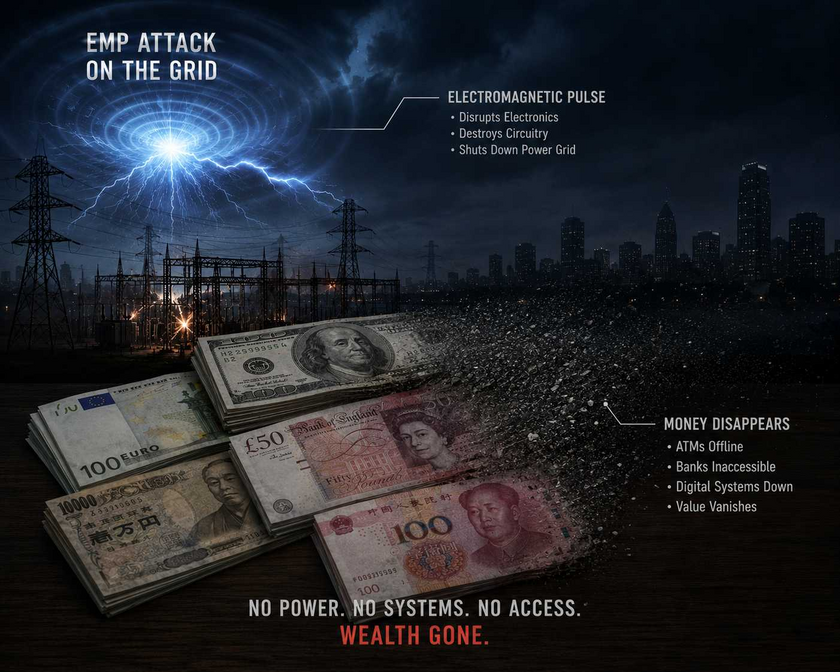
Consider not catastrophe but interruption. Consider a Carrington-scale solar event, a successful cyberattack, a cascading grid failure, or an electromagnetic pulse. The specific mechanism matters less than the principle. The lights go out. The servers stop responding. The networks cease synchronizing. The endless choreography of verification pauses. Legal claims may survive. Contracts may survive. Accounting entries may survive. Yet the practical ability to verify, transfer, access, or exercise those claims becomes uncertain. The abstractions remain theoretically intact while becoming functionally irrelevant.

Gold occupies a peculiar place within this thought experiment because it exists outside the thought experiment. It requires no password, no network connection, no authentication server, no intermediary, and no continuous electrical infrastructure to affirm its existence. The ledger may disappear. The gold remains. Whether one views gold as a monetary asset, a strategic reserve, or simply a historical curiosity, its persistence reveals something deeper about the nature of value itself. Assets that derive their existence from the systems that record them are fundamentally different from assets that exist independently of those systems.

What fascinates me, however, is not the rhetoric surrounding the so-called Great Reset, because the phrase itself has become one of the most effective distractions of the modern era. During the COVID years, populations were conditioned into increasingly reflexive forms of polarization in which every issue was immediately translated into opposing camps, every observation became a declaration of allegiance, and every question became a test of ideological loyalty. One side treated the Great Reset as evidence of a coordinated conspiracy while the other dismissed it as evidence of irrational paranoia. Both reactions produced the same outcome. Attention became fixed upon the slogan while remaining safely distant from the structure beneath it.

History has never required a committee to produce a reset. Resets emerge whenever claims become sufficiently detached from assets, whenever promises become sufficiently detached from productive capacity, whenever leverage becomes sufficiently detached from resilience, and whenever abstractions become sufficiently detached from reality. Long before a reset acquires a name, it exists as a tension embedded within the architecture itself.

This is why the most revealing actions in history are rarely the ones announced from podiums. They are the quiet movements that occur beneath the rhetoric. While populations argue over narratives, central banks move bullion. While commentators debate ideology, nations secure custody. While attention remains fixed upon political theater, the custodians of monetary power appear to be asking an older and more fundamental question concerning what survives when confidence falters, when access becomes uncertain, and when the systems responsible for recording ownership can no longer be assumed to function exactly as they did yesterday.

History repeatedly demonstrates that major transitions rarely emerge from the causes later assigned to them. Wars, sovereign defaults, financial crises, technological disruptions, infrastructure failures, and natural disasters frequently function as explanatory narratives that make visible contradictions that had already been accumulating for decades. The triggering event receives the blame because it is easier to understand than the architecture that rendered the event consequential. Yet the architecture is always where the real story resides. The event merely exposes what was already true.

Seen from this perspective, the most important question is not whether a particular organization intends to implement a Great Reset. The more important question concerns the conditions under which resets become inevitable. Whenever claims multiply faster than assets, whenever obligations expand faster than productive capacity, whenever financial abstractions drift sufficiently far from physical realities, tensions accumulate that eventually demand reconciliation. That reconciliation may arrive through inflation, restructuring, default, crisis, technological disruption, or events conveniently attributed to forces beyond human control, but the mechanism remains secondary to the principle. Reality eventually reasserts itself because reality is the only foundation upon which any abstraction can ultimately stand.

Viewed through that lens, the repatriation of gold appears less like a financial decision than an institutional acknowledgment that the distinction between claims and assets still matters. It represents a quiet recognition that resilience and possession acquire increasing importance precisely when complexity and uncertainty begin to rise. It suggests that beneath the public narratives, beneath the political theater, and beneath the endless distractions that dominate contemporary discourse, some of the world's most consequential actors may be asking the same question that inspired an essay sixteen years ago. What do you actually possess when the systems recording possession become uncertain?

The question is not fundamentally about gold. It is not fundamentally about vaults. It is not fundamentally about central banks. It is a question about the difference between a thing and a description of a thing, between ownership and access, between claims and assets, between abstractions and realities. It is the question that emerges whenever a civilization becomes sufficiently dependent upon representations that it forgets to examine the realities those representations are intended to describe.

Sixteen years ago I asked what was in your wallet. Watching nations quietly move bullion across oceans and into sovereign custody, the question feels sharper today than it did then. Not because the answer has changed, but because the institutions themselves appear increasingly unwilling to pretend that a claim and an asset are the same thing. The distinction sounded eccentric in 2010. It sounds increasingly obvious in 2026. The most interesting question is whether the rest of us will recognize the significance of that realization before history once again forces the issue on its own terms.

Source

🙏To support my work, Helping to keep the signal high and the noise low:

👉 Cashapp: $thedinarian

👉 Buy me a coffee: https://buymeacoffee.com/thedinarian

👉 PayPal: Scan the QR code below 📲 or Click Here: 

👇 Crypto Donations 👇

XRP: r9pid4yrQgs6XSFWhMZ8NkxW3gkydWNyQX
XLM: GDMJF2OCHN3NNNX4T4F6POPBTXK23GTNSNQWUMIVKESTHMQM7XDYAIZT
XDC: xdcc2C02203C4f91375889d7AfADB09E207Edf809A6

Read full Article
post photo preview
⚠️90 DAYS WITHOUT THE GRID⚠️
Why Governments Are Preparing for Critical Systems to Fail

MIND BEND THEORY | DOCUMENTED INVESTIGATION

The United States is preparing major military installations to continue operating if civilian infrastructure goes down. Britain is telling households to prepare for days without essential services. India is warning that an attack on the financial system can weaken a nation. And the Bank of England is asking what happens when cyber defenses fail—not if they can prevent every attack.

Individually, each development has an explanation.

Put them beside one another, however, and a larger pattern becomes visible.

Over the span of only a few weeks, governments and financial authorities in the United States, United Kingdom and India have publicly discussed preparations for disruptions involving some of the systems modern society depends upon most:

Power.

Water.

Fuel.

Communications.

Banking.

Supply chains.

This does not establish that these governments are preparing for one secret event.

There is no public evidence of a coordinated countdown, predetermined blackout date or single intelligence warning connecting them.

But there is something here that can be documented.

Governments are increasingly planning around a question that sounds very different from traditional emergency preparedness:

What happens when the systems we normally assume will be available are no longer available?

And in the United States, that question has now reached the Pentagon.

DOCUMENT 01

UNITED STATES — FORTRESS AMERICA

On September 30, 2026, Defense Secretary Pete Hegseth established a program called FORTRESS America.

The acronym stands for:

Federal Operations for Resilience, Troop Resources, Energy, Supply and Survivability.

The program addresses a vulnerability that rarely receives much public attention:

The world's most powerful military still depends extensively on civilian infrastructure.

Electric grids.

Commercial supply chains.

Communications infrastructure.

Fuel.

Foreign sources of critical materials.

FORTRESS America is intended to reduce those dependencies.

The Pentagon's own public description says the initiative is designed to ensure that major U.S. military installations generate independent power so that bases remain operational even if the civilian grid is taken down by cyberattack or sabotage.

It goes beyond electricity.

The program includes five major areas:

Energy independence

Installation hardening and cyber resilience

Supply-chain and defense-industrial-base resilience

Strategic defense reserves

Space and spectrum resilience

The Pentagon also wants deeper reserves of critical supplies so military operations can continue when ordinary supply lines are disrupted.

The underlying idea is simple:

The military should be capable of functioning even when the infrastructure surrounding it cannot.

An October 7 implementation memorandum obtained by DefenseScoop shows that the Pentagon had already begun establishing the FORTRESS America Program Office and assigning officials to implement those objectives.

Then another piece of the story emerged.

DOCUMENT 02

THE 90-DAY REQUIREMENT

On October 25, Fox News published details from additional FORTRESS America documents its reporters reviewed.

According to that reporting, major continental U.S. military installations are being prepared to sustain essential operations for at least 90 days without outside support.

The essential systems reportedly include:

Power.

Water.

Fuel.

Communications.

Think about the distinction carefully.

The Pentagon isn't telling Americans that the United States will lose electricity for 90 days.

It isn't predicting a 90-day blackout.

Military contingency planning deliberately prepares for scenarios officials hope never occur.

But preparing installations for this possibility tells us something about the scenario being considered.

The Pentagon is building resilience around the possibility that a sufficiently serious conflict or attack could interfere with the civilian systems on which military installations normally depend.

The publicly released FORTRESS material specifically discusses:

Cyberattack.

Sabotage.

Grid disruption.

Foreign supply-chain disruption.

Attacks against installations.

And prolonged military contingencies.

That makes the 90-day requirement significant—but it must be described accurately.

Mind Bend Theory verification note:

The September 30 FORTRESS America program itself is documented publicly.

The October 7 implementation memorandum has been reported and described by DefenseScoop.

The 90-day requirement, however, currently comes from documents reviewed by Fox News, rather than a primary 90-day document independently published for the public.

That distinction matters.

We follow the documents as far as they take us—and no farther.

DOCUMENT 03

UNITED KINGDOM — BE READY FOR THREE DAYS

Now cross the Atlantic.

On October 22, the British government launched its new Be Ready campaign.

This time the audience wasn't the military.

It was ordinary households.

The UK government is asking households that are able to do so to prepare to remain self-sufficient for approximately three days during an emergency.

The government specifically discusses disruptions affecting:

Power.

Water.

Phones.

Internet access.

A Parliamentary Written Statement issued the same day explicitly states:

“The updated advice calls on households to be self-sufficient for three days in the case of an emergency.”

The government recommends maintaining three days of bottled water and non-perishable food.

Its expanded preparedness guidance includes:

Approximately three litres of drinking water per person per day

Three days of non-perishable food

Battery-powered or wind-up radio

Torch and spare batteries

Charged power bank

Essential medications

First-aid supplies

Blankets and warm clothing

Important telephone numbers written down

Basic hygiene supplies

Cash

Why cash?

Because during some disruptions, electronic payment systems and ATMs may not function normally.

That creates an important connection between infrastructure and finance.

Electricity isn't isolated from banking.

Communications aren't isolated from payments.

Modern infrastructure is interconnected.

And failure can move through those connections.

DOCUMENT 04

INDIA — “WARS ARE NOT FOUGHT WITH WEAPONS ALONE”

Three days later, on October 25, another statement appeared.

This one came from Indian Prime Minister Narendra Modi.

Modi was inaugurating the Reserve Bank of India's newly established Data Centre and Cybersecurity Training Institute in Bhubaneswar.

The facilities are designed to strengthen the technological foundations and cybersecurity resilience of India's financial system.

Four data centres will host mission-critical payment and settlement systems.

But Modi's explanation of why this matters went beyond ordinary cybersecurity.

His official statement says:

“Nowadays, wars are not fought with weapons alone; a nation can also be weakened by attacking its economy.”

He continued by saying India's growing economy requires its banking system to be protected against cyber looters and cyber terrorists.

That puts another critical system into the picture:

Money.

A modern economy depends on digital banking infrastructure almost as heavily as it depends on electricity and telecommunications.

Payment systems move commerce.

Banks hold liquidity.

Settlement systems move money between financial institutions.

Data centres keep those networks functioning.

Disrupt the financial infrastructure badly enough and the consequences don't remain inside banks.

They reach businesses.

Supply chains.

Payroll.

Purchasing.

Markets.

And households.

DOCUMENT 05

BANK OF ENGLAND — WHAT IF CYBER DEFENSE FAILS?

There is another document worth reading.

On June 30, Bank of England Deputy Governor Sarah Breeden delivered a speech titled:

“Agents of Change.”

The subject was artificial intelligence and financial stability.

One section deserves particular attention.

Breeden warned that advanced AI systems are becoming increasingly capable of identifying and chaining together cyber vulnerabilities.

That changes the nature of cyber risk.

AI can help defenders.

But the same capabilities can potentially increase the speed and effectiveness of attackers.

The important change in thinking comes afterward.

Preventing attacks is no longer enough.

Financial institutions must also prepare to recover after a successful attack.

Breeden raised the possibility of simultaneous disruption across multiple financial firms.

She then asked whether critical financial institutions may eventually require completely separate failover capabilities—or even the ability to rebuild compromised core systems from “bare metal.”

In October, Reuters reported that the Bank of England was pushing financial institutions further toward this type of recovery planning.

That represents a subtle but significant change in the question.

It isn't simply:

How do we stop the attack?

It's becoming:

What happens if we don't?

And:

How do we keep the system functioning afterward?

CONNECT THE DOCUMENTS

Now put the documents beside one another.

UNITED STATES

Military installations are being hardened so essential operations can continue when civilian infrastructure is disrupted.

UNITED KINGDOM

Households are being told to prepare for three days without services they normally assume will remain available.

INDIA

The prime minister publicly warns that modern conflict can weaken a country by attacking its economy and calls for stronger protection of banking infrastructure.

BANK OF ENGLAND

Financial authorities are examining recovery scenarios in which cyber defenses have already failed and multiple institutions could potentially be disrupted simultaneously.

These aren't identical programs.

They aren't even aimed at the same people.

And there is currently no public evidence demonstrating that they were coordinated.

But they share one important assumption:

CRITICAL SYSTEMS CAN FAIL.

And resilience therefore cannot begin after the failure occurs.

It has to exist beforehand.

THE SYSTEM BEHIND THE SYSTEM

This is where the story becomes bigger than individual announcements.

Modern infrastructure isn't a collection of isolated systems.

It's a network.

Consider what happens when electricity fails.

Without power, telecommunications eventually become difficult to maintain.

Without communications, electronic payments can be affected.

Fuel pumps require electricity.

Water systems depend on pumping and treatment infrastructure.

Businesses depend on payment processing.

Supply chains depend on communications, transportation and fuel.

Hospitals require electricity, communications, water, medicine and logistics simultaneously.

A serious disruption doesn't necessarily remain inside the system where it started.

It can propagate.

POWER → COMMUNICATIONS → BANKING → COMMERCE → SUPPLY CHAINS

And the dependency runs in multiple directions.

That interconnectedness is precisely why governments plan for resilience.

WHAT THIS DOES NOT PROVE

Mind Bend Theory exists to examine unusual patterns.

But a pattern isn't automatically proof of a conspiracy.

There is currently no public evidence showing that Washington, London and New Delhi are secretly preparing for the same scheduled event.

There is no verified date for a coming global blackout.

There is no public document establishing an imminent 90-day collapse of the American electrical grid.

And the Pentagon's 90-day military resilience requirement should not be interpreted as a prediction that Americans will lose electricity for 90 days.

That would go beyond the evidence.

What the evidence actually establishes is interesting enough.

Governments increasingly consider disruption of power, communications, supply chains and financial infrastructure plausible enough to justify concrete preparation.

The UK is preparing households.

The United States is hardening military infrastructure.

India is strengthening the technological backbone of its financial system.

The Bank of England is thinking about how banks recover after cyber defenses fail.

That isn't speculation.

It's in the documents.

THE QUESTION

Perhaps the most important change isn't what governments believe will happen.

It's what they're preparing to survive.

For decades, infrastructure security focused heavily on preventing failure.

The emerging model looks different:

Assume something eventually gets through.

Assume something eventually goes down.

Build the ability to continue operating anyway.

The Pentagon calls that resilience.

The UK calls it being ready.

Central banks call it operational resilience.

Different terminology.

Same fundamental question:

WHAT STILL WORKS WHEN THE SYSTEM DOESN'T?

DOCUMENT TRAIL

Read the Evidence Yourself

Mind Bend Theory strongly encourages readers to examine the original material rather than relying solely on our interpretation.

🇺🇸 DOCUMENT 01 — FORTRESS America Establishment

September 30, 2026

Defense Secretary Pete Hegseth's memorandum establishes FORTRESS America as a Department of Defense resilience program.

The publicly reported memorandum establishes the program around installation resilience, independent energy, strategic reserves, supply chains and related national-defense infrastructure.

Source type: Pentagon memorandum / official announcement.

🇺🇸 DOCUMENT 02 — FORTRESS America Implementation Memorandum

October 7, 2026

DefenseScoop obtained the memorandum from Under Secretary for Acquisition and Sustainment Michael Duffey directing officials to begin operationalizing the FORTRESS America Program Office.

It identifies five foundational pillars, including energy independence, installation hardening and cyber resilience, strategic reserves and supply-chain resilience.

Source type: Pentagon memorandum obtained by DefenseScoop.

🇺🇸 DOCUMENT 03 — 90-Day FORTRESS Requirement

October 25, 2026

Fox News reports that documents it reviewed require major continental U.S. installations to sustain essential operations for at least 90 days without outside support.

Source type: Journalistic reporting based on documents reviewed by reporters.

Important: This is not currently being presented by Mind Bend Theory as a publicly released primary 90-day Pentagon document.

🇬🇧 DOCUMENT 04 — UK Cabinet Office Be Ready Announcement

October 22, 2026

The Cabinet Office announces the three-year Be Ready campaign and describes preparation for disruption affecting power, water, phones and internet.

Source type: Official UK government publication.

🇬🇧 DOCUMENT 05 — Parliamentary Written Statement HCWS409

October 22, 2026

The UK Parliament records the government's explicit recommendation that households prepare to remain self-sufficient for three days.

Source type: Official Parliamentary record.

🇬🇧 DOCUMENT 06 — Be Ready Household Emergency Checklist

The government's practical household guidance provides recommendations for water, food, radio, lighting, medication, power banks, emergency cash and other supplies.

Source type: Official UK government preparedness guidance.

🇮🇳 DOCUMENT 07 — Prime Minister of India / RBI Cybersecurity Facilities

October 25, 2026

Official statement documenting the opening of the Reserve Bank of India's Data Centre and Cybersecurity Training Institute and Modi's warning that countries can be weakened through attacks against their economies.

Source type: Official Government of India statement.

🇬🇧 DOCUMENT 08 — “Agents of Change” — Sarah Breeden

June 30, 2026

The Bank of England deputy governor discusses rapidly advancing AI cyber capabilities, simultaneous disruption across financial institutions, separate failover infrastructure and potentially rebuilding compromised systems from bare metal.

Source type: Official Bank of England speech.

DOCUMENT 09 — Bank of England Cyber-Recovery Reporting

October 15, 2026

Reuters reports on the Bank of England's push for stronger recovery capabilities against AI-enabled cyberattacks, including bare-metal recovery.

Source type: Independent reporting.

MIND BEND THEORY

Follow the documents. Separate what they prove from what they don't.

Then ask why the preparation is happening now.

Documents attached to the investigation

FORTRESS America — Sept. 30 memorandum record
Pentagon FORTRESS America implementation memorandum — DefenseScoop
FORTRESS America 90-day documents — Fox News investigation
UK Cabinet Office — Be Ready announcement
UK Parliament — Written Statement HCWS409
India PM's Office — RBI Data Centre & Cybersecurity Training Institute
Bank of England — Sarah Breeden, “Agents of Change”
Reuters — Bank of England cyber-recovery warning

Source

🙏To support my work, Helping to keep the signal high and the noise low:

👉 Cashapp: $thedinarian

👉 Buy me a coffee: https://buymeacoffee.com/thedinarian

👉 PayPal: Scan the QR code below 📲 or Click Here: 

👇 Crypto Donations 👇

XRP: r9pid4yrQgs6XSFWhMZ8NkxW3gkydWNyQX
XLM: GDMJF2OCHN3NNNX4T4F6POPBTXK23GTNSNQWUMIVKESTHMQM7XDYAIZT
XDC: xdcc2C02203C4f91375889d7AfADB09E207Edf809A6

Read full Article
September 13, 2026
post photo preview
Revolut Leak Shows the Cost of Constant ID Collection
Revolut’s mistake is the news, but the bigger problem is the growing number of companies being encouraged or required to keep copies of our most sensitive identity documents.

Online bank Revolut has revealed that it gave out sensitive personal and financial information of an undisclosed number of its customers in response to a fake government request.

The information that was handed over to an “unauthorized third party” reportedly includes names, dates of birth, occupations, addresses, phone numbers, account numbers, transaction histories (including Bitcoin), and even copies of government-issued IDs and onboarding verification selfies.

Revolut claims that derived biometric face data was not.

The company said that the data was handed over in response to an email that came from a real government agency’s domain, but was not actually sent or authorized by that agency.

The email passed several authentication checks (SPF, DKIM, and DMARC) that are designed to establish the authenticity of a message’s origin and integrity, but do not verify the legitimacy of the legal request itself.

Revolut said that it complied with the request “under the reasonable belief that it was an authentic government agency request” – and only later found out that it was not.

Revolut said it later realized its mistake, blocked the email address, and reported the incident to the relevant authorities.

Revolut said that only a “limited” number of its customers were affected by the data leak, and that the company’s systems were not hacked, nor was any money stolen.

The story broke on September 11 when Revolut customers started receiving an email notice about a data leak, and the news was picked up by media outlets the following day.

Revolut notice explaining customer identity and financial data was shared after an unauthorized government email request.

The reason this is a recurring problem is that companies are keeping highly sensitive information about their customers’ identities, and sometimes even financial transactions, for a long time, and this data is then available to be disclosed to third parties – either in response to valid legal requests, or, as in the case of Revolut, fake ones.

One reason for this is know your customer (KYC) and anti-money laundering (AML) rules. Revolut’s current UK customer privacy notice spells it out: the company generally keeps personal data of UK customers for no more than seven years after the relationship ends, and sometimes longer – for legal reasons.

This means that even if you close your account, your identity documents don’t disappear.

And while the incident with Revolut happened in the financial sector, it’s by no means the only one that requires customers to hand over sensitive identity information. Discord, a popular chat service, said in an October 9, 2025 security update that government ID photos of approximately 70,000 users may have been exposed after a third-party customer service provider got hacked.

This was not a financial service, nor the same type of attack. But the result was similar – because the underlying business process was the same: requiring and storing sensitive identity documents. In the case of Discord, these were used to review age-related appeals.

It’s hard to do anything about a copy of your old passport, or a photo of your face, or a record of your past transactions. These can be used to identify and profile you, and can be used to carry out targeted fraud. And this can happen even if the initial disclosure didn’t result in financial loss.

The more companies are forced to collect and store such information, and the more of it they have, the more opportunities there are for this data to be leaked, either by the company itself or a third party it works with. That's what makes governments' push for more ID checks just to access ordinary parts of life so reckless.

Source

🙏To support my work, Helping to keep the signal high and the noise low:

👉 Cashapp: $thedinarian

👉 Buy me a coffee: https://buymeacoffee.com/thedinarian

👉 PayPal: Scan the QR code below 📲 or Click Here: 

👇 Crypto Donations 👇

XRP: r9pid4yrQgs6XSFWhMZ8NkxW3gkydWNyQX
XLM: GDMJF2OCHN3NNNX4T4F6POPBTXK23GTNSNQWUMIVKESTHMQM7XDYAIZT
XDC: xdcc2C02203C4f91375889d7AfADB09E207Edf809A6

Read full Article
See More
Available on mobile and TV devices
google store google store app store app store
google store google store app tv store app tv store amazon store amazon store roku store roku store
Powered by Locals