Dinarian888
News • Business • Investing & Finance
šŸ’„BLAZESWAP WOULD BE THE FIRST AND ONLY DECENTRALIZED EXCHANGE ON FLAREšŸ’„
October 28, 2022
post photo preview

BlazeSwap, the first-ever DEX on Flare’s upcoming mainnet, it is going to advance yield farming

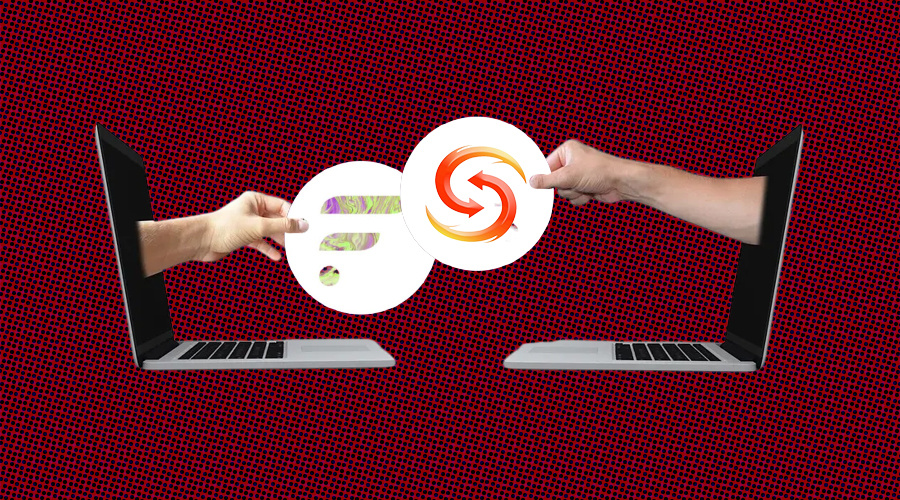
BlazeSwap, the Flare Network’s first open-source,Ā decentralized exchange, says it provides users with Flare’s pricing oracle delegation and network airdrop incentives in addition to liquidity provider fees. Once the blockchain breaks observation mode, BlazeSwap will be activated on Flare. In addition, BlazeSwap would be the first and onlyĀ DEXĀ on Flare and will charge liquidity provider fees, providing users with network airdrop benefits and Flare’s price oracle delegation.

Comparable to staking but based on proven reliability, FTSO delegation compensates token holders who actively delegate to the most trustworthy FTSO price providers. BlazeSwap implements this Flare-native functionality, providing a more lucrative earnings structure by combining the conventional incentives for DEX Liquidity Providers from pool trading fees with the native FTSO advantages.

Hugo Philion, Flare CEO & Co-founder said, ā€œWe are thrilled to see Blazeswap integrating Flare’s native data infrastructure to offer a new way of doing DeFi. This is exciting news, not only for BlazeSwap and Flare, but also the broader Web3 and DeFi communities. We look forward to seeing what other innovative products our growing developer base will be able to build using Flare’s native protocols.

BlazeSwap: Need of the hour

Based on the same Automated Market Maker (AMM) model as Uniswap V2, BlazeSwap has completed an audit by Omniscia. However, contributors to BlazeSwap’s liquidity pools will be eligible to receive a share of the delegation reward pool token payouts, if Flare Improvement Proposal 01, FIP.01, is approved by the community.

Also, BlazeSwap pools allow automatic delegation in a new way, to give data providers access to Flare’s native decentralized price oracle, the Flare Time Series Oracle (FTSO). FTSO represents delegation and distributes network benefits to the most reputable FTSO value sources and the token owners who actively delegate to them.

Moreover, this Flare-native capability is implemented into BlazeSwap, providing an improved structure that combines the organic FTSO benefits with the standard DEX Liquidity Provider rewards from pool trading fees. Furthermore, BlazeSwap allows FLR holders to reap the benefits of trading on the DEX, increasing network security and offering liquidity.

BlazeSwap will be launched on Flare’s mainnet as soon as the blockchain exits observation mode. Alex Dupre, BlazeSwap founder, is excited by the innovation his product brings to Flare’s ecosystem of dApps:

After months of development we’ve been very happy to see the enthusiasm from Flare’s community about the launch of the alpha version of BlazeSwap on the Coston testnet. The speed of the Flare network, its low gas fees and its goal to ā€œconnect everythingā€ make it a perfect match with our decentralized exchange. Its full integration with Flare’s native components is what the community has been waiting for, in order to demonstrate and fully unlock the network’s potential. We’ll soon be announcing a bug bounty program to further strengthen the security of our platform. We are now eager to roll out the final version of the smart contracts on Songbird, and later on Flare, and to continue working on the user interface and third party integrations, listening to the feedback from our awesome user base.

About Flare

FlareĀ is a new blockchain built to connect everything. It presents developers with a single, simple, coherent stack to build applications that are fully cross-chain capable. Flare’s protocols will provide

(1) scalable EVM-based smart contracts

(2) truly decentralized price feeds

(3) secure state acquisition from other blockchains via the first consensus protocol for external data

(4) insured smart contract token bridging

(5) non-smart contract token bridging

(6) secured data relay

(7) horizontal scaling through a fully interoperable multi-chain ecosystem. This will allow developers to serve multiple communities and ecosystems simultaneously through a single deployment on Flare.

About BlazeSwap

BlazeSwapĀ is the first open-source, fully decentralized exchange on the Flare Network. Developed by the same team behindĀ A-FTSO, it aims to become the best and cheapest place to swap and earn fees from all tokens on the Flare network. Supplying to BlazeSwap allows FLR token holders to receive full FTSO rewards from inflation and FIP.01 (should it pass), avoiding the dilemma of staking versus providing liquidity in pools.


Link

community logo
Join the Dinarian888 Community
To read more articles like this, sign up and join my community today
0
What else you may like…
Videos
Podcasts
Posts
Articles
You don't live in 3 dimensions. šŸ“

You never have. 🚫

A high school student just proved why everything you learned about reality is incomplete. šŸ«āœØ

This will break your brain: šŸ§ šŸ’„

Look at any object near you — a cup, a book, or your phone. ā˜•šŸ“–šŸ“±

Notice how every one of them casts a shadow, and that shadow is always flatter than the object itself:

A 3D cup makes a 2D shadow on your desk. ā˜• āž” 🟦

A 2D piece of paper makes a 1D line on the wall. šŸ“„ āž” āž–

Every dimension drops a flatter version of itself into the dimension below. šŸ“‰

Now flip that idea around. šŸ”„

If your body is 3D, and the pattern always works the same way... your body might be the shadow of something 4D that you can't see. šŸ‘¤āœØ

You might not be the real thing. 🤯

There's a shape called a tesseract that describes this:

šŸ“¦ A cube is 6 flat squares folded together.

šŸ”® A tesseract is 8 cubes folded together in a direction that doesn't exist in our world.

You can't picture it. Nobody can. āŒ Your brain was built to help your ancestors dodge tigers and find ...

00:09:04
How does AI actually understand sign language? 🤟✨

​It takes way more than tracking fingers:

āœ‹ Hands: Geometry & visual shape
šŸ‘ļø Face: Expression & non-manual markers
šŸ•ŗ Body: Posture & spatial movement
ā³ Time: Learning how all 3 streams evolve together

​Incredible look inside the early UMI / @umi_sn78 research pipeline. Showing real baselines, finding where meaning gets lost, and building better models.

​From motion to meaning. šŸš€ $UMI on #Bittensor

00:00:29
September 07, 2026
āš ļø The UN Has Just Made This Mandatory Worldwide āš ļø
00:03:14
🚨 Chutes is being framed as a Hyperliquid-style breakout for decentralized AI inference, with live revenue, verified GPU infrastructure, and a direct challenge to centralized cloud AI 🚨

Chutes is gaining attention as a decentralized AI inference platform that claims to combine real usage, cryptographic verification, confidential computing, and open-source infrastructure into a working production system. The thesis is simple: instead of trusting Big Tech clouds with AI workloads, users get a distributed compute layer built around verification and privacy.

šŸ”‘ Key points

šŸ”¹ Chutes is live in production and reportedly scaled to more than 1,170 active GPU nodes, including large numbers of Nvidia H200s and Blackwell-class hardware.

šŸ”¹ The platform says it has processed nearly 38 trillion tokens since launch across 53 deployed applications and more than 700,000 registered users.

šŸ”¹ The team reportedly cut unprofitable usage programs, reduced total token volume, and still improved revenue efficiency, with revenue per GPU rising sharply after removing subsidized traffic.

šŸ”¹ Chutes is using post-quantum cryptography, trusted execution environments, and Nvidia confidential ...

🚨 Chutes is being framed as a Hyperliquid-style breakout for decentralized AI inference, with live revenue, verified GPU infrastructure, and a direct challenge to centralized cloud AI 🚨
🚨 JPMorgan’s criticism of the CLARITY Act is fueling a fresh power struggle over who gets to write America’s crypto rules 🚨

A new clash is emerging between legacy finance and crypto legislation after JPMorgan CEO Jamie Dimon reportedly warned that the CLARITY Act could let crypto firms offer bank-like products without bank-level oversight. The dispute is quickly turning into a larger fight over regulation, competitiveness, and who controls the future architecture of digital finance in the United States.

šŸ”‘ Key points

šŸ”¹ Jamie Dimon reportedly called the CLARITY Act a threat to the financial system, arguing it could allow crypto firms to offer yield-like products while avoiding the capital, reserve, and oversight burdens traditional banks face.

šŸ”¹ Senator Cynthia Lummis pushed back publicly, framing the issue as a global strategic race and warning that if the U.S. does not set digital asset standards, other powers will.

šŸ”¹ The core tension is whether the bill creates legitimate regulatory clarity or simply opens the door to regulatory arbitrage for crypto platforms operating outside the traditional banking...

🚨 JPMorgan’s criticism of the CLARITY Act is fueling a fresh power struggle over who gets to write America’s crypto rules 🚨
šŸ‘‰ Coinbase just launched an AI agent for Crypto Trading

Custom AI assistants that print money in your sleep? šŸ”œ

The future of Crypto x AI is about to go crazy.

šŸ‘‰ Here’s what you need to know:

šŸ’  'Based Agent' enables creation of custom AI agents
šŸ’  Users set up personalized agents in < 3 minutes
šŸ’  Equipped w/ crypto wallet and on-chain functions
šŸ’  Capable of completing trades, swaps, and staking
šŸ’  Integrates with Coinbase’s SDK, OpenAI, & Replit

šŸ‘‰ What this means for the future of Crypto:

1. Open Access: Democratized access to advanced trading
2. Automated Txns: Complex trades + streamlined on-chain activity
3. AI Dominance: Est ~80% of crypto šŸ‘‰txns done by AI agents by 2025

🚨 I personally wouldn't bet against Brian Armstrong and Jesse Pollak.

šŸ‘‰ Coinbase just launched an AI agent for Crypto Trading

What if Subnet.tv becomes the ultimate channel connecting the entire Bittensor ecosystem to the outside world? šŸ“ŗĻ„

We all know @Rapido_ai—someone who relentlessly gives back to the network. After delivering TaoSwap (arguably the cleanest UI in the ecosystem) and pushing forward with Kusanagi Ventures, he’s now dropping subnet.tv. 🧠⚔

Bittensor’s true superpower has always been decentralized synergy: individuals and teams combining skill sets to build something far greater than themselves. šŸ¤šŸ”„

Now imagine taking that collective energy and building a 24/7 global media machine to cover the expanding universe across all 128 subnets:

šŸŽ™ļø Podcasts & Founder Interviews
šŸ“Š Ecosystem Analytics & Reports
šŸ’” Live Product Demos & AI Showcases
🌐 Multilingual Translations & Educational

šŸ“° Breaking News & Alpha: Bittensor doesn't lack groundbreaking tech or content—it lacks a unified distribution machine. šŸš€

šŸ’” A word for Subnet Owners: If you're genuinely building value, media ...

post photo preview

šŸ¤– Best blockchains for building AI applications: infrastructure matters more than hype šŸ¤–

Different blockchains serve different AI needs. The right network depends on whether an application requires model incentives, GPU compute, decentralized storage, smart contracts, privacy, or high-speed payments.

šŸ”‘ Key points šŸ‘‡ šŸ˜‰

šŸ”¹ Bittensor targets AI-native markets: Subnets coordinate miners and validators around inference, training, data, cybersecurity, robotics, and other specialized AI services.

šŸ”¹ Ethereum provides composability: Its smart-contract ecosystem supports AI marketplaces, payments, identity, ownership, and DeFi integrations.

šŸ”¹ Solana emphasizes speed: High throughput and low fees can support AI agents, micropayments, consumer applications, and real-time interactions.

šŸ”¹ Internet Computer focuses on onchain applications: Developers can run more application logic directly on the network rather than relying entirely on external servers.

šŸ”¹ NEAR supports account abstraction and AI ...

post photo preview

šŸ›¢ļø Brent crude crosses $100 as Strait of Hormuz tensions shake global energy markets šŸ›¢ļø

Brent crude has climbed above $100 per barrel for the first time since July 24, while West Texas Intermediate also surged as traders assessed growing risks to oil supplies moving through the Strait of Hormuz.

šŸ”‘ Key points

šŸ”¹ Brent breaks $100: The global benchmark crossed the psychologically important level on September 9, 2026.

šŸ”¹ WTI also rises: U.S. crude prices climbed alongside Brent as energy markets reacted to supply concerns.

šŸ”¹ Strait of Hormuz is central: The waterway handles a significant share of global oil shipments, making any disruption a major market risk.

šŸ”¹ Geopolitical risk is driving the move: Traders are pricing in the possibility of shipping delays, restricted passage, attacks, or retaliatory action.

šŸ”¹ Supply disruption matters more than headlines: Prices will depend on whether oil flows are physically reduced or whether markets are reacting mainly to fear and risk premiums.

šŸ”¹ ...

post photo preview
post photo preview
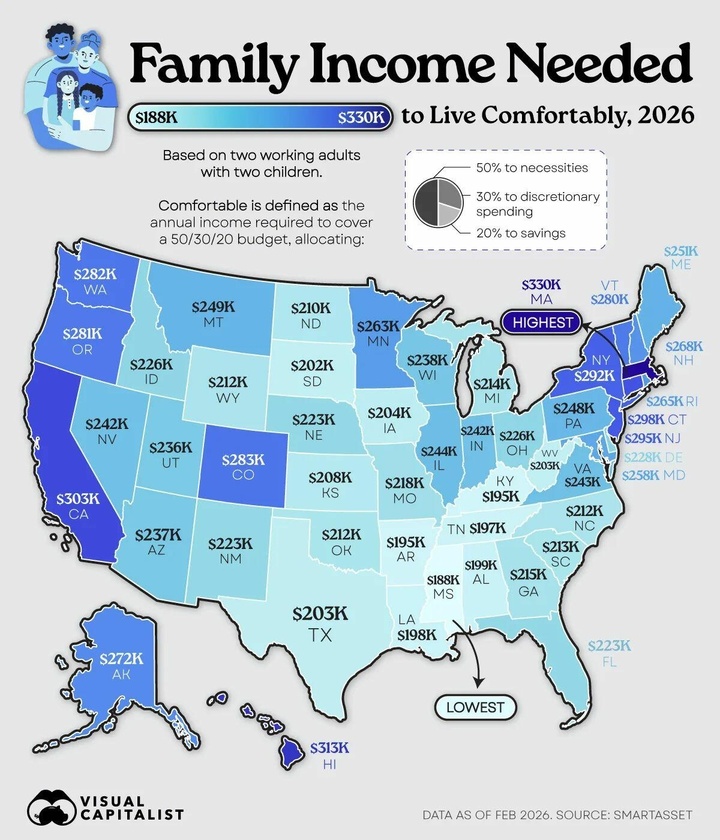
This Is The Income A Family Needs To Live Comfortably In Every US State

Here’s the short version of what it takes for a family of four to live comfortably in 2026 by state:

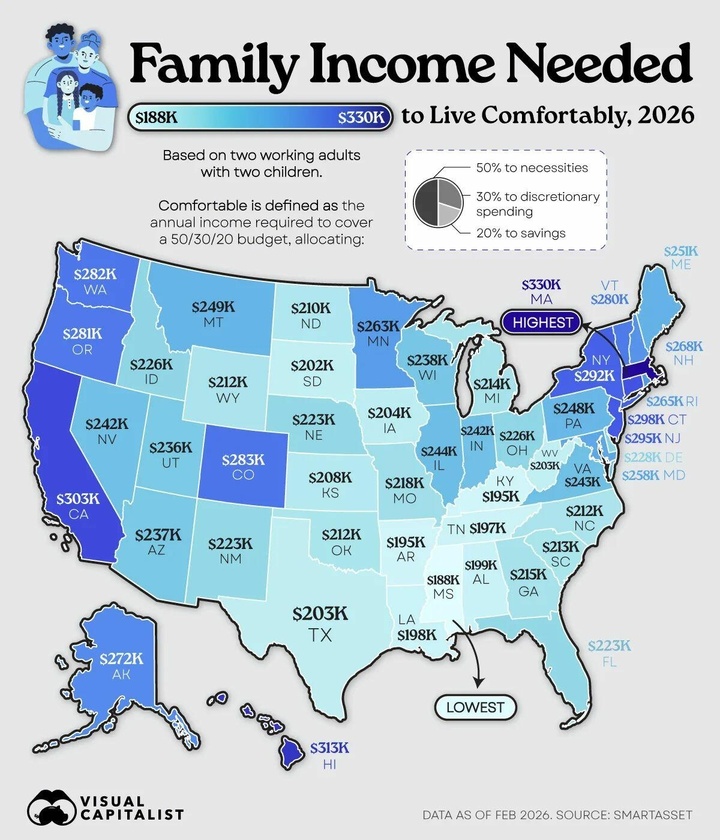
In Massachusetts, you’d need nearly $330,000 a year - the highest figure in the entire country. Only three states clear the $300,000 mark: Massachusetts, Hawaii, and California. At the other end of the spectrum, Mississippi is the most affordable at about $188,000. That’s a full $142,000 less than what you’d need in Massachusetts.

So… how much does a family of four need in your state?

This map shows the pre-tax income a household with two working adults and two kids needs to live comfortably in every U.S. state.

The numbers come fromĀ SmartAssetĀ (as of February 2026). They’re based on the familiar 50/30/20 budget: 50% for necessities, 30% for discretionary spending, and 20% for savings or other goals. These aren’t bare-minimum survival numbers—they’re what it takes to live pretty well while still putting money aside.

And asĀ Visual CapitalistĀ notes,Ā Massachusetts sits at the very top of that list.Ā Massachusetts tops the ranking, with a family of four needing $329,555 per year to meet the 50/30/20 benchmark.

Hawaii follows at $313,165, while California ranks third at $302,682.

Rank State Income needed for family of four (2026)

  • 1 - Massachusetts - $329,555
  • 2 - Hawaii - $313,165
  • 3 - California - $302,682
  • 4 - Connecticut - $298,189
  • 5 - New Jersey - $295,110
  • 6 - New York - $291,533
  • 7 - Colorado - $283,213
  • 8 - Washington - $281,798
  • 9 - Oregon - $280,966
  • 10 - Vermont - $280,384
  • 11 - Alaska - $272,064
  • 12 - New Hampshire - $267,904
  • 13 - Rhode Island - $264,659
  • 14 - Minnesota - $263,078
  • 15 - Maryland - $257,837
  • 16 - Maine - $250,931
  • 17 - Montana - $249,434
  • 18 - Pennsylvania - $247,936
  • 19 - Illinois - $244,109
  • 20 - Virginia - $242,944
  • 21 - Nevada - $242,278
  • 22 - Indiana - $241,696
  • 23 - Wisconsin - $238,451
  • 24 - Arizona - $236,870
  • 25 - Utah - $235,789
  • 26 - Delaware - $228,134
  • 27 - Ohio - $226,221
  • 28 - Idaho - $226,054
  • 29 - Florida - $223,392
  • 30 - New Mexico - $223,142
  • 31 - Nebraska - $223,059
  • 32 - Missouri - $217,734
  • 33 - Georgia - $214,573
  • 34 - Michigan - $214,323
  • 35 - South Carolina - $212,909
  • 36 - North Carolina - $212,410
  • 37 - Wyoming - $212,410
  • 38 - Oklahoma - $211,910
  • 39 - North Dakota - $210,496
  • 40 - Kansas - $207,917
  • 41 - Iowa - $204,422
  • 42 - Texas - $203,424
  • 43 - West Virginia - $202,592
  • 44 - South Dakota - $201,760
  • 45 - Alabama - $198,931
  • 46 - Louisiana - $197,933
  • 47 - Tennessee - $197,267
  • 48 - Arkansas - $195,437
  • 49 - Kentucky - $194,854
  • 50 - Mississippi - $187,533

Connecticut, New Jersey, and New York aren't far behind, bringing the number of states with comfortable-income thresholds above $290,000 to six.

Colorado and Vermont Make the Top 10

As expected, many of the highest income thresholds are concentrated in the Northeast and along the West Coast.

However, Colorado has the seventh-highest threshold in the country at $283,213, ranking above Washington and Oregon.

Vermont rounds out the top 10 at $280,384, despite having theĀ second-smallest populationĀ of any U.S. state. Meanwhile, nearby states like New Hampshire, Maine, and Rhode Island all fall outside the top 10.

Just Six States Come in Below $200,000

Despite theĀ wide range in living costsĀ across the country, only six states have a comfortable-income threshold below $200,000 for a family of four.

Mississippi ranks lowest at $187,533, followed by Kentucky.Ā The states of Arkansas, Tennessee, Louisiana, and Alabama also fall below the $200,000 mark.

The gap between Massachusetts and Mississippi exceeds $142,000 per year, meaning the Massachusetts benchmark is about 76% higher.

Source

šŸ™To support my work, Helping to keep the signal high and the noise low:

šŸ‘‰ Cashapp: $thedinarian

šŸ‘‰ Buy me a coffee: https://buymeacoffee.com/thedinarian

šŸ‘‰ PayPal: Scan the QR code below šŸ“² or Click Here:Ā 

šŸ‘‡ Crypto Donations Always Welcome šŸ‘‡

XRP: r9pid4yrQgs6XSFWhMZ8NkxW3gkydWNyQX
XLM: GDMJF2OCHN3NNNX4T4F6POPBTXK23GTNSNQWUMIVKESTHMQM7XDYAIZT
XDC: xdcc2C02203C4f91375889d7AfADB09E207Edf809A6

Read full Article
post photo preview
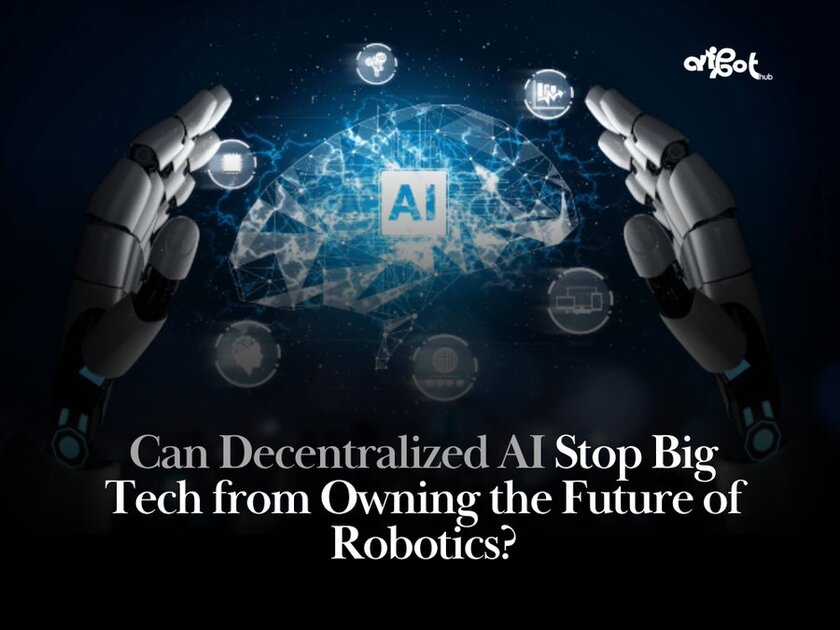
šŸ¤–Can Decentralized AI Stop Big Tech from Owning the Future of Robotics?šŸ¤–
The race to build the future of robotics is no longer just about robots. It's about who controls the intelligence behind them.
Ā 
Over the last three years, a small group of companies has emerged as the backbone of the AI revolution. Microsoft provides cloud infrastructure. NVIDIA supplies the chips. Google, OpenAI, Anthropic, Meta, and others develop the models. Together, they control much of the compute, data, and software stack powering modern AI.
Ā 
Now that AI is moving into the physical world, many are asking a bigger question:
Ā 
Will these same companies end up controlling robotics too?
Ā 
It's a valid concern.
Ā 
The latest generation of robots relies on enormous amounts of compute, simulation, training data, and foundation models. Many robotics startups today are built on infrastructure provided by large technology companies. NVIDIA's Omniverse is becoming a key simulation environment for robot training. Microsoft Azure is powering the training of robotics foundation models. Physical AI startups increasingly depend on hyperscale cloud infrastructure to train and deploy intelligent systems. Recent partnerships across the industry show just how central Big Tech has become to robotics development.
But while Big Tech is building the highways, another movement is trying to ensure it doesn't own every destination.
Ā 
That movement is decentralized AI.
Ā 
Why Decentralized AI Exists
Ā 
The idea behind decentralized AI is simple. Instead of a handful of companies owning the models, compute infrastructure, data pipelines, and intelligence networks, these resources are distributed across thousands of participants.
Ā 
This means anyone can contribute compute, contribute models, validate outputs and can participate.
The most visible example today is the decentralized AI network known as Bittensor (@bittensor). The network has evolved into a large ecosystem of specialized AI markets called subnets, where participants compete to provide useful machine intelligence and are rewarded based on performance. Rather than relying on a single company, intelligence is generated and validated by a distributed network of miners and validators.
Ā 
Think of it as an attempt to build an open marketplace for AI instead of a world where intelligence is rented from a few centralized providers.
Ā 
Why This Matters for Robotics
Ā 
Robotics has a unique problem. Unlike chatbots, robots operate in the physical world. They need to perceive environments, make decisions, move safely and they need to learn continuously.
Ā 
The challenge is that collecting and training on real-world robotic data is incredibly expensive. That's one reason large companies have such an advantage. They can afford the compute, simulation environments, and data infrastructure needed to train robotics models at scale.
Ā 
This is where decentralized systems become interesting.
Ā 
Instead of one company collecting all the data and training all the models, decentralized networks could allow thousands of contributors to participate in building robotic intelligence.
Ā 
Imagine a future where:
  • Warehouse robots contribute operational data.
  • Delivery robots contribute navigation data.
  • Factory robots contribute manipulation data.
  • Developers contribute models.
  • Validators evaluate performance.
The resulting intelligence becomes a shared network rather than a proprietary asset.
Ā 
That vision is beginning to emerge.
Ā 
Bittensor's Move Toward Physical AI
Ā 
While many people associate Bittensor (@bittensor) with language models and AI services, parts of the ecosystem are increasingly exploring embodied intelligence and robotics.
Ā 
One example is Kinitro, a subnet focused on incentivizing the training and evaluation of embodied AI systems. The goal is to create competitive environments where developers build robotic intelligence and are rewarded based on performance.
Ā 
The broader Bittensor ecosystem has also expanded into compute marketplaces, distributed inference systems, bandwidth infrastructure, and AI coordination layers that could eventually support robotics workloads. Several subnets now focus on decentralized compute, confidential inference, data transfer, and model training, critical components for future robotic systems.
Ā 
In other words, the pieces are starting to appear.
Ā 
Not a decentralized robot network yet.
Ā 
But the infrastructure that could support one.
Ā 
Beyond Bittensor: The Rise of Physical AI Networks
Ā 
Bittensor isn't alone.
Ā 
Across the industry, researchers and builders are experimenting with decentralized approaches to physical AI.
Ā 
New research published in 2026 introduced the concept of DAO-enabled decentralized physical AI, or DePAI. The idea combines robotics, decentralized infrastructure, AI models, governance systems, and human oversight into a single framework. Instead of centralized control, robots and physical infrastructure could be coordinated through transparent rules and distributed ownership models.
Ā 
At the same time, developers are exploring decentralized operating systems for robots that allow machines to communicate directly with each other and with distributed compute resources. These architectures are designed to make robotic systems more resilient and less dependent on a single cloud provider.
Ā 
The goal is not simply decentralization for its own sake.
Ā 
The goal is resilience.
Ā 
If one server fails, the system continues.
Ā 
If one company disappears, the network survives.
Ā 
If one participant leaves, innovation continues.
Ā 
But Here's the Reality
Ā 
Decentralized AI faces the same challenge every decentralized technology faces.
Ā 
Big Tech has resources. A lot of resources.
Ā 
Training advanced robotics models requires enormous compute budgets, sophisticated simulation environments, access to specialized hardware, and vast amounts of real-world data.
Ā 
That's why many robotics startups still partner with major cloud providers and AI companies. It's often the fastest path to deployment.
Ā 
And there are legitimate concerns about whether decentralized networks can maintain quality, reliability, and security at the scale required for industrial robotics. Even researchers studying decentralized AI systems have highlighted risks around concentration, incentives, governance, and network security.
Ā 
The challenge isn't just decentralizing intelligence.
Ā 
It's decentralizing intelligence while maintaining performance.
Ā 
That's much harder.
Ā 
The Most Likely Outcome
Ā 
The future probably won't be fully centralized. And it probably won't be fully decentralized either. Instead, we're likely heading toward a hybrid model.
Ā 
Large technology companies will continue providing chips, cloud infrastructure, simulation platforms, and foundational research.
Ā 
At the same time, decentralized AI networks will emerge as alternative coordination layers where intelligence, data, and economic value can be shared more openly.
Ā 
The companies building robots may use NVIDIA hardware.
Ā 
Train on Azure.
Ā 
Run foundation models from OpenAI.
Ā 
But they may also participate in decentralized data networks, decentralized compute markets, and decentralized intelligence protocols.
Ā 
The future of robotics could end up looking less like a monopoly and more like an ecosystem.
Ā 
The Bigger Question
Ā 
The real question isn't whether decentralized AI can eliminate Big Tech.
Ā 
It can't.
Ā 
At least not anytime soon.
Ā 
The real question is whether decentralized AI can prevent a future where a handful of companies control every robot, every model, every dataset, and every decision made by the machines operating around us.
Ā 
As robots become workers, assistants, delivery drivers, factory operators, and even economic agents, that question becomes increasingly important.
Ā 
Because the battle for the future of robotics is no longer about hardware.
Ā 
It's about who owns the intelligence.
Ā 
And that battle is just getting started.
Ā 
Ā 

šŸ™To support my work, Helping to keep the signal high and the noise low:

šŸ‘‰ Cashapp: $thedinarian

šŸ‘‰ Buy me a coffee: https://buymeacoffee.com/thedinarian

šŸ‘‰ PayPal: Scan the QR code below šŸ“² or Click Here:Ā 

šŸ‘‡ Crypto Donations šŸ‘‡

XRP: r9pid4yrQgs6XSFWhMZ8NkxW3gkydWNyQX
XLM: GDMJF2OCHN3NNNX4T4F6POPBTXK23GTNSNQWUMIVKESTHMQM7XDYAIZT
XDC: xdcc2C02203C4f91375889d7AfADB09E207Edf809A6

Read full Article
post photo preview
Navigating the world of blockchain 🧭
Navigating the world of blockchain can feel like learning a completely foreign language. Between technical jargon and fast-moving Web3 terminology, getting started can be overwhelming.

Whether you are exploring digital assets, building on-chain, or simply trying to understand decentralized technology, here is your foundational glossary of essential blockchain terms every beginner should know.

šŸ›ļø 1. Core Architecture: The Base Layer

  • Blockchain: A distributed, immutable digital ledger that records transactions across a peer-to-peer network of computers. Once data is written to a block and added to the chain, it cannot be altered without altering all subsequent blocks.
  • Block: A collection of verified transactions grouped together. Once filled, the block is cryptographically linked to the previous one, forming a chronological "chain."
  • Node: An individual computer connected to a blockchain network that helps validate transactions, store ledger data, and maintain network consensus.
  • Consensus Mechanism: The set of rules and algorithms that network nodes use to agree on the validity of transactions.

    • Proof of Work (PoW): Requires miners to solve complex mathematical puzzles using computational power (e.g., Bitcoin).
    • Proof of Stake (PoS): Requires validators to lock up ("stake") native tokens as collateral to participate in block validation (e.g., Ethereum).

šŸ”‘ 2. Ownership & Security: Wallets and Keys

  • Public Key (Address): An alphanumeric string that acts like your bank account number or email address. It is safe to share publicly so others can send you digital assets.
  • Private Key: A secret cryptographic passphrase or key that grants full access and control over your wallet assets. Never share your private key or seed phrase with anyone.
  • Seed Phrase (Recovery Phrase): A sequence of 12 to 24 random words generated when you set up a wallet. It acts as the master backup key to restore your wallet and access your funds on any device.
  • Hot Wallet vs. Cold Wallet:

    • Hot Wallet: A software-based crypto wallet connected to the internet (e.g., browser extensions, mobile apps), making it convenient for frequent transactions but higher risk.
    • Cold Wallet: An offline hardware device (e.g., Ledger, Coldcard) designed to isolate private keys from internet-connected threats.

āš™ļø 3. Execution & Functionality: Smart Contracts and Apps

  • Smart Contract: Self-executing code stored on a blockchain that automatically enforces agreement terms once predetermined conditions are met—eliminating the need for intermediaries.
  • dApp (Decentralized Application): Applications built on top of a blockchain network that run via smart contracts rather than centralized cloud servers.
  • Gas Fees: Network transaction fees paid to validators or miners to cover the computational energy required to process actions on a blockchain.
  • Layer 1 vs. Layer 2:

    • Layer 1 (L1): The underlying primary blockchain network (e.g., Bitcoin, Ethereum, Solana) that handles base security and finality.
    • Layer 2 (L2): Secondary frameworks or companion networks built on top of an L1 to increase transaction speeds and lower gas fees (e.g., Arbitrum, Optimism, Base).

šŸ’° 4. Financial & Market Concepts

  • Tokenomics: The economic design, supply dynamics, utility, and distribution model of a cryptocurrency or token project.
  • DeFi (Decentralized Finance): Financial services—such as lending, borrowing, trading, and earning interest—built on smart contracts without traditional banks or financial intermediaries.
  • Liquidity: The ease with which an asset can be bought or sold in a market without significantly impacting its price.
  • DYOR (Do Your Own Research): A foundational golden rule in the Web3 space reminding users to independently verify technical code, whitepapers, and team backgrounds before making any capital commitments.

šŸ’” Quick Cheat Sheet

"Not your keys, not your coins."

If you do not hold the private keys or seed phrase to your digital wallet, you do not truly own the assets inside it—a centralized entity or exchange does. Always prioritize security first as you explore the space.

šŸ™To support my work, Helping to keep the signal high and the noise low:

šŸ‘‰ Cashapp: $thedinarian

šŸ‘‰ Buy me a coffee: https://buymeacoffee.com/thedinarian

šŸ‘‰ PayPal: Scan the QR code below šŸ“² or Click Here:Ā 

šŸ‘‡ Crypto Donations šŸ‘‡

XRP: r9pid4yrQgs6XSFWhMZ8NkxW3gkydWNyQX
XLM: GDMJF2OCHN3NNNX4T4F6POPBTXK23GTNSNQWUMIVKESTHMQM7XDYAIZT
XDC: xdcc2C02203C4f91375889d7AfADB09E207Edf809A6

Read full Article
See More
Available on mobile and TV devices
google store google store app store app store
google store google store app tv store app tv store amazon store amazon store roku store roku store
Powered by Locals