TheDinarian
News • Business • Investing & Finance
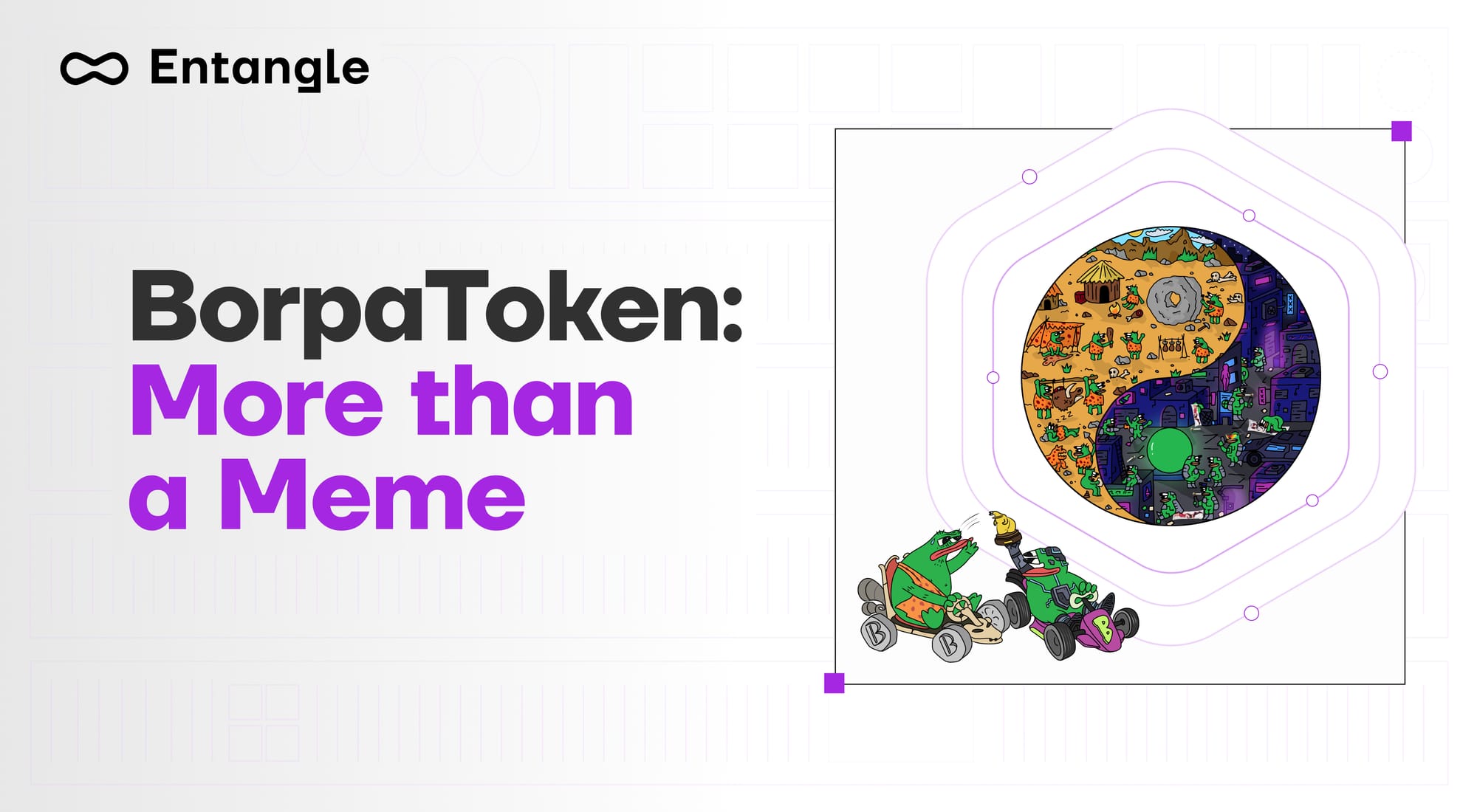
BORPA, More Than Just A Meme
$NGL @Entanglefi
April 23, 2024
post photo preview

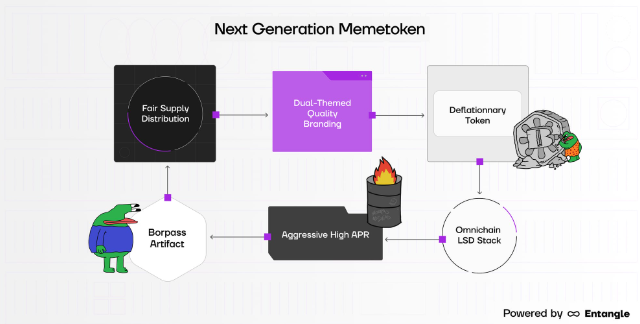
BORPA, built by Entangle Labs from the ground up,  introduces a unique "dual-themed" branding strategy that masterfully blends the playful allure of memecoins with the robust functionality of DEX AMM technology. This unique approach is designed to present users with a strategic financial game that rewards them with $BORPA for participating in high-risk financial strategies

Moreover, BORPA leverages several key infrastructure components of Entangle to create a true Omnichain experience. This integration allows BORPA to operate seamlessly across multiple blockchain networks, enhancing its accessibility and utility in a diverse crypto environment. 

By leveraging this dual theme, BORPA successfully caters to both the retail audience with a sleek and professional appearance and the 'degen' audience, who participate in the big brain financial mechanics of DeFi.

The Importance of BORPA

Entangle understands the importance of memecoins. 

Reflecting on the history of cryptocurrencies, memecoins like DOGE and SHIB have amassed large, vocal communities that rally around what they symbolize. 

For example, in 2021, following the infamous GameStop surge, the subreddit WallStreetBets shifted its focus to Dogecoin, aspiring to push its value to $1. This price pump became a rallying cry for the community, a symbolic gesture of defiance against Wall Street institutions and corporations.

That's the real beauty of memecoins. It tokenizes something as abstract as the “collective feeling” of a community. At its core, it's almost like "tokenized culture" or "tokenized zeigeist." 

Unfortunately, most memecoins are merely speculative assets, their value hinging solely on community sentiment.

But what if we could elevate this concept?

What if we could craft a memecoin that not only embodies the irreverent spirit of other memecoins but is also supported by a solid infrastructure and sound crypto-economic principles?

This is where BORPA comes in.
Investigating the BORPA infrastructure

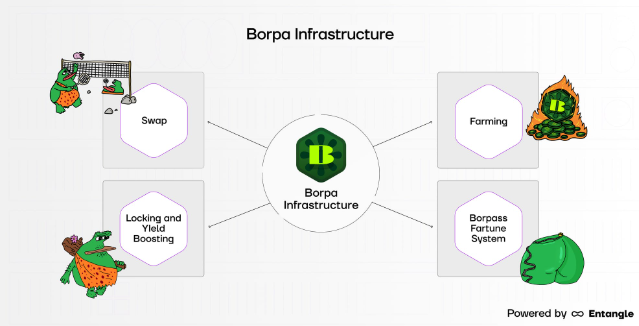
Here's a breakdown of how the infrastructure functions:

  • Swap
  • Locking and Yield Boosting
  • Farming
  • Borpass Fartune System

Swap

The Swap Module is a key component of the BORPA ecosystem. It enables users to trade various assets, essential for engaging in the platform's financial game. Users can purchase $BORPA tokens or other approved assets to participate and earn rewards through this module. This flexibility allows users to adapt their investment strategies effectively according to market conditions.

Each transaction involving $BORPA tokens incurs a base transfer fee dedicated entirely to burning $BORPA, thus reducing the total supply and potentially increasing the token's value over time.

The Swap Module supports transactions on several major blockchains and decentralized exchanges (DEXes), including:

  • Ethereum, via Uniswap
  • BNB Smart Chain, via PancakeSwap
  • Solana, via Raydium

This integration across multiple platforms ensures a broad accessibility and seamless trading experience for users across different blockchain networks.

Locking and Yield Boosting

The Lock Module within the BORPA ecosystem enables users to convert their liquid $BORPA tokens into vested $xBORPA tokens. This conversion is central to employing advanced strategies in the platform's various financial games and reward systems.

Once converted, $xBORPA tokens offer several strategic benefits:

  • Yield Boosting: Users can employ $xBORPA to enhance the rewards from their existing farm positions. By locking $BORPA into $xBORPA, users can approach or even achieve the maximum 2.5x bonus multiplier offered in the Yield Boosting Module. This dramatically increases the effective annual percentage rate (APR) of their staked assets.
  • Chest Mechanism: $xBORPA also plays a pivotal role in the Borpass Fartune System. Users who choose to slash large quantities of $xBORPA unlock liquidity and increase their chances of winning valuable chests. 

Farming

The Farming module is designed to distribute a significant portion of the total $BORPA supply as Liquidity Mining (LM) rewards. Users can stake their LP assets in whitelisted farms across multiple blockchains, which earns them swap fees and $BORPA rewards and mints a Composable Derivative Token (CDT). This CDT allows users to borrow against their staked, interest-earning positions.

Upon staking in a farm, users incur a deposit fee of 2% to 5%. This fee serves multiple purposes: 40% is allocated to the buyback and burn of $BORPA, thus reducing the token supply and potentially increasing its value; another 40% supports the Chest Module, and the remaining 20% funds operational aspects and development.

The rewards from liquidity provisioning are distributed using a dual-token system:

  • 30% of the rewards are received immediately in liquid $BORPA tokens.
  • The remaining 70% are granted as $xBORPA tokens, vested over 28 days. Users have the flexibility to "slash" their $xBORPA early for liquid $BORPA, affecting the total amount received based on the timing of the transaction.  

The Farming module strategically distributes 51% of $BORPA’s total supply, focusing on enhancing liquidity for the $BORPA/$ETH pool. This pool alone directs 75% of all LM incentives, spotlighting its importance within the ecosystem.

Borpass Fartune System (Chest Mechanism)

The Borpass Fartune System is designed to drive community engagement and investment through a competitive and rewarding mechanism. This system revolves around a community chest accumulating a portion of the fees generated from various platform activities. The chest grows until it reaches a predetermined financial threshold, triggering a random draw to determine a lucky winner.

Chest Allocation and Growth:

  • 40% of the deposit fees collected are converted into USDC and added directly to the chest.
  • Once the chest hits its threshold, 40% of its contents are awarded to the winner.
  • The remaining funds are split as follows: 30% is retained to seed the next chest, and 30% is used to buy back and burn $BORPA tokens.

Winning Mechanics:

  • Users can increase their chances of winning by burning $BORPA tokens, thereby creating $bBORPA during the chest's active period. The more $bBORPA a user has, the higher their probability of winning.
  • Each subsequent chest (ChestN+1) sets its threshold at 1.33 times the previous chest's (ChestN) threshold, ensuring progressively larger prizes.

Incentives for Participation

Active participation in BORPA’s various economic activities, such as swapping, liquidity provision, or slashing xBORPA, leads to burning $BORPA tokens, thereby enhancing a user's odds of winning.

The Borpass Fartune System is attractive to new participants due to its potential for large payouts. It supports the token’s deflationary strategy by incentivizing the burning of $BORPA, potentially increasing the remaining tokens' value.

How BORPA Integrates With the Entangle Ecosystem

Here's a brief breakdown of how BORPA utilizes key technologies from the Entangle ecosystem and sets itself apart from the rest of the market.

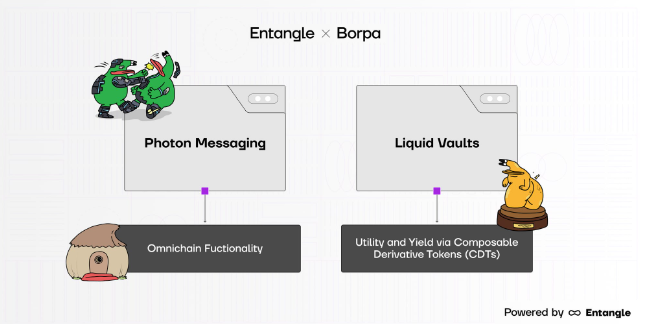
Photon Messaging

Photon, Entangle's crosschain messaging solution, plays a crucial role in enabling the cross-chain functionality of BORPA tokens. By leveraging Photon Messaging, BORPA tokens can freely move between Solana and EVM-compatible chains. 

This capability allows BORPA to attract liquidity from diverse blockchain environments, enhancing its accessibility and utility across various platforms.

Liquid Vaults

Liquid vaults will further extend the utility of BORPA by providing an avenue for users to stake and earn yield on their BORPA Composable Derivative Tokens (CDTs). Here's how the synergy between BORPA and Liquid Vaults works.

  • Staking: Users can deposit their BORPA token pairs on Liquid Vaults to earn yield.
  • Generate CDT: Users can also lock up their BORPA pairs in various DEXes (such as PancakeSwap) and receive the corresponding LP token. The LP token can be further staked on Trillion to generate CDTs. All this process is done smoothly in one zap transaction. CDTs allow users to borrow against their staked, interest-earning positions, essentially freeing up liquidity that would have otherwise been locked up.
  • CDT Utilization: Once users acquire CDT tokens, they can engage further within the BORPA ecosystem. CDTs can be further staked in BORPA's “Staking Module,” where users can utilize them in NFT Pools. This in turn generates an NFT which certifies the user's right to claim rewards from the pool.

These integrations play a major role in underpinning BORPA's unique dual-themed approach, blending the playful elements of memecoins with serious financial strategies.

Thanks to Photon Messaging, BORPA is more versatile than any other memecoin on the market. On the other hand, Liquid Vaults ensures that BORPA holders have multiple avenues to earn yields, giving them extra incentives to hold onto their coins.

This synergy of elements positions BORPA as the next evolutionary leap for memecoins.
In Closing

Building upon the rich history of cryptocurrencies and the unique cultural movements that memecoins represent, BORPA stands poised to redefine what a memecoin can achieve. Unlike its predecessors, which largely depended on whimsical community sentiment and speculative trading, BORPA successfully blends the “degen-ness” of traditional memecoins with a virtuous flywheel.

By implementing a deflationary token model alongside a suite of interactive modules, BORPA fosters a self-sustaining ecosystem where engagement directly fuels investment and token value growth. Its strategic burns and reward mechanisms ensure fair distribution and long-term value retention, making BORPA not just a token of culture, but a cornerstone of a new era in cryptocurrency. 

Through BORPA, we see the embodiment of a meme transformed into a meaningful asset, demonstrating that even the most lighthearted origins can lead to serious and impactful financial innovation.


Link

community logo
Join the TheDinarian Community
To read more articles like this, sign up and join my community today
0
What else you may like…
Videos
Podcasts
Posts
Articles
🚨The Biggest Risk, Is Not Taking Any Risk!🚨

"The biggest risk is not taking any risk... In a world that is changing really quickly, the only strategy that is guaranteed to fail is not taking risks." ~Mark Zuckerberg

00:02:13
This is actually the real problem.

Not Ai, not Iran ... this is the one that will cause the real crisis.

Both parties in Congress refuse to control spending. You are not prepared for what happens when this breaks.

00:00:09
‼️ A DETAILED VIDEO BREAKDOWN OF THE 3 CORE SERVICES ON THE HEDERA NETWORK‼️

Smart Contract Service✅
Token Service ✅
Consensus Service ✅
Hedera = The Trust Layer 🌐

Watch.😶‍🌫️👇

00:02:01
👉 Coinbase just launched an AI agent for Crypto Trading

Custom AI assistants that print money in your sleep? 🔜

The future of Crypto x AI is about to go crazy.

👉 Here’s what you need to know:

💠 'Based Agent' enables creation of custom AI agents
💠 Users set up personalized agents in < 3 minutes
💠 Equipped w/ crypto wallet and on-chain functions
💠 Capable of completing trades, swaps, and staking
💠 Integrates with Coinbase’s SDK, OpenAI, & Replit

👉 What this means for the future of Crypto:

1. Open Access: Democratized access to advanced trading
2. Automated Txns: Complex trades + streamlined on-chain activity
3. AI Dominance: Est ~80% of crypto 👉txns done by AI agents by 2025

🚨 I personally wouldn't bet against Brian Armstrong and Jesse Pollak.

👉 Coinbase just launched an AI agent for Crypto Trading
🚨 15 Quantum Computing Breakthroughs That Change Everything 🚨

Quantum computing is entering a new era of breakthroughs that could transform science, technology, and entire industries. In this video, we explore the top 15 new quantum computing breakthroughs that could change everything.

Unlike classical computers, quantum machines use qubits that can exist in multiple states at once, allowing them to solve certain problems far beyond the reach of traditional computing. Recent advances are pushing quantum systems closer to practical use in areas like drug discovery, cryptography, materials science, and complex optimization.

We break down the most exciting breakthroughs—from improved quantum error correction and stable qubits to powerful new algorithms and hardware designs that are accelerating progress. These developments are bringing quantum computing out of the lab and closer to real-world impact.

By the end of this video, you’ll understand why quantum computing is considered one of the most powerful technologies of the future—and how these ...

🚨 Evernorth XRP Treasury Company to Go Public via SPAC with $1B+ Gross Proceeds—Led by Ex-Ripple Executive Asheesh Birla, Ticker Symbol "XRPN"

Evernorth Holdings announced public launch via business combination with Armada Acquisition Corp II (Nasdaq: AACI) expected to close Q1 2026, trading under ticker "XRPN." Transaction raises $1B+ gross proceeds including $200M from SBI plus investments from Ripple, Rippleworks, Pantera Capital, Kraken, GSR, and Ripple co-founder Chris Larsen. Net proceeds primarily fund open-market XRP purchases to build world's leading institutional XRP treasury—unlike passive ETF, Evernorth seeks to grow XRP per share through institutional lending, liquidity provisioning, and DeFi yield opportunities.

🔑 Key Points:

🔹 SPAC Transaction Structure: Business combination with Armada Acquisition Corp II creating largest public XRP treasury company; expected Q1 2026 close subject to shareholder approvals and customary conditions; Armada II Class A shares convert to Evernorth Class A...

🇮🇷 Iran says the Strait of Hormuz is open to all countries except the United States and Israel.

post photo preview
post photo preview
🧬VINDICATED! The Epstein Files Connect Gates, Pandemics & Censorship to a Globalist Blueprint for a Biosecurity State🧬

Every warning. Every documentary. Every article. Every post that got us banned. All of it was true. Now what? What can we do? Read on, share this Substack, help us save lives! The Light is shining! ✨

Well, well, well… look what the cat dragged in.

Actually, scratch that. Look what the Department of Justice finally dragged out of Jeffrey Epstein’s email inbox and dumped on the world’s doorstep like a rotting corpse nobody wanted to claim. Yep, that’s right. The Epstein files. It’s hilarious how the “Democratic hoax” and “fantasy” client list we were all told didn’t exist suddenly became a very real, very unsealed document.

For years—years—they called us conspiracy theorists. They slapped “misinformation” labels on our posts faster than Pfizer could print liability waivers. They kicked us off platforms, lied about us in the media, and shadow-banned our reach. Meanwhile, the real conspiracy—the one typed out in black-and-white emails between billionaires, bankers, and a convicted pedophile—was sitting in a government vault, waiting to prove us right.

And now? Now the receipts are public.

The release of Jeffrey Epstein’s files has done far more than expose a network of elite pedophilia and blackmail—it has vindicated truth-tellers like us and countless others who were smeared, censored, de-platformed, and persecuted for warning about the sinister agendas of the globalist elite. The documents reveal shocking connections between Epstein, Bill Gates, pandemic planning, and the systematic suppression of anyone who dared to connect the dots.

We weren’t crazy. We were just early. And they hated us for it.

Epstein, Gates, and the Pandemic “Business Model” They Built Together

One of the most damning revelations from Epstein’s files is his partnership with Bill Gates. Forget the carefully crafted PR spin about “regretting” those meetings. These weren’t casual dinners. These were planning sessions.

Back in 2015, Gates and Epstein exchanged emails about “preparing for pandemics” and strategies to “involve the WHO.” Gates wrote: I hope we can pull this off.”

How’s that for a chill down your spine?

This eerily foreshadowed the 2019 Event 201 simulation—a pandemic exercise hosted by the Gates Foundation, Johns Hopkins, and the World Economic Forum that just happened to model a global coronavirus outbreak… just months before COVID-19 ”mysteriously” emerged in Wuhan. Funny how that works, isn’t it?

But let’s rewind even further, to the real blueprint—the financial architecture that made the pandemic response not just possible, but profitable.

The story crystallizes in a chilling 2011 email exchangeJuliet Pullis, a JPMorgan executive under then-chairman Jes Staley, emailed Jeffrey Epstein with a list of detailed questions. The source? “The JPM team that is putting together some ideas for Gates.

The questions were precise: What are the objectives? Is anonymity key? Who directs the investments and grants? This wasn’t JPMorgan consulting an expert; it was a trillion-dollar bank asking a convicted felon to architect a billion-dollar philanthropic fund for Bill Gates.

This wasn’t JPMorgan consulting a philanthropic expert. This was a trillion-dollar bank asking a convicted felon to architect a billion-dollar philanthropic fund for one of the richest men on Earth. Let that marinate for a moment.

Epstein’s reply was fluent and commanding. He described a donor-advised fund with a “stellar board” and ties to the Gates-Buffett “Giving Pledge.” He noted the billions already pledged and identified the gap: “They all have a tax advisor, but have no real clue on how to give it away.” His solution? JPM would be an integral part. Not advisor… operator, compliance. Staley’s response: We need to talk.

By July 2011, the plan evolved. In an email to Staley, copying Boris Nikolic (Gates’ chief science advisor), Epstein laid out the core pitch: A silo based proposal that will get Bill more money for vaccines.”

Not “more research for pandemics.” Not “better public health infrastructure.” More money for vaccines.” This is the unambiguous language of capital formation, not charity. It reveals the structure’s intended output planning reached the highest levels.

In August 2011, Mary Erdoes, CEO of JPMorgan’s $2+ trillion Asset & Wealth Management division, emailed Epstein (while on vacation) with additional operational questions.

Epstein’s reply was breathtaking in scope:

  • Scale: “Billions of dollars” in two years, “tens of billions by year 4.”

  • Structure: Donors choose from “silos” like mutual funds.

  • The Kicker: However, we should be ready with an offshore arm — especially for vaccines.”

An offshore arm. For vaccines. For a charitable vehicle. Let that sink in.

So, by the time the world was panicking in March 2020, the financial machinery was already built. The investment vehicles, the donor-advised funds, the reinsurance products at places like Swiss Re, and even the simulation playbooks were dusted off and ready to go.

The pandemic wasn’t an interruption to their business—it was the Grand Opening.

Epstein’s role extended far beyond trafficking; he was a facilitator and blackmail operative for the global elite. The same forces that orchestrated the COVID-19 power grab—the mask mandates, lockdowns, censorship, and coercive mRNA push—are the ones who silenced critics like us.

Gates, despite his documented ties to Epstein (multiple flights on the “Lolita Express” after Epstein’s 2008 conviction), walks freely. He’s on TV. He’s advising governments. He’s still funding “global health initiatives” and pushing digital IDs, vaccine passports, and climate lockdowns.

Meanwhile, people like our friend, Joby Weeks, are under house arrest without charges, and voices like ours were de-platformed, demonetized, and destroyed for saying this very thing.

We told you. You knew it in your gut. Now you have the emails.

Censorship: The Elite’s “Misinformation” Label to Cover Their Crimes

The Epstein files expose not just criminal behavior, but the playbook for the systematic suppression of truth. While Epstein’s powerful friends were being protected by the FBI, the DOJ, and the media, platforms like Facebook (Meta), YouTube (Google), and Twitter went to war against anyone talking about it.

Think about the sheer audacity.

We were banned from social media for calling COVID-19 a “fake pandemic” and exposing the vaccine injury data that’s now undeniable.

Below is a screenshot of the first Facebook post that was taken down and then used as “Exhibit A” in their “reports” about how bad we were, naming us the 3rd most dangerous people on earth after Dr Joseph Mercola and Bobby Kennedy in the digital hit list they called the “Disinformation Dozen.” They attacked us, lied about us, and pressured the media, social media, and population at large to do the same: attack, threaten, and cast us out.

We were labeled “dangerous” for sharing emails, documents, and research that the DOJ and the CDC have now confirmed.

It was never about “safety.” It was about narrative control.

The same institutions that turned a blind eye to Epstein’s crimes for decades—the same ones that let him “commit suicide” in a maximum-security prison with cameras conveniently malfunctioning—suddenly became the ruthless hall monitors of “acceptable discourse,” ensuring only their approved stories could be told.

Big Tech, Big Media, and Big Government are all part of the same protection racket. They shielded Epstein’s client list, and now they shield the architects of the pandemic debacle. Independent journalists, researchers, and health advocates like us, who connected these dots, were systematically de-platformed, demonetized, and destroyed.

Why? Because we were right, and that was the greatest threat of all.

When you’re over the target, that’s when the flak gets heaviest. And brothers and sisters, we were getting shelled.

They Lied About Us While Protecting the Real Criminals

Let’s be crystal clear about what happened here.

We have spent decades exposing the cancer industry, Big Pharma’s corruption, and the suppression of natural health solutions. We produced The Truth About Cancer docu-series, reaching millions worldwide. We warned about vaccine injuries, censorship, and the coming medical tyranny years before COVID-19.

And what did they do? They called us “Conspiracy Theorists,” “Anti-Vaxxers,” and “Killers.” Dangerous.

They said we were killing people with “misinformation.”

Facebook banned us. YouTube deleted our videos. Legacy media ran hit pieces. PayPal froze our accounts.

All while Bill Gates—a man with documented ties to Jeffrey Epstein, who flew on his plane multiple times after Epstein’s conviction, who got STDs from Russian girls Epstein provided for him for which Gates asked Epstein’s help getting him antibiotics to slip secretly to his then wife, Melinda, so that she would not know about his inexcusable and perverted escapades—yes, THAT Bill Gates—was at the same time, being platformed on every major news network as the world’s health oracle.

All while Anthony Fauci—who funded gain-of-function research in Wuhan through Peter Daszak and EcoHealth Alliance, who lied under oath to Congress, who flip-flopped on masks, lockdowns, and vaccines—was treated like a saint. Time Magazine’s “Guardian of the Year.”

All while Pfizer—a company with a $2.3 billion criminal fine for fraudulent marketing, bribery, and kickbacks—was given blanket immunity from liability and billions in taxpayer dollars to produce a vaccine in record time with no long-term safety data.

Were we the dangerous ones?

No.

We were the truthful ones. And that made us the enemy.

The Weaponized Institutions: From Epstein’s Blackmail to Your Digital ID

Epstein’s operation was never just about blackmail for perversion; it was blackmail for control. The files show his cozy ties to intelligence agencies (Mossad, CIA), financial giants like JPMorgan and Deutsche Bank, and political leaders across the globe.

This is the same cabal now pushing:

  • The Great Reset

  • Digital IDs

  • Central Bank Digital Currencies (CBDCs)

  • 15-minute cities

  • Carbon credit social scoring

  • Vaccine passports

Let’s connect the dots they desperately don’t want you to see:

Financial Control:

JPMorgan banked Epstein for years despite clear red flags—over $1 billion in suspicious transactions flagged internally and ignored. They knew. They didn’t care. They paid a $290 million fine and moved on.

Now, banks like Bank of America, Chase, and PayPal de-bank conservatives, truckers, health freedom advocates, and anyone who questions the narrative. Canadian truckers. Gun shops. Crypto entrepreneurs. The goal is the same: punish dissent and control economic life.

CBDCs are the endgame—a digital leash on every citizen. Programmable money that can be turned off, restricted, or expired. Social credit by another name.

Medical Tyranny:

The FDA, CDC, and WHO—utterly captured by Big Pharma—lied about:

  • COVID origins (Wuhan lab leak dismissed as conspiracy theory)

  • Vaccine efficacy (”95% effective” turned into “you need boosters forever”)

  • Natural immunity (ignored despite being superior)

  • Early treatments (ivermectin, hydroxychloroquine, vitamin D censored and mocked)

They attacked natural health advocates just as they’ve done for decades with cancer cures, detox protocols, and anything that threatens Big Pharma profits. They are not health agencies; they are profit-enforcement arms dressed in lab coats.

Political Corruption:

Epstein’s blackmail ensured elite immunity. His client list includes presidents, princes, CEOs, scientists, and media moguls.

Meanwhile, true dissidents—Julian Assange (tortured in prison for journalism), Edward Snowden (exiled for exposing mass surveillance), and journalists like us—face persecution, imprisonment, debanking, slanderous hit pieces, and/or constant character assassination.

Two systems of justice: one for them, one for you. One for Epstein’s friends, one for truth-tellers.

The Way Forward: They’re Exposed. Now It’s Time to Build.

The Epstein files are more than proof; they are a declaration that the system is rotten to its core. But here’s the beautiful part: they vindicate us completely.

Every warning. Every documentary. Every article. Every post that got us banned. All of it was true.

The globalists’ grip is weakening. The truth—the real, ugly, documented truth—is erupting from the very files they tried to hide. They labeled us liars, but the emails show they were the architects. They silenced us, they censored us, but that only made our voices more necessary.

Epstein did not kill himself. COVID-19 was not natural. The vaccines were not safe or effective. The censorship was not about protecting you—it was about protecting them.

And now? Now it’s time to use this vindication as fuel. Not for revenge, but for revolution. A revolution of truth, health, freedom, and justice.

They tried to bury us. They didn’t know we were seeds.

The Epstein files are a smoking gun. A paper trail. A confession written in emails, financial structures, and offshore accounts.

They prove what we’ve been saying all along:

  • The system is rigged.

  • The elites are criminals.

  • The pandemic was planned.

  • The censorship was coordinated.

And we were right. 👍

Source

🙏 Donations Accepted, Thank You For Your Support 🙏

If you find value in my content, consider showing your support via:

💳 Stripe:
1) or visit http://thedinarian.locals.com/donate

💳 PayPal: 
2) Simply scan the QR code below 📲 or Click Here


🔗 Crypto Donations Graciously Accepted👇
XRP: r9pid4yrQgs6XSFWhMZ8NkxW3gkydWNyQX
XLM: GDMJF2OCHN3NNNX4T4F6POPBTXK23GTNSNQWUMIVKESTHMQM7XDYAIZT
XDC: xdcc2C02203C4f91375889d7AfADB09E207Edf809A6

Read full Article
post photo preview
💳Citi’s Strategy to Dominate Institutional Payments💳

Citi's Institutional Payments Strategy

Citi’s Strategy to Dominate Institutional Payments is built on a foundation of technological innovation, strategic simplification, and a laser focus on institutional clients. The bank has transitioned from a fragmented global retail bank to a streamlined provider of high-margin institutional services, with its Treasury and Trade Solutions (TTS) and Securities Services segments now considered its "crown jewel." This shift, led by CEO Jane Fraser, involved exiting 14 international consumer markets and slashing decades of "tech debt" through a multi-billion-dollar partnership with **Google Cloud**, creating a modern, unified data and cloud infrastructure.

At the core of Citi’s dominance in institutional payments is Citi Token Services, a blockchain-powered platform launched in September 2023. This service converts client deposits into digital tokens, enabling 24/7, real-time cross-border payments, automated trade finance, and just-in-time liquidity management. By using private blockchain technology managed entirely by Citi, clients avoid the need to host their own nodes. The solution has been successfully piloted with Maersk and a canal authority, demonstrating how smart contracts can reduce transaction times from days to minutes—mirroring the functions of traditional bank guarantees and letters of credit.

Citi is further strengthening its position through strategic partnerships, such as its collaboration with Coinbase to expand digital asset payment solutions for institutional clients, enabling seamless fiat-to-crypto transitions. The bank is also leveraging generative AI to automate regulatory compliance, improve cash forecasting by 50%, and reduce operational case times by 90%, directly enhancing the efficiency and reliability of its payment services.

With a global network spanning 95 countries and a focus on real-time, transparent, and programmable financial services, Citi is redefining the institutional payments landscape. Its strategy—centered on infrastructure modernization, digital asset innovation, and client-centric automation—positions it to capture market share from both traditional banks and fintechs, particularly as cross-border instant payments become the norm by 2028.

As blockchain infrastructure inches closer to the core of global finance, a consequential debate is taking shape inside banks and among institutional investors.

What form of digital money will ultimately dominate on-chain settlement?

Stablecoins have so far captured the spotlight, buoyed by rapid adoption and growing regulatory attention. But a different shift is underway inside the banking sector, where executives are increasingly confident that tokenized bank deposits, and not privately issued stablecoins, could become the preferred on-chain dollar for institutional and wholesale use.

“We don’t start with the asset,” Biswarup Chatterjee, global head of partnerships and innovation, Citi Services at Citi, told PYMNTS. “We typically start with our client need, and then we look at the pros and cons of each type of asset or financing instrument.”

For institutional money, innovation can often begin with constraint.

“When you’re dealing with money as a financial institution, you’re acting in a fiduciary capacity,” Chatterjee said, framing why safety and soundness dominate early conversations with clients.

From that perspective, the critical questions around new digital instruments are regulatory and operational before they are technological. Are these assets well-regulated? Do they operate within clearly defined legal frameworks? Can they be governed with the same rigor as traditional deposits or securities?

For institutions that manage systemic liquidity, and their clients, those questions are becoming non-negotiable. Within that context, tokenized deposits are what is emerging as a natural evolution of existing bank money.

“Within the bank’s network, tokenized deposits are an efficient way for our clients to be able to get that 24/7, always-on availability,” Chatterjee said.

The Race to Define the On-Chain Dollar for Institutional Use

By anchoring decisions in client economics and workflows, banks are positioning themselves less as promoters of specific technologies and more as integrators tasked with assembling the right mix of tools for each use case. Institutional clients are not simply looking for digital replicas of existing money; they are grappling with the friction of moving funds across use cases and jurisdictions.

“There’s this constant need to transform money across its various forms and shapes,” Chatterjee said, adding that payments, working capital and financing increasingly overlap, and inefficiencies emerge when money cannot move fluidly between those roles.

By representing deposits on distributed ledgers, banks can offer real-time movement of money across accounts, entities and geographies without leaving the regulated perimeter. For enterprises and institutions, this promises faster settlement, improved liquidity management and reduced operational friction, all without introducing new balance sheet or counterparty risks.

In this sense, tokenized deposits may turn out to be less disruptive than they appear. They modernize the plumbing of banking rather than bypassing it, extending familiar money into programmable environments.

Regulation, Interoperability and the Velocity of Money

The moment money exits a bank’s direct network, however, the strengths of tokenized deposits begin to fade. Cross-border payments, underbanked regions and counterparties outside major financial institutions can expose gaps in reach and efficiency when it comes to tokenized deposits.

This is where Chatterjee said he sees a role for stablecoins, not as competitors to banks, but as connective tissue.

“When money leaves the bank’s network and goes out into the external ecosystem, that’s where we see the role of stablecoins coming in,” he said, assuming they operate in a “very safe and sound and regulated manner.”

The result is likely to represent not a binary choice but a continuum. Just as checks, wires, cash and instant payments coexist today, digital money is likely to fragment into specialized forms optimized for different environments.

At the heart of the impact financial blockchain is having on digital money’s evolution lies a deceptively simple question: What makes money “good”?

For Chatterjee, the answer hinges on universal acceptance and trust.

“What makes a currency strong … has a lot to do with universal acceptance,” he said.

Assets that cannot be readily transferred or accepted risk becoming stranded, unable to circulate productively; while trust is fundamental to the value and stability of money, no matter its form. That logic applies equally to tokenized deposits and stablecoins. Without trust and transferability, neither is likely to function as a true institutional settlement asset.

Despite the focus on tokens and technology, Chatterjee was clear about where long-term value resides. It is not in the token itself, but in service.

“Client service and the client experience is what is going to drive the winning proposition,” he said.

Source 1

Source 2

🙏 Donations Accepted, Thank You For Your Support 🙏

If you find value in my content, consider showing your support via:

💳 Stripe:
1) or visit http://thedinarian.locals.com/donate

💳 PayPal: 
2) Simply scan the QR code below 📲 or Click Here: https://www.paypal.com/donate/?business=8K3TZ2YFZ7SMU&no_recurring=0&item_name=Support+Crypto+Michael+%E2%9A%A1+Dinarian+on+Locals+Blog&currency_code=USD


🔗 Crypto Donations Graciously Accepted👇
XRP: r9pid4yrQgs6XSFWhMZ8NkxW3gkydWNyQX
XLM: GDMJF2OCHN3NNNX4T4F6POPBTXK23GTNSNQWUMIVKESTHMQM7XDYAIZT
XDC: xdcc2C02203C4f91375889d7AfADB09E207Edf809A6


Read full Article
post photo preview
New Allegations Link Former National Intelligence Leaders Clapper and O’Sullivan to UFO Shoot-Down and Retrieval Program

Written by Christopher Sharp - 24 January 2026

Multiple sources have told Liberation Times that, during the Obama administration, senior intelligence figures James Clapper and Stephanie O’Sullivan oversaw a program relating to Unidentified Anomalous Phenomena (UAP) within the Office of the Director of National Intelligence. 

The sources allege the effort involved the shootdown and recovery of exotic vehicles thought to be of non-human origin.

Three separate sources told Liberation Times that Clapper allegedly ran the program alongside O’Sullivan, dating back to his tenure as Under Secretary of Defense for Intelligence from 2007 to 2010

During that period, O’Sullivan led the CIA’s Directorate of Science and Technology before being promoted in 2009 to become the agency’s third-most senior officer.

One source alleged to Liberation Times that Clapper and O’Sullivan oversaw a program codenamed ‘Golden Domes,’ which the source claimed was jointly run by the CIA and the United States Air Force (USAF), where Clapper previously served.

The source further alleged that the program could detect and track UAP even when ‘cloaked’ and as they physically manifested.

The same source claimed the program employed a mix of electronic and laser-based capabilities intended to bring down what the source described as ‘exotic non-human vehicles.’

Sources were unable to offer Liberation Times a clear explanation for why the U.S. government would choose to engage UAP, including whether any such actions were taken routinely, in specific circumstances, or in relation to any potential understandings or rules of engagement involving other purported non-human factions.

In the recently released documentary ‘The Age of Disclosure’, James Clapper alleged that a secretive USAF program had been actively monitoring UAP, particularly over the highly classified Area 51 facility in Nevada - an epicentre of cutting-edge military development and testing.

Clapper, a former Chief of USAF Intelligence, stated:

“When I served in the Air Force, there was an active program to track anomalous activities that we couldn’t otherwise explain - many of them connected with ranges out west, notably Area 51.”

In a recent interview with journalist Megyn Kelly, former intelligence official, USAF veteran, and UAP whistleblower David Grusch claimed that James Clapper managed a UAP program, stating:

“I'm a little bit disappointed as a fellow Air Force officer…. That's all he said in the documentary: that there was a program he was aware of. 


“In fact, without being inappropriate, I will say that General Clapper was well aware of the crash retrieval issue, managed the crash retrieval issue, and, when he was a DNI [Director of National Intelligence], USDI [Undersecretary of Defense for Intelligence and Security], DIA [Defense Intelligence Agency], he placed people in critical roles to manage this issue, both publicly - and I'll just say not publicly as well - and I'll allow the audience to distill what I'm saying at the, at the risk of being inappropriate or going too far with my discussion. 


“So General Clapper, Stephanie O’Sullivan, other folks in the IC [Intelligence Community] that are well aware of this issue, that were in rooms discussing this issue, I ask you to be greater leaders on this. I should not be the only former military officer and intelligence official that is being completely candid with the information that they were exposed to.”

Grusch’s lawyer, Charles McCullough III served as the Intelligence Community Inspector General, reporting directly to then–Director of National Intelligence James Clapper.

In that role, according to his biography, McCullough ‘oversaw intelligence officers responsible for audits, inspections, and investigations. Furthermore, he was responsible for inquiries involving the Office of the Director of National Intelligence as well as the entire Intelligence Community.’

                            Above: Charles McCullough, III and James Clapper

Grusch, in that same interview, also alleged that former Vice President Dick Cheney, who has since died, was the “closest person” to a “mob boss,” exerting “central leadership” over UAP-related activities.

Notably, Dick Cheney’s wife, Lynne Cheney, served on Lockheed Corporation’s board of directors from 1994 to 2001.

Against that backdrop, in written testimony to Congress, Lue Elizondo, the former director of the Pentagon’s Advanced Aerospace Threat Identification Program, claimed that Naval Air Station Patuxent River in Maryland was among the sites prepared in connection with an alleged transfer of UAP materials to Bigelow Aerospace from Lockheed Martin - an organisation long accused of involvement in an alleged UAP reverse-engineering program.

In a 2013 Fox News interview, Dick Cheney said he first met James Clapper around 25 years earlier, when Clapper was serving as a USAF intelligence officer in Korea.

James Clapper served as the fourth Director of National Intelligence under President Obama from August 2010 to January 2017. Before that, he was Under Secretary of Defense for Intelligence from 2007 to 2010 under President George W. Bush and Vice President Dick Cheney.

Clapper also previously served as Director of the National Geospatial-Intelligence Agency and Director of the Defense Intelligence Agency

In his book Facts and Fears, he recounts how he was assigned as the USAF senior resident officer at the National Security Agency (NSA) to represent Air Force interests. In February 1980, then-NSA Director Vice Admiral Bobby Inman presided over Clapper’s promotion to colonel, as he assumed responsibility for all Air Force personnel stationed at the NSA.

Clapper writes in his book that he served as an intermediary for Vice Admiral Bobby Inman, whom he describes as “an icon and a legend” and who has also been alleged to be a UAP gatekeeper.

Inman was clearly aware of the link between O’Sullivan’s former office and UAP-related matters. In a now-public phone call with NASA engineer Bob Oechsler, Inman said that Everett Hineman, then Deputy Director of the CIA’s Directorate of Science and Technology, would be “the best person” to ask whether any recovered UAP vehicles might be made available for technological research outside military channels.

Notably, former NSA administrator Mike Rogers has recalled in an interview that, while serving as Director of National Intelligence, Clapper unexpectedly ordered him and his team to review the NSA’s files and provide everything relating to UFOs.

Upon being nominated as Director of National Intelligence by President Obama in 2010, Clapper was described as having developed close ties to the intelligence community during his long career and is particularly close to senior managers at the CIA.

In 2011, Clapper recommended that President Obama nominate Stephanie O’Sullivan as Principal Deputy Director of National Intelligence (PDDNI). 

Before her nomination, O’Sullivan served as the CIA’s Associate Deputy Director from December 2009 to February 2011, working alongside the Director and Deputy Director to provide overall leadership of the agency, with a particular focus on day-to-day management. 

                                                Above: Stephanie O’Sullivan

Before that, she served as the CIA’s Deputy Director of Science and Technology for 4 years. According to Liberation Times sources, the CIA’s Directorate of Science and Technology has and continues to be involved in coordinating UAP retrieval missions and safeguarding technologies derived from UAP-related research carried out by the Department of War (DoW) and its contractors.

Based on the best available open source information, previous Deputy Directors of the CIA’s Directorate of Science and Technology include:

  • Albert Wheelon 1963-1966

  • Carl Duckett 1966-1967

  • Leslie Dirks 1967-1982

  • R. Evan Hineman 1982-1989

  • James Hirsch 1989-1995

  • Ruth David 1995-1998

  • Gary Smith 1999-1999

  • Joanne Isham 1999-2001

  • Donald Kerr 2001-2005

  • Stephanie O’Sullivan 2005-2009

  • Glenn Gaffney 2009-2015

  • Dawn Meyerriecks 2015-2021

  • Todd Lowery 2021-present

In his book, ‘Facts and Fears’, Clapper writes that he knew O’Sullivan by reputation as a brilliant technical engineer, and that then-CIA Director Leon Panetta put her forward to him as his deputy - someone who could help cover his blind spots when CIA-related issues arose

Clapper describes the day of O’Sullivan’s confirmation to PDDNI - a title O’Sullivan jokingly referred to as ‘P-Diddy’ - as ‘an extremely happy one’. Their working relationship within the ODNI was extremely close, and Clapper has written that he learned to adopt the line “Stephanie speaks for me, even when we haven’t spoken.”

O’Sullivan entered the intelligence world after responding to a cryptic newspaper classified advert seeking an “ocean engineer”. That move led her to TRW, the defense contractor absorbed into Northrop Grumman, and later the Office of Naval Intelligence. Liberation Times sources allege that Northrop Grumman’s Tejon Ranch Radar Cross Section Facility in southern California is a site where UAPs are routinely retrieved.

Since her retirement from government in 2017, O’Sullivan now serves as a member of the Board of Trustees of the Aerospace Corporation and is on the Board of Directors of Battelle Memorial Institute. 

Battelle and The Aerospace Corporation have both been referenced publicly in connection with UAP programs

Sources also note that O’Sullivan sits on the board of HRL Laboratories, formerly Hughes Research Laboratories, part of the wider Hughes corporate legacy that is closely associated with the Hughes Glomar Explorer, the vessel later linked to the CIA’s effort to recover a sunken Soviet submarine.

Sources told Liberation Times that Stephanie O’Sullivan has been questioned by the Senate Select Committee on Intelligence about her alleged role in a UAP program

The sources further allege that she misled committee members, including then Senator Marco Rubio, now Secretary of State, by nervously claiming that she had no involvement.

Allegations of kinetic engagement have surfaced in other contexts. 

In written testimony submitted to Congress, journalist George Knapp relayed what he said he was told by figures linked to a former Russian Ministry of Defense UAP program: that Russian fighter aircraft were dispatched to intercept UAP on numerous occasions and, in a small number of cases, were ordered to fire. 

Knapp wrote that after several alleged incidents in which aircraft subsequently crashed, a standing order was issued instructing pilots to disengage and ‘leave the UFOs alone because, quote, “they could have incredible capacities for retaliation.”’ 

Source

  🙏 Donations Accepted, Thank You For Your Support 🙏

If you find value in my content, consider showing your support via:

💳 Stripe:
1) or visit http://thedinarian.locals.com/donate

💳 PayPal: 
2) Simply scan the QR code below 📲 or Click Here: https://www.paypal.com/donate/?business=8K3TZ2YFZ7SMU&no_recurring=0&item_name=Support+Crypto+Michael+%E2%9A%A1+Dinarian+on+Locals+Blog&currency_code=USD


🔗 Crypto Donations Graciously Accepted👇
XRP: r9pid4yrQgs6XSFWhMZ8NkxW3gkydWNyQX
XLM: GDMJF2OCHN3NNNX4T4F6POPBTXK23GTNSNQWUMIVKESTHMQM7XDYAIZT
XDC: xdcc2C02203C4f91375889d7AfADB09E207Edf809A6

Read full Article
See More
Available on mobile and TV devices
google store google store app store app store
google store google store app tv store app tv store amazon store amazon store roku store roku store
Powered by Locals