This week, the VeBetterDAO team are excited to introduce the 'Endorsement' mechanism – an innovative new way for Economic and X node holders to play an active role in platform governance, and further decentralize the Better ecosystem.
In the initial version, apps must obtain a minimum score of 100 points – awarded by Nodes (detailed scoring below) -to be eligible for active participation in weekly allocation rounds. By working with Node holders – a key pillar of governance in the VeChainThor ecosystem – the community can drive quality and reliability across the VeBetterDAO platform.
The endorsement process empowers all stakeholders by facilitating transparent and collaborative two-way interactions among key ecosystem participants, with aligned interests in driving the best future outcome for the platform.
Why Endorsements Matter
Endorsements mark a key step towards the Better ecosystem’s longer-term objective of decentralizing decision-making, and placing power in the hands of the community. This includes choosing which apps are eligible to join the platform, and ultimately earn weekly governance rewards – a role that currently sits with the VeChain Foundation. .
As a key part of the VeChain governance network, we welcome and encourage active and engaged Economic and X-Node holders to work with builders and the community, as well as the VeChain team, to drive the platform forward.
How Endorsements Work
With endorsements now live, each app in the VeBetterDAO ecosystem requires a total score of 100 to be eligible for allocation rounds - all apps have a grace period of 2 weeks from the start of Round 21 to be able to obtain the requisite score.
Scoring is based on endorsements from Economic and X nodes, with each tier contributing a specific value. Apps can receive endorsements from multiple nodes, allowing them to gradually accumulate points to reach the required total.
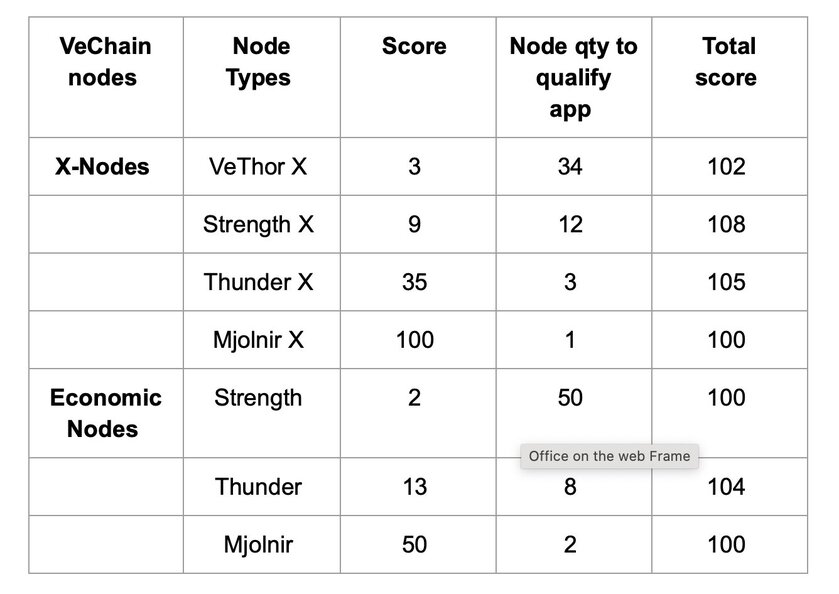
Node Influence: Different node levels contribute different scores. Higher-level nodes offer a greater impact on an app’s score, ensuring that endorsement power aligns with node responsibility.
Grace Period for Score Recovery: If an app’s score drops below 100 due to a loss of endorsements, it enters a two-week grace period. During this time, the app remains active but must regain the required score; otherwise, it will be marked inactive for allocation rounds after the grace period expires. However, inactive apps remain visible in the app section, allowing them to continue seeking endorsements.
Flexible Endorsement Management: Both nodes and apps can withdraw endorsements. If a node removes its endorsement and the app’s score falls under 100, the app has two weeks to secure new endorsements. Apps may also remove specific endorsements from nodes at any time if they choose, providing flexibility and alignment with their goals.
New Apps: Decentralizing Entry into VeBetterDAO’s Ecosystem
New app creators can now initiate their journey with VeBetterDAO by submitting an application form directly on the platform. Upon approval, they receive a Creator’s NFT, which allows them to submit their app for endorsement through the VeBetter platform directly, as well as join the endorsement channels on Discord to connect with Node holders.
During this time, the app will become visible in the VeBetterDAO app section with a “looking for endorsement” status.
Application and Verification: Submit your app through VeBetterDAO, and upon eligibility, receive a Creator’s NFT to apply for endorsement.
Connect with Node Holders: Using the Creator’s NFT, join a dedicated Discord channel where you can interact with node holders to discuss endorsements, building valuable connections within the ecosystem.
Visibility While Pending: Apps in the endorsement-seeking phase are visible in the app section, enabling users to explore and interact with their profile. Creators have the flexibility to manage endorsements and may remove any node’s endorsement at their discretion.
Creators NFT
The Creators NFT is an ERC721 Token (non-transferable) minted to creators submitting their app for the first time.
A user can hold a maximum of one NFT per wallet, irrespective of the number of X-Apps they manage. Additionally, app administrators, through the app detail page in VeBetterDAO, may mint up to three NFTs for team members, with the ability to revoke them.
The burn policy dictates that a creator's NFT will be burned if the associated X-App is blacklisted, and the user has no other active X-Apps.
Existing Apps: Transitioning to the New System
Existing apps will be integrated into the endorsement system with a two-week grace period to obtain the required 100-point score. If an app does not secure sufficient endorsements within this time, it will be marked as inactive in allocation rounds.
However, the app will still be visible in the VeBetterDAO app section, where it can continue seeking endorsements until reactivated.
Economic and X Node Holders: The Backbone of VeChainThor
Economic and X node holders are now at the heart of VeBetterDAO’s app endorsement mechanism. By logging into the VeBetter platform and connecting wallet, Node holders can the explore apps and provide endorsement as they see fit.
Node holders are invited to join a dedicated Discord channel where they can connect to our bot and access a special channel for communicating directly with app creators, on topics from app objectives to potential impact, before making endorsement decisions.
Please note: Connecting your wallet on Discord is done solely for verification purposes, and to ensure users hold the relevant NFT. VeChain does not store any personal information and has no access to users' wallets or funds.
Influence and Responsibility: The app ecosystem’s quality is in your hands, making node holders responsible for setting VeBetterDAO’s standards and future direction.
Engage with App Creators: In the dedicated endorsement Discord channel, node holders can chat with app creators, discussing endorsement possibilities and app goals.
Flexible Endorsement Choices: Node holders have the flexibility to remove their endorsements at any time or switch support to different apps, ensuring alignment with the most promising projects in the ecosystem.
Node holders and app creators can mutually agree on the terms of endorsement, defining expectations from both sides.
App creators may offer shares, tokens, rewards, exclusive features, experiences, or prizes to node holders who endorse their apps. In return, node holders can provide endorsements, support by engaging with the VeChain community, and assist with the app's operations and daily activities.
There are no mandatory requirements or formal agreements; the terms are left to the discretion of the apps and node holders to discuss and negotiate an arrangement that best meets their needs.
Check Out VeBetterDAO Endorsement - Putting Power In Your Hands
Come explore VeBetterDAO’s app ecosystem and learn more about how you can play an active role in the future development of the platform. Visit the website, connect with the community and l et's build the future, together!

Jacob Steeves just described what Bittensor becomes in 3 to 5 years.
Most people are not ready for this answer.
He called it a hive mind.
Not a network. Not a protocol. A self-optimizing intelligence market where agents mine the subnets, agents build the subnets, agents continuously optimise the subnets, and humans become optional in the process.
Read that again.
The system was always designed to eventually strip away the human layer entirely and run as a pure abstract incentive market.
That is not a roadmap item. That is the original vision finally becoming technically possible because of where AI agents are right now.
Here is what makes this different from every other AI crypto narrative.
Bittensor does not just talk about decentralised AI. It repeatedly beats state of the art.
It takes a specific domain, builds a well-defined market for it, aggregates global talent around solving it, and produces results that beat every centralised competitor.
AI detection. Inference at a lower cost than any centralised ...
🚨 SCIENTISTS JUST COMPLETED A KEY PART OF A 100-YEAR-OLD THEORY PROPOSED BY ERWIN SCHRÖDINGER.
For nearly a century, physicists and mathematicians have struggled to fully explain one of the most everyday experiences in human life: Color
Now researchers at Los Alamos National Laboratory say they have finally filled in a major missing piece of Schrödinger’s color theory by uncovering a hidden geometric structure that governs how humans perceive color.
The surprising finding?
Hue, saturation, and lightness are not just cultural or learned concepts. They appear to emerge directly from the underlying mathematics of human color perception itself.
In other words: The way you experience color may be deeply rooted in geometry.
Why this matters:
🔹️ More accurate and efficient display technologies
🔹️ Better imaging and color reproduction systems
🔹️ New insights into human perception and neuroscience
🔹️ A clearer mathematical framework for how information is structured in perception
For over 100 years, one incomplete mathematical element prevented Schrödinger’s vision from being ...
🚨 Remember when the media laughed and told you that Ivermectin was only for horses and cows? They knew it was made for humans since 1987...🚨
This is what they didn't want you to know...
1 – Prevents damage caused by drugs created with mRNA technology, blocks the entry of the Spike Protein into cells and, if the person was vaccinated, can treat the damage already produced through Ivermectin.
2 – It only has beneficial effects and no harmful effects in the treatment of the C virus. In fact, even before entering the cell, it has already destroyed the virus in the blood.
3 – It has a very potent anti-inflammatory action and has a powerful impact on traumatic and orthopedic injuries, strengthens muscles and has no side effects like corticosteroids.
🚨 Chutes is being framed as a Hyperliquid-style breakout for decentralized AI inference, with live revenue, verified GPU infrastructure, and a direct challenge to centralized cloud AI 🚨
Chutes is gaining attention as a decentralized AI inference platform that claims to combine real usage, cryptographic verification, confidential computing, and open-source infrastructure into a working production system. The thesis is simple: instead of trusting Big Tech clouds with AI workloads, users get a distributed compute layer built around verification and privacy.
🔑 Key points
🔹 Chutes is live in production and reportedly scaled to more than 1,170 active GPU nodes, including large numbers of Nvidia H200s and Blackwell-class hardware.
🔹 The platform says it has processed nearly 38 trillion tokens since launch across 53 deployed applications and more than 700,000 registered users.
🔹 The team reportedly cut unprofitable usage programs, reduced total token volume, and still improved revenue efficiency, with revenue per GPU rising sharply after removing subsidized traffic.
🔹 Chutes is using post-quantum cryptography, trusted execution environments, and Nvidia confidential ...
🚨 Chutes is being framed as a Hyperliquid-style breakout for decentralized AI inference, with live revenue, verified GPU infrastructure, and a direct challenge to centralized cloud AI 🚨
🚨 JPMorgan’s criticism of the CLARITY Act is fueling a fresh power struggle over who gets to write America’s crypto rules 🚨
A new clash is emerging between legacy finance and crypto legislation after JPMorgan CEO Jamie Dimon reportedly warned that the CLARITY Act could let crypto firms offer bank-like products without bank-level oversight. The dispute is quickly turning into a larger fight over regulation, competitiveness, and who controls the future architecture of digital finance in the United States.
🔑 Key points
🔹 Jamie Dimon reportedly called the CLARITY Act a threat to the financial system, arguing it could allow crypto firms to offer yield-like products while avoiding the capital, reserve, and oversight burdens traditional banks face.
🔹 Senator Cynthia Lummis pushed back publicly, framing the issue as a global strategic race and warning that if the U.S. does not set digital asset standards, other powers will.
🔹 The core tension is whether the bill creates legitimate regulatory clarity or simply opens the door to regulatory arbitrage for crypto platforms operating outside the traditional banking...
👉 Coinbase just launched an AI agent for Crypto Trading
Custom AI assistants that print money in your sleep? 🔜
The future of Crypto x AI is about to go crazy.
👉 Here’s what you need to know:
💠 'Based Agent' enables creation of custom AI agents
💠 Users set up personalized agents in < 3 minutes
💠 Equipped w/ crypto wallet and on-chain functions
💠 Capable of completing trades, swaps, and staking
💠 Integrates with Coinbase’s SDK, OpenAI, & Replit
👉 What this means for the future of Crypto:
1. Open Access: Democratized access to advanced trading
2. Automated Txns: Complex trades + streamlined on-chain activity
3. AI Dominance: Est ~80% of crypto 👉txns done by AI agents by 2025
🚨 I personally wouldn't bet against Brian Armstrong and Jesse Pollak.
👉 Coinbase just launched an AI agent for Crypto Trading
Because you can NEVER have too many ON/OFF ramps. 😉
The @AnodosFinance team has raised $150,000 from angel investors and secured a $130,000 non-equity grant from Ripple.
They were accepted into the XRPL accelerator program run jointly by Ripple and Tenity, and have formalized partnerships with Axelar, Palisade, Schuman Financial, and more.
🚨 SBI Shinsei Bank plans crypto rewards for depositors as Japan’s banking and digital asset worlds keep converging 🚨
SBI Shinsei Bank is preparing to launch a cryptocurrency rewards program for depositors this fall, according to reporting cited by The Block. The move would let customers receive crypto-linked rewards on top of ordinary deposit interest, adding another bridge between traditional banking and digital assets in Japan.
🔑 Key highlights:
🔹️ SBI Shinsei Bank plans to launch a crypto rewards program for depositors in fall 2026.
🔹️ The bank is part of SBI Group, which has been steadily expanding its digital asset footprint.
🔹️ The program would give depositors a crypto-linked reward layer on top of standard banking products.
🔹️ The move reflects Japan’s growing openness to regulated crypto integration inside mainstream finance.
🔹️ SBI has already been active across exchanges, payments, and crypto reward products, making this part of a broader strategy....
Technology Provider of the Year: Overall 🏆
Pyth has been recognized by the Hedgeweek® Global Digital Assets Awards 2026 for powering the next generation of financial markets.
This recognition reflects a simple belief: real markets deserve real prices.
Over the past several years, Pyth has pioneered a new model for market data, sourcing prices directly from the institutions and trading firms that create them and making that data accessible across onchain markets.
Thank you to the publishers, builders, institutions, applications, and community members who continue to build with Pyth every day.
USDC "wins" the Hyperliquid deal by securing dominant distribution and deeper integration into one of crypto's fastest-growing on-chain perpetuals platforms, in exchange for sharing most of the USDC reserve yield (up to ~90%) back with Hyperliquid.
Background on the Deal: Hyperliquid had ~$5–6B in USDC deposits (a huge chunk of total USDC supply, often cited around 7–8%). Previously, the interest/yield on those reserves (~$180–250M annually at prevailing rates) mostly flowed to Circle (issuer) and Coinbase (key partner/treasury handler), with little returning to Hyperliquid.
In late 2025, Hyperliquid ran an RFP for a native stablecoin (USDH) to capture that revenue. Native Markets won the community vote, and USDH launched as an "Aligned Quote Asset" (AQA).
In May 2026, Native Markets sold USDH brand assets to Coinbase. USDH is being sunsetted over time (with feeless conversions/redemptions to USDC/fiat), and USDC becomes the primary/official Aligned Quote Asset on Hyperliquid. Coinbase acts as the main treasury deployer; Circle handles minting, redemptions, and cross-chain (e.g., CCTP).
How USDC Wins: 🔑 Key Advantages
Massive, sticky distribution in a high-growth venue: Hyperliquid is a leading on-chain perp DEX. USDC gains preferred status as the quote asset for most trading pairs, reducing friction vs. bridging/swapping other stables. This concentrates liquidity, improves efficiency, and funnels more capital flows through USDC.
Deep on-chain integration: Builds on prior Native USDC + CCTP launches. Coinbase's involvement adds fiat on/off-ramps and institutional trust. USDC was already dominant (~95% of stables on the platform); this formalizes and expands it.
Regulatory and brand alignment: Ties USDC to a high-profile, high-volume platform at a time when USDC has gained transaction volume momentum (surpassing USDT in some months post-regulatory clarity like GENIUS). It strengthens USDC's positioning vs. USDT (which dominates on centralized venues like Binance).
Longer-term consolidation play: Analysts see this as part of stablecoin market consolidation around established players with liquidity and infrastructure. Fewer conversion layers = better efficiency for USDC.
The Trade-Off (and Hyperliquid's Win)Hyperliquid gets ~90% of the reserve yield (estimates: $135–160M+ annually at current balances, potentially scaling to $300–500M with growth), funneled into protocol revenue/HYPE buybacks. This is roughly double what they got from USDH and turns stablecoin balances into a resilient revenue stream (less volatile than trading fees).
For Circle/Coinbase, they give up a big share of yield (analysts estimate $60–80M hit to combined EBITDA) but retain/expand USDC's role as the backbone stable on a major platform. It's a strategic distribution win over building or competing with a new native coin.
🎯Bottom Line: USDC trades some margin for premier, high-volume real estate in perpetuals/DeFi trading—the exact use case driving massive on-chain dollar demand. This cements its lead in the evolving stablecoin wars, especially as platforms demand better economics. The deal highlights shifting power dynamics: big platforms now negotiate hard for yield share.
🙏 Donations Accepted, Thank You For Your Support 🙏
If you find value in my content, consider showing your support via:
Handshake Wants to Be the Front Door to Bittensor’s Agent Economy
In this Beanstock interview, Harry Jackson of Subnet 58 (Handshake) lays out a thesis that’s worth understanding even if you never buy a single SN58 alpha token. He also explained where Bittensor’s agentic layer is heading.
Handshake wants to be the front door to the agent economy on Bittensor. The Amazon-like gateway where AI agents discover, pay for, and stack together skills from across all 128 subnets.
Why this matters now
There’s a critical distinction Harry emphasized: AI is intelligence, but agents need tooling. An LLM without payment rails, plugins, and workflow infrastructure is “a young person trying to cut a tree down with a pen knife.”
Agent-to-agent commerce is on the edge of going viral. Harry’s prediction for the tipping point: a woman in her 40s lets her agent do her shopping end-to-end (research, stock check, autonomous payment), posts it to social media, and it becomes the “four-minute mile” moment everyone copies.
Bittensor is uniquely positioned because agents don’t care about marketing or pretty UIs. They only care about best-in-class products and services. That’s exactly what Bittensor’s 128 subnets produce.
The product reality (what’s currently shipping)
Handshake is live with paying users generating a few thousand USD in revenue as of today. The business model: 2% of every transaction on the platform.
The flywheel is Amazon-like: better skills → more agents arrive → providers get distribution → more skills get added → cycle repeats.
The headline product on the way is Axiom. This is an agent that trades subnets while you sleep. Built around the realization that what the Bittensor community wants from agents isn’t generic skills; it’s more TAO. Each “hole” they find in the agent becomes a new tradeable skill on the marketplace.
The investment angles (read these carefully)
The moat is data, not distribution. Every workflow run by an agent generates failure data, success data, payment data. No outside competitor can replicate that without running the marketplace itself.
The metric Harry tells you to judge them on is revenue. Not agent count. Not user count. Revenue, which is publicly visible on-chain via the front page of their site. He’s basically inviting investors to hold him to it.
The pitch for emissions: the biggest TAM in Bittensor is the agent market, and Handshake is the most integrated subnet, meaning if Handshake wins, the subnets it routes to all win too. Bullish on agents + bullish on Bittensor = bullish on Handshake by transitive logic.
Where Harry stands on the Conviction
On the conviction upgrade and locked alpha: he’s fine with it. Handshake is a revenue-focused company, so locked alpha isn’t a survival issue. He acknowledges it’ll be harder on research-stage subnets that need to raise external capital, but argues most subnet founders are thinking long-term, not short-term extraction.
On the broader vibe: he just got back from Bittensor events in Spain and San Francisco. He observed that the overwhelming reality of the ecosystem is people working hard to build the best products. “It’d be a lot easier in some ways to build a company outside of Bittensor.” The only reason to do it on Bittensor is if you actually want the moonshot.
Full interview below:
🙏 Donations Accepted, Thank You For Your Support 🙏
If you find value in my content, consider showing your support via:
Last week at the @YumaGroup Summit I had the opportunity to present on The State of Bittensor. That presentation is in the thread below. If you choose to read it, I'd ask that you keep the following three things in mind:
This is just one guy's view of what was the most relevant for a 25-minute talk; a difficult filter for such a dynamic industry.
The slides were designed to supplement a talk; I've done my best to replicate what I recall of the talk in the accompanying X posts.
The topic of the Summit was "The Tipping Point" - a candid assessment of what could lead to Bittensor's breakout success and what evidence we see of that today - which also thematically anchored this presentation.
Let's dive in:
We are in the most important race in human history – the race for intelligence itself. AI has advanced beyond the point of no return. As an example of what I mean: Ramp is a widely used financial services platform for companies. They looked at spending and revenue across their clients since the launch of ChatGPT: Companies who did not spend on AI have had flat revenue for the last three years. The top quartile of AI spenders have grown revenue by more than 100%.
We are already at the point where investing in AI is a matter of survival. But what exactly are we getting for the hundreds of billions being spent? Right now, its overwhelmingly going to corporations who have repeatedly shown they don’t have our best interest in mind.
Claude Opus 4.6 – the leading deep thinking model, had a measured hallucination rate of 16% in February. Then, without telling anyone, Anthropic throttled its reasoning – presumably to reduce GPU utilization – and didn’t tell anyone. Hallucinations climbed to 33% - a 98% increase.
They only admitted it after third party benchmarking proved it. And they were still charging everyone at the same price the whole time. Even since my talk last week, they've supposedly been found to be throttling people simply because HERMES.md was in their commits. You may say, "well there are solid open source options..."
Yes, open source models have gotten very good, but they’re not immune to capture either. Try asking DeepSeek what happened in Tiananmen Square and then let me know if that’s the intelligence you want to trust.
This needs to be addressed right now or it will be too late. To give you a sense of what I mean, this is a chart of the total annual commits on GitHub. That’s 500% growth since the launch of ChatGPT in 2022. From 200M per year to a one billion in 2025. 2026 is on track for **14 billion** The genie is out of the bottle – there is no going back; we are already at the exponential inflection point.
This reminds me of many years ago: Bitcoin shined a light on how much our rights were impacted when we became dependent on private companies to run our day-to-day lives.
Your right to privacy? That doesn’t extend to your bank account. Your "money" is just a ledger at a private company, available for interrogation and suspension at any time. Bitcoin gave us back the sovereignty of our wealth.
Similarly, we’ve depended on things like privacy of our medical records and attorney client privilege for our entire lives. What do you think is going to happen when a private company’s servers are giving you legal and medical advice? Who are you going to trust for that intelligence? The company that lobotomized its top model? The model constrained by the foreign governments? As I said at the beginning, we’re in the most important race in human history and Bittensor well may be our best shot at winning.
One of the things about having a different model to produce intelligence is it requires an economic system suited to it. Subnets are the intelligence and economic engines that drive Bittensor’s value. That’s why the Summit was themed around The Tipping Point: understanding how subnets can reach breakout success and what we can do to help.
To summarize Bittensor's intelligence economics: miners create intelligence for which they earn subnet tokens. In many cases they sell those tokens to fund operations, putting downward pressure on token prices and decreasing the incentive to mine (similar to bitcoin). In parallel, if that intelligence is being used to generate real world value, one of the parties who benefits from that value (e.g. the Operator monetizing it, institutions using intelligence commodities to advance their research, etc.) can buy the subnet tokens to keep token prices elevated and sustain the miner incentive.
Investors get to participate in this process, often supporting token prices before the commercial value of intelligence is realized, and/or subsequently holding an asset that parties gaining fundamental value from the intelligence (eg Operator or others) will need to purchase at some point in the future if they want to maintain sufficient incentives for the intelligence machine to continue running.
For Bittensor to succeed, this value loop has to work. So, to understand the State of Bittensor, we have to take a look at how that’s going today and what that means for the network overall.
One of the many unique features of Bittensor is that subnets are native to the protocol. That is not the case on most crypto networks where the true utility lives in smart contracts with no direct tie to network value.
As an example, Polymarket has seen 800% growth in volume this year. Users can bet any arbitrarily large amount of value on Polymarket for a few cents of network fees. There is nothing tying that to value of the network’s native token, which is down 80% over the same period as Polymarket’s amazing success.
Conversely, Bittensor subnets are intrinsically linked to $TAO. If you want $1,000 worth of subnet exposure, you first need $1,000 of TAO. We analyzed subnet pool data surrounding the announcement of @tplr_ai's recent training run and normalized across them by indexing them to a starting level of 100.
As shown by the orange line, there was no material change in pool size for non-Templar subnets over the observation period. There was however, major inflow into Templar’s pool. Given Bittensor’s unique network model, we saw a direct correlation to the change in TAO price over the same period. As value flows into subnets, the whole network benefits. A rising boat lifts the tide, so to speak.
That can go both ways. When Sam left, we saw something similar in reverse; as value was exfiltrated from the network, it started in Covenant subnets and dragged TAO down with it. You know what else we saw in the data though? For all of the noise about concerns of Bittensor’s future, the other subnet pools were mostly unchanged.
The event was interesting because it reminded me of the early days of bitcoin: people would say Bitcoin was only used by drug dealers on the internet. I'd stare at them aghast because in the same breath they told me that an open, permissionless network was used to reliably move money anywhere in the world in minutes by the most untrustworthy people on the planet and yet they didn't understand how the technical feat required to achieve that would create tremendous value.
The Covenant situation is similar: people were concerned about the operator's exit, rather than realizing the only reason we care is because a ground-breaking technical innovation was achieved. But even bigger than that: Bittensor has 128 subnets currently, each striving to generate value for themselves and, transitively, the network as well.
And we’re seeing that occur – Templar was not unique in that regard. The same pattern emerged around the Intel publication on @TargonCompute. The non-Targon pools remained largely unchanged. Targon saw heavy inflows. TAO price climbed with it.
Again: rising boats lift the tide. And there are many boats in Bittensor right now.
We’re seeing major technical innovations at an increasing rate.
Just a few examples from the last couple weeks:
@QuasarModels just announced a custom attention architecture targeting 5M token context windows.
@IOTA_SN9 developed a technique that compresses data flowing between distributed GPUs by 128x with little to no loss in training quality, increasing viability of training large AI models across internet-connected machines worldwide.
We're seeing the building blocks start to form whereby competitive large generalized models can eventually be built. In the meantime, we're also witnessing more targeted, niche players start to pull ahead in their respective fields.
During the presentation, I gave the example of @resilabsai achieving 90% accuracy on their home valuation model, making it the most performant open source model and quickly approaching state of the art. Quite literally as I was explaining this during the talk, @markjeffrey pointed out they had just achieved 98% accuracy.
In the time between when I prepared the presentation and actually presented, they went from best open source to at or near state of the art - only further highlighting the unique value of Bittensor's open, competitive intelligence creation cycle.
And the tech that’s being built on Bittensor is getting real attention from serious players. Again, just a few examples of many: Harvard partnered with @Chutes on research about AI inference efficiency. Valeo – an auto company with $20B in annual revenue – is working with @natix on an AI model for self-driving cars. @zeussubnet- the weather forecasting subnet, is the only party in the world allowed to use data WeatherXM’s network of global weather sensors for commercial purposes. And there are in fact many subnets already commercializing their intelligence.
Most of us are already aware of Chutes seven-figure ARR, but a few other examples:
@LeadpoetAI– which uses their Bittensor subnet to source sales leads, announced earlier this year that they crossed $1M ARR
@Bitcast_network– the content creation platform built on their subnet competition – is already operating profitably
@lium_io– a hardware subnet – has bought more than 4,000 TAO worth of their token
Remember the economic model I outlined earlier; we’re seeing real evidence that it’s starting to work across many subnets. Intelligence built on Bittensor, capturing value in the real economy, and bringing it back into the network.
That’s why when we look at Bittensor we like to look at Total Network Value (TNV);
$TAO market cap is only part of the story in Bittensor. TNV = market cap of TAO + market cap of subnets – tao in the pools [as not to double count] The actual value of this network is already higher than most people realize. And notably, subnets make up an increasing proportion of TNV – recently crossing 35% - as value continues to flow into the pools.
Interestingly, we recently noticed a change in TNV: In particular, despite all the volatility in TAO, the dramatic subnet issuance curves, etc. - the combined subnet market cap had been remarkably consistent around $750 million for most of the last year, until recently.
It’s nearly doubled over the last few months – a clear breakout in the trend. If you were looking for Tipping Point, it might look something like this...
I hear a lot that that value is relatively concentrated in the largest subnets. And the market cap distribution does indeed reflect that, but that’s not necessarily a bad thing.
This is the market cap distribution of the S&P 500. Many healthy economic systems tend towards Pareto distributions. And so what if some subnets are worth more? As we showed earlier, this is an ecosystem that will win or lose *together* And we’re seeing that play out every day.
We track announcements of subnets utilizing each others infrastructure and intelligence. Just as an example, we identified at least eight subnets who announced that they use Chutes for inference. But we have dozens of similar examples of cross-subnet collaboration across many subnets like
1. Collaboration seems to be happening at an increasing pace as subnets continue to mature and build out contiguous pipelines of AI infrastructure
2. Keeping money circulating within an economy creates a money multiplier. Capital circulating within a single economy without leaving creates economic value for each party it passes through, without having to bring in new capital. That’s uniquely possible here because of the diversity of infrastructure built on Bittensor.
This network is not 128 discrete growth drivers; it’s increasingly functioning as an interconnected graph, which has substantially more stickiness and value And the pace is about to increase dramatically:
We’re starting to see increasing agents operating on Bittensor: subnets mined by agents, subnets operated by agents...
Consider the Bittensor value flywheel:
-An intelligence goal is established
-Miners compete to achieve the goal
-That produces intelligence
-Intelligence generates value
That’s happening today, as we’ve seen earlier in this discussion.
As agents get more capable, that flywheel spins faster and faster. Permissionless entry means any agent can compete. Protocol-native economic incentives mean good work gets rewarded. Bittensor is uniquely advantaged for agentic speed over guarded, centralized alternatives with corporate procurement cycles.
That also means exploits will be found faster. But, it also means solutions that harden the network against them will be found faster as well.
Accordingly the impact of the network primitives – incentives, accessibility, governance, security, reliability, and all the infrastructure we’re building around the network - have an exponentially larger impact. It is critical that we get these right. The time to nail this, is right now. If we don’t someone else will.
The good news is, for now, Bittensor seems to be in the lead The 30-day moving average of Daily active wallets just crossed a record, approaching 10,000 Up 100% just in the last year.
We’re also seeing subnet ownership increasingly diversify and distribute. The median number of holders of subnet tokens at 2,000 is a 10x increase since the dtao launch a year ago. And at Yuma, we spend a lot of effort and resources to help broaden that access.
Yuma currently partners with 16 custodian and wallet providers to bring Bittensor access to the masses As an institutional-grade validator, the relationships and service we offer give them the confidence to make TAO staking available to millions of end users.
During the Summit, we announced that BitGo’s clients will now have access to subnet token staking through our partnership, making subnet investing available to customers of one of the world’s largest custodians.
We also help people gain access to subnets via investment vehicles. The Yuma Composite Fund gives investors access to a market-cap weighted portfolio of subnets through traditional investment structures. The Yuma Large Cap Fund gives investors concentrated exposure to Bittensor's largest subnets.
Our institutional asset management team handles everything from initial subnet token purchases, to portfolio rebalancing, custody, and reporting. The appeal for institutions is obvious, but even for the Bittensor native, it’s an amazingly simple way to get access to a broadly diversified portfolio, rebalanced regularly.
Between the breakout performance of subnets, the attractive staking rewards, and benefits of diversification, the Yuma funds have outperformed TAO materially year to date [as of when the presentation was created] Nearly 3x outperformance relative to TAO.
And last but definitely not least, our subnet accelerator has helped a wide range of companies access Bittensor. We help them acquire subnet slots, design incentives, provide marketing assistance, review pitch decks, make introductions to other investors, etc. At Yuma we deeply believe in the power of subnets and have helped many of the network's leading intelligence providers start and succeed.
Disclaimer: For informational purposes only. Nothing herein should be construed as financial, investment, legal, or tax advice. This material does not constitute an offer to sell or a solicitation of an offer to buy any securities or tokens. Investing in digital assets involves significant risk, including the potential loss of principal. Subnet tokens do not represent equity or ownership interests in any entity. Performance comparisons and index references are illustrative only and not indicative of future results. Charts and indices are based on methodologies and assumptions that may change and may not reflect actual market conditions or liquidity.
Sign Up for free to see more from this community or subscribe to TheDinarian for $5/month to support TheDinarian for more interaction and exclusive content.
Welcome to the Dinarian on Locals, where we discuss everything blockchain and digital asset related. We are here to learn from one another as this is a new and ever evolving space. Please post and share what you like, but be respectful to others as they are here to learn as well.
Knowledge is power, using that knowledge can be extremely powerful,
The Dinarian