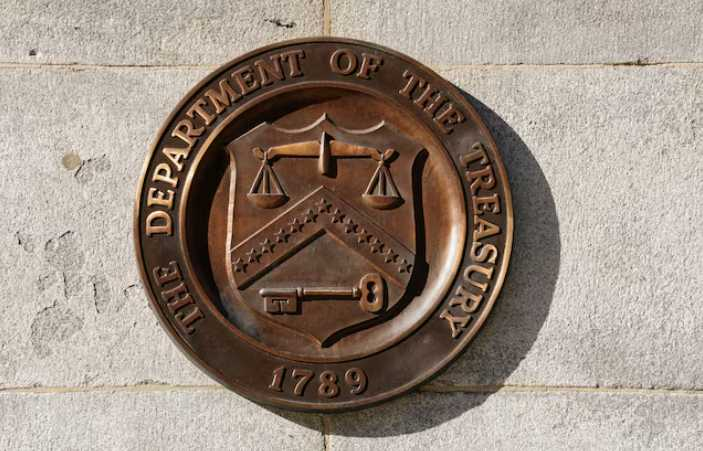
March 21 (Reuters) - The U.S. Treasury on Friday lifted economic sanctions against Tornado Cash, a firm that makes cryptocurrency transactions harder to track, which the Biden administration had accused of helping launder more than $7 billion for North Korean and other cyber hackers.
The Treasury Department's Office of Foreign Assets Control blacklisted Tornado Cash in 2022 after concluding it was helping launder the proceeds of cyber crimes, including more than $455 million stolen by Lazarus, a North Korean government-backed hacking group.
Six users of Tornado Cash - a cryptocurrency "mixer" that obscures the origins and recipients of transactions - had filed a lawsuit to challenge the sanctions with the financial backing of the Coinbase (COIN.O), opens new tab crypto exchange.
In a statement, the Treasury said it had decided to repeal them after reviewing legal and policy issues raised by the use of sanctions within "evolving technology and legal environments".
Still, the Treasury Department said it remained concerned about North Korea's "state-sponsored hacking and money laundering campaign," through which it has stolen digital assets to finance government activities.
“Securing the digital asset industry from abuse by North Korea and other illicit actors is essential to establishing U.S. leadership and ensuring that the American people can benefit from financial innovation and inclusion,"
said Treasury Secretary Scott Bessent.
President Donald Trump has sought to broadly overhaul U.S. cryptocurrency policies and this month signed an executive order to establish a strategic reserve of cryptocurrencies. He also held a summit for industry leaders at the White House.
Two of the co-founders of Tornado Cash were charged in 2023 with facilitating more than $1 billion in money laundering, including for the Lazarus Group. One, Roman Storm, awaits trial and has denied engaging in criminal activity.
Last May, one of Tornado Cash's developers, Alexey Pertsev, was sentenced to five years and four months in prison in the Netherlands for money laundering.

👉 Coinbase just launched an AI agent for Crypto Trading

Custom AI assistants that print money in your sleep? 🔜
The future of Crypto x AI is about to go crazy.
👉 Here’s what you need to know:
💠 'Based Agent' enables creation of custom AI agents
💠 Users set up personalized agents in < 3 minutes
💠 Equipped w/ crypto wallet and on-chain functions
💠 Capable of completing trades, swaps, and staking
💠 Integrates with Coinbase’s SDK, OpenAI, & Replit
👉 What this means for the future of Crypto:
1. Open Access: Democratized access to advanced trading
2. Automated Txns: Complex trades + streamlined on-chain activity
3. AI Dominance: Est ~80% of crypto 👉txns done by AI agents by 2025
🚨 I personally wouldn't bet against Brian Armstrong and Jesse Pollak.
👉 Coinbase just launched an AI agent for Crypto Trading
Earlier this week, UFO/UAP whistleblower David Grusch appeared on The Megyn Kelly Show for a brief but revealing interview. During the conversation, Grusch named individuals he claimed were involved in managing the alleged UFO/UAP Legacy crash retrieval program, statements that immediately drew attention across the disclosure community.
Most notably, Grusch asserted that former Vice President Dick Cheney played a central role in overseeing the program. Cheney’s name has circulated within UFO/UAP research circles for years, but this marks the first time it has been spoken publicly by a former intelligence official who claims direct knowledge of the issue. It is also notable that just weeks ago, journalist Ross Coulthart independently referenced Cheneyin a similar context, lending additional weight to the consistency of these claims.
Grusch also named former Director of National Intelligence James Clapper, stating that Clapper was not only aware of the crash retrieval issue, but managed it and helped place individuals into key roles, both publicly and behind the scenes. These are serious assertions that warrant scrutiny and further investigation, given their potential implications for disclosure.
Please watch the full interview and consider its significance within the broader context of the disclosure conversation. Please note that the interview concludes with a paid promotional pitch, and Grusch does not provide any additional comments after the pitch.
🙏 Donations Accepted, Thank You For Your Support 🙏
If you find value in my content, consider showing your support via:
Stellar CEO Reveals Where Real Opportunity Lies in Crypto Market: Details
In a recent tweet, Stellar Development Foundation (SDF) CEO and Executive Director Denelle Dixon defines what "real opportunity" is in blockchain as a new financial future beckons.
The SDF CEO was reacting to a recent Bloomberg report on Bank of New York Mellon Corp (BNY), Nasdaq, S&P Global and iCapital participation in a new $50 million investment round by Digital Asset Holdings. This comes as some of Wall Street’s biggest names embrace the technology that underpins cryptocurrencies to handle traditional assets.
Reacting to this development, Stellar Foundation CEO Denelle Dixon stated that every blockchain investment is a bet on a different financial future. Dixon added that seeing banks explore blockchain technology validates what has been known over the years.
Real opportunity defined
While Wall Street’s biggest names betting on blockchain might be one of the most significant adoption milestones in the digital asset market, Dixon defines what real opportunity is and what it is not.
According to the SDF executive director, real opportunity is not replicating old systems on new rails but rather building open networks that fundamentally expand global finance participation.
"But the real opportunity isn’t replicating old systems on new rails—it’s building open networks that fundamentally expand who gets to participate in global finance. That’s the opportunity," Dixon tweeted.
At the Meridian 2025 event, Stellar outlined its long-term privacy strategy, committing to investing in critical privacy infrastructure and building foundational cryptographic capabilities.
Stellar eyes privacy upgrade
A new protocol upgrade is on the horizon for the Stellar network: X-Ray, which lays the groundwork for developers to build privacy applications on Stellar using zero-knowledge (ZK) cryptography.
The protocol timeline testnet vote is anticipated for Jan. 7, 2026, while the mainnet vote is expected for Jan. 22, 2026.
XDC Network's acquisition of Contour Network marks a silent shift to connect the digital trade infrastructure to real-time, tokenized settlement rails.
In a world where cross-border payments still take days and trap trillions in idle liquidity, integrating Contour’s trade workflows with XDC Network Blockchains' ISO 20022 financial messaging standard to bridge TradFi and Web3 in Trade Finance.
The Current State of Cross-Border Trade Settlements
Cross-border payments remain one of the most inefficient parts of global finance. For decades, companies have inter-dependency with banks and their correspondent banks across the world, forcing them to maintain trillions of dollars in pre-funded nostro and vostro balances — the capital that sits idle while transactions crawl across borders.
Traditional settlement is slow, often 1–5 days, and often with ~2-3% in FX and conversion fees. For every hour a corporation can’t access its own cash increases the cost of financing, tightens liquidity that could be used for other purposes, which in turn slows economic activity.
Before SWIFT, payments were fully manual. Intermediary banks maintained ledgers, and reconciliation across multiple institutions limited speed and volume.
SWIFT reshaped global payments by introducing a secure, standardized messaging infrastructure through ISO 20022 - which quickly became the language of money for 11,000+ institutions in 200 countries.
But SWIFT only fixed the messaging — not the movement. Actual value still moves through slow, capital-intensive correspondent chains.
Regulated and Compliant Stablecoin such as USDC (Circle) solves the part SWIFT never could: instant, on-chain settlement.
Stablecoin Settlement revamping Trade and Tokenization
Stablecoin such as USDC is a digital token pegged to the US Dollar, still the most widely used currency for trade, enabling the movement of funds instantly 24*7 globally - transparently, instantly, and without the need for any intermediaries and the need to lock in trillions of dollars of idle cash.
Tokenized settlement replaces multi-day reconciliation with on-chain finality, reducing:
Dependency on intermediaries
Operational friction
Trillions locked in idle liquidity
For corporates trapped in long working capital cycles, this is transformative.
Digital dollars like USDC make the process simple:
Fiat → Stablecoin → On-Chain Transfer → Fiat
This hybrid model is already widely used across remittances, payouts, and treasury flows.
But one critical piece of global commerce is still lagging:
👉 Trade finance.
The Missing link is still Trade Finance Infrastructure.
While payments innovation has raced ahead, trade finance infrastructure hasn’t kept up. Document flows, letters of credit, and supply-chain financing remain siloed, paper-heavy, and operationally outdated.
This is exactly where the next breakthrough will happen - and why the recent XDC Network acquisition of Contour is a silent revolution.
It transforms to a new era of trade-driven liquidity through an end-to-end digital trade from shipping docs to payment confirmation – one infrastructure that powers all.
The breakthrough won’t come from payments alone — it will come from connecting trade finance to real-time settlement rails.
The XDC + Contour Shift: A Silent Revolution
Contour already connects global banks and corporates through digital LCs and digitized trade workflows.
XDC Blockchain brings a settlement layer built for speed, tokenization, and institutional-grade interoperability and ISO 20022 messaging compatibility
Contour’s digital letter of credit workflows will be integrated with XDC’s blockchain network to streamline trade documentation and settlement.
Together, they form the first end-to-end digital trade finance network linking:
Documentation → Validation → Settlement all under a single infrastructure.
XDC Ventures (XVC.TECH) is launching a Stable-Coin Lab to work with financial institutions on regulated stablecoin pilots for trade to deepen institutional trade-finance integration through launch of pilots with banks and corporates for regulated stable-coin issuance and settlement.
Sign Up for free to see more from this community or subscribe to TheDinarian for $5/month to support TheDinarian for more interaction and exclusive content.
Welcome to the Dinarian on Locals, where we discuss everything blockchain and digital asset related. We are here to learn from one another as this is a new and ever evolving space. Please post and share what you like, but be respectful to others as they are here to learn as well.
Knowledge is power, using that knowledge can be extremely powerful,
The Dinarian